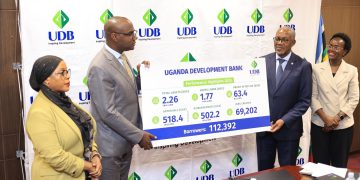



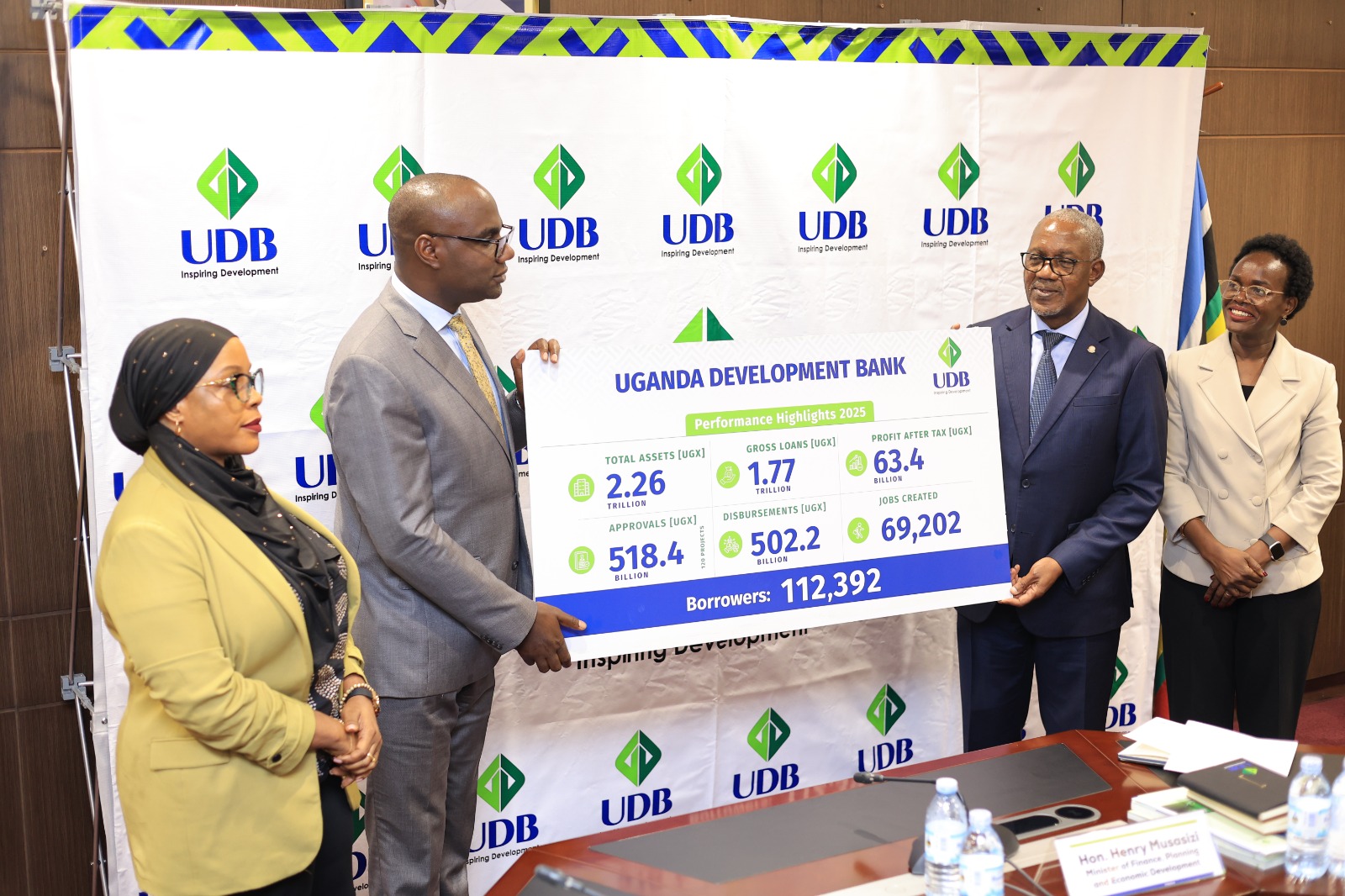
Uganda Development Bank Limited (UDB), the country’s national Development Finance Institution, has reported strong financial and development performance for 2025, with UGX 502.2 billion disbursed to support private-sector growth and 69,202 jobs created and sustained by enterprises financed by the Bank.
The results were announced on Thursday, August 13, 2026, during UDB’s Annual General Meeting held at the Ministry of Finance, Planning and Economic Development.
During the year, UDB recorded a post-tax profit of UGX 63.4 billion, representing a 9.7 percent increase from 2024. The Bank said the improved performance strengthens its capacity to finance larger and more transformational investments capable of delivering lasting economic and social benefits.
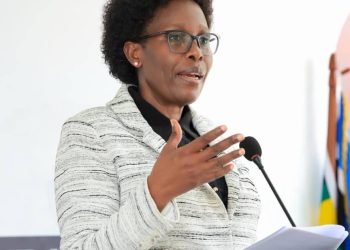
Speaking at the meeting, UDB Managing Director Dr. Patricia Ojangole said the Bank’s continued institutional growth was strengthening its ability to mobilise and provide long-term capital to businesses that create jobs, increase exports and expand domestic production.
“Development finance delivers its greatest value when it unlocks opportunities that commercial markets alone cannot provide. Every investment we make is intended to strengthen productive enterprises, create decent jobs, expand value addition and improve incomes for Ugandans. These results demonstrate that development finance continues to be an effective catalyst for inclusive economic transformation,” Ojangole said.
Strong financial growth
UDB’s total assets grew by 27 percent to UGX 2.26 trillion in 2025, up from UGX 1.78 trillion in 2024. The growth was supported by increased government capitalisation and financing from development partners.
Total equity increased by 24.8 percent to UGX 1.89 trillion, while net loans and advances to customers rose by about seven percent to UGX 1.63 trillion.
The Bank approved UGX 518.4 billion in new financing for 120 projects across Uganda and disbursed UGX 502.2 billion, representing a 29 percent increase compared with 2024.
The financing enabled businesses to expand production, modernise operations, adopt new technologies and improve their competitiveness in domestic and export markets.
UDB’s active customer base grew to 689 enterprises operating across 105 districts, while the number of direct borrowers increased to 112,392, reflecting the Bank’s expanding reach.
Nearly two-thirds of UDB’s financing was directed towards agriculture, agro-industrialisation and manufacturing—sectors considered critical to increasing productivity, strengthening food systems, promoting value addition and reducing Uganda’s dependence on imported manufactured goods.
Jobs and economic impact
Enterprises financed by UDB created and sustained 69,202 jobs during 2025, representing a 24.6 percent increase and one of the strongest annual employment impacts recorded by the Bank in recent years.
UDB said the jobs have contributed to more stable household incomes, improved livelihoods and greater economic participation, particularly among young people employed in productive sectors.
The enterprises financed by the Bank generated annual production valued at UGX 6.26 trillion, demonstrating continued expansion of Uganda’s productive capacity.
The increased production has also strengthened local supply chains, promoted domestic value addition and increased the availability of locally produced goods.
The enterprises generated profits of more than UGX 1.16 trillion, enabling them to reinvest in their operations, adopt modern technologies and expand their businesses.
Meanwhile, tax contributions from UDB-supported enterprises increased by 22.5 percent to UGX 387 billion, providing additional domestic revenue to support government investment and public services.
Foreign exchange earnings generated by the supported enterprises also rose sharply to UGX 1.84 trillion in 2025, up from UGX 1.11 trillion the previous year.
UDB said the increase reflects growing competitiveness among Ugandan enterprises in regional and international markets while strengthening the country’s external position.
Recognition and awards
The Bank’s financial performance and governance also received recognition from international rating agencies and development finance institutions.
UDB secured an AA+ (Uga) National Rating and a B Long-Term Foreign Currency Issuer Default Rating from Fitch Ratings, with the Bank describing the national rating as the highest available on Uganda’s national scale.
UDB also maintained an A+ rating from the Association of African Development Finance Institutions (AADFI), the highest rating category under the association’s rating system.
Dr. Ojangole was named Banker of the Year at the Africa Banker Awards 2025 in recognition of her leadership in driving the Bank’s performance and development impact.
The Bank also received the Outstanding Business Sustainability Achievement Award at the 2025 Karlsruhe Sustainable Finance Awards in Germany, following four consecutive years of being named Sustainability Leader of the Year between 2021 and 2024.
UDB further retained its Level 5 certification under the Sustainability Standards and Certification Initiative (SSCI) Version 2, the highest level under the certification process.
Key institutional milestones
During the year, UDB hosted the inaugural Uganda Development Finance Summit, which brought together more than 500 policymakers, industry leaders and local and international development partners to discuss development finance challenges and opportunities in Uganda and Africa.
The summit was officiated by President Yoweri Kaguta Museveni.
The Bank also partnered with key stakeholders to launch the Reshaping Industry for Sustainable Economy (RISE) initiative, a platform designed to translate development challenges into viable, investment-ready and fundable projects.
UDB further strengthened its funding base through partnerships with bilateral and multilateral development partners, aimed at enhancing its capacity to sustainably finance priority sectors and fulfil its development mandate.
Government commends UDB
The Minister of Finance, Planning and Economic Development, Hon. Henry Musasizi, commended UDB for translating government capital into measurable economic outcomes through investments that are expanding industry, supporting value addition and strengthening the private sector.
He said the Bank’s performance contributes to the implementation of the National Development Plan IV and the Government’s Ten-Fold Growth Strategy.
The Chairman of the UDB Board of Directors, Geoffrey Kihuguru, reaffirmed the Bank’s commitment to long-term sustainability through prudent stewardship of its assets and continued focus on operational efficiency.
UDB said its 2025 performance was achieved against a positive macroeconomic backdrop, with Uganda’s economy growing by 6.3 percent and inflation declining to 3.3 percent, creating a more favourable environment for business investment and economic growth.