



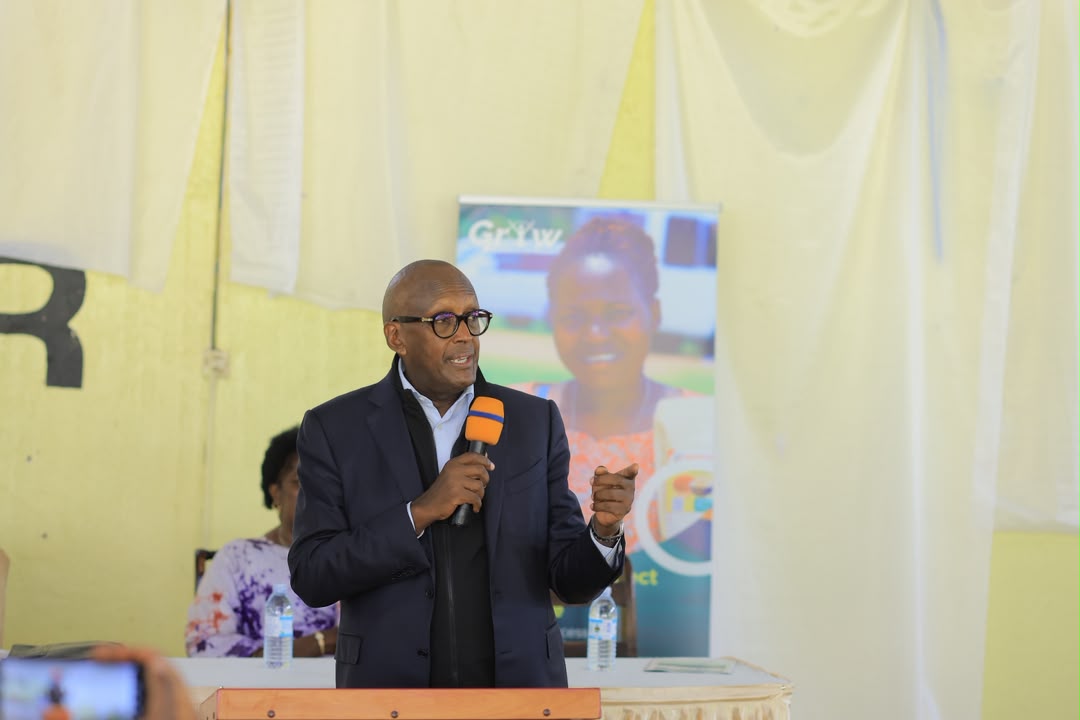
RUKUNGIRI, Uganda (UGNEWSLINE) – The Minister of Gender, Labour and Social Development, Lt. Gen. Henry Tumukunde, has warned women entrepreneurs against paying money to anyone to access government business grants under the Generating Growth Opportunities and Productivity for Women Enterprises (GROW) Project.
Tumukunde said applications for the GROW Business Plan Competition Grants are entirely free, cautioning applicants against fraudsters, brokers and officials who may demand money in exchange for application forms or promises of securing funding.
Speaking on October 8, 2026, during an orientation meeting for local government leaders at Hotel Riverside in Rukungiri Municipality, Tumukunde said the government is committed to ensuring that eligible women entrepreneurs benefit from the programme without being exploited.
“No woman entrepreneur should pay any fee to any official, consultant, or broker to access application forms or win a grant,” he said.
The Business Plan Competition Grants provide non-repayable funding ranging from Shs3.5 million to Shs107.07 million to women-owned micro and small enterprises that failed to access the GROW loan due to financial constraints, banking requirements or credit limitations.
The government targets at least 2,626 women-owned businesses nationwide, including at least 767 enterprises in refugee-hosting districts.
Under the funding arrangement, micro enterprises employing up to four people, with sales or assets of up to Shs10 million, will qualify for grants ranging from Shs3.5 million to Shs35.69 million.
Small enterprises employing between five and 49 people, with assets ranging from Shs10 million to Shs100 million, will be eligible for grants between Shs39.259 million and Shs107.07 million.
The grants will support business expansion, formalisation, the purchase of production equipment and working capital, with priority given to innovative and high-impact enterprises.
The programme will promote businesses operating in science, technology, engineering and mathematics (STEM), green enterprises and climate-resilient sectors, including solar energy, irrigation, waste management, agricultural processing, health technology and childcare facilities for children aged zero to three years.
Women entrepreneurs in refugee-hosting districts, persons with disabilities and other vulnerable groups will also benefit from broader eligibility provisions covering businesses such as poultry and goat rearing, food processing, tailoring, childcare, mobile money services and catering.
Tumukunde urged local government leaders, including resident district commissioners, district chairpersons, mayors, chief administrative officers and commercial officers, to mobilise eligible women and provide accurate information about the application process.
He emphasised that the grants are intended for women who did not receive GROW loans, warning that previous loan beneficiaries would not be eligible to apply for the new funding.
Applications are scheduled to open on October 15, 2026, and will remain open for 30 calendar days. Applicants will be required to submit their applications digitally through the official GROW Project website or mobile application.
Business clinics will also be organised across Uganda’s 19 sub-regions and 12 refugee settlements from the end of October to help applicants prepare business proposals, budgets and supporting documents.
Successful applicants are expected to receive grants by the end of December 2026, with funded projects required to run for nine to 12 months and conclude by June 2027.
To qualify, businesses must be legally registered in Uganda, owned by a Ugandan woman or an eligible registered refugee woman, and have operated for at least one year with supporting business records. Applicants will also be required to provide identification documents and at least 12 months of bank statements.
The application process will include Credit Reference Bureau checks, financial sanctions reviews and labour and human rights compliance assessments.
The GROW Project is implemented by the Ministry of Gender, Labour and Social Development with support from the World Bank. The $217 million initiative, which includes $40 million for refugees and host communities, aims to expand women’s access to business services and help them grow sustainable enterprises.