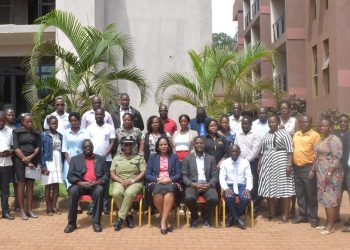



In a wide-ranging engagement with journalists from the Busoga Sub-region at the Mayuge District State Lodge, President Yoweri Kaguta Museveni sought to frame Uganda’s current trajectory as evidence of a nation steadily consolidating what he called the “seven pillars” of socio-economic transformation.
At the heart of his message was a familiar argument: that peace, stable governance, and expanding economic opportunity are beginning to reinforce each other in ways that position Uganda for long-term prosperity.
Museveni pointed to the rapid expansion of the service sector and what he described as healthier, more resilient state institutions.
He argued that Ugandans now enjoy an unprecedented degree of free expression and political openness, features he said are essential to building a confident, productive citizenry.
For the President, these gains are not incidental but foundational blocks in the architecture of development he has promoted for decades.
Yet the speech also reflected his broader strategic concerns, particularly regarding East Africa’s stalled integration agenda.
Museveni reiterated his belief that Uganda’s economic future is inseparable from the creation of a larger, unified regional market, one capable of absorbing domestic production and attracting global investment.
Africa’s fragmentation, he warned, remains both an economic bottleneck and a security liability. Without coordinated defense and intelligence systems, he argued, African states will continue confronting global threats piecemeal and from a position of weakness.
The President’s remarks were also shaped by local tensions in Busoga, especially the simmering land disputes involving the National Forestry Authority and communities encroaching on Mayuge forest land.
Museveni urged a practical and lawful settlement that balances environmental stewardship with community livelihoods.
His comments extended to wetland management, where he encouraged residents to rethink land use in favor of ventures that generate higher returns without degrading fragile ecosystems.
Fish farming, he noted, outperforms traditional wetland rice growing and could coexist with well-planned irrigation systems that sustain additional agricultural activity.
Infrastructure compensation, a persistent flashpoint in national projects, also surfaced. Museveni directed NRM Secretary General Richard Todwong to expedite compensation payments for residents affected by the Standard Gauge Railway corridor in Busoga.
Ensuring fairness and timeliness, he emphasized, is not only an administrative necessity but also a prerequisite for public trust in state-led development.
Returning to a long-standing theme in his economic narrative, Museveni urged Busoga residents to embrace proven commercial farming models that have lifted households elsewhere in the country.
He cited examples from Masaka’s coffee revival, Kalangala and Bundibugyo’s palm oil ventures, and the dairy boom along the cattle corridor as evidence that Uganda’s wealth-creation strategy, first codified in the 1996 NRM Manifesto, remains consistent and attainable.
Museveni closed the engagement with a call for unity, mindset change, and a shift toward commercially oriented agriculture.
The message underscored an enduring presidential refrain: that Uganda’s path to prosperity lies not only in policy, but in the choices citizens make as the country seeks to transition from subsistence to a modern, market-driven economy.