


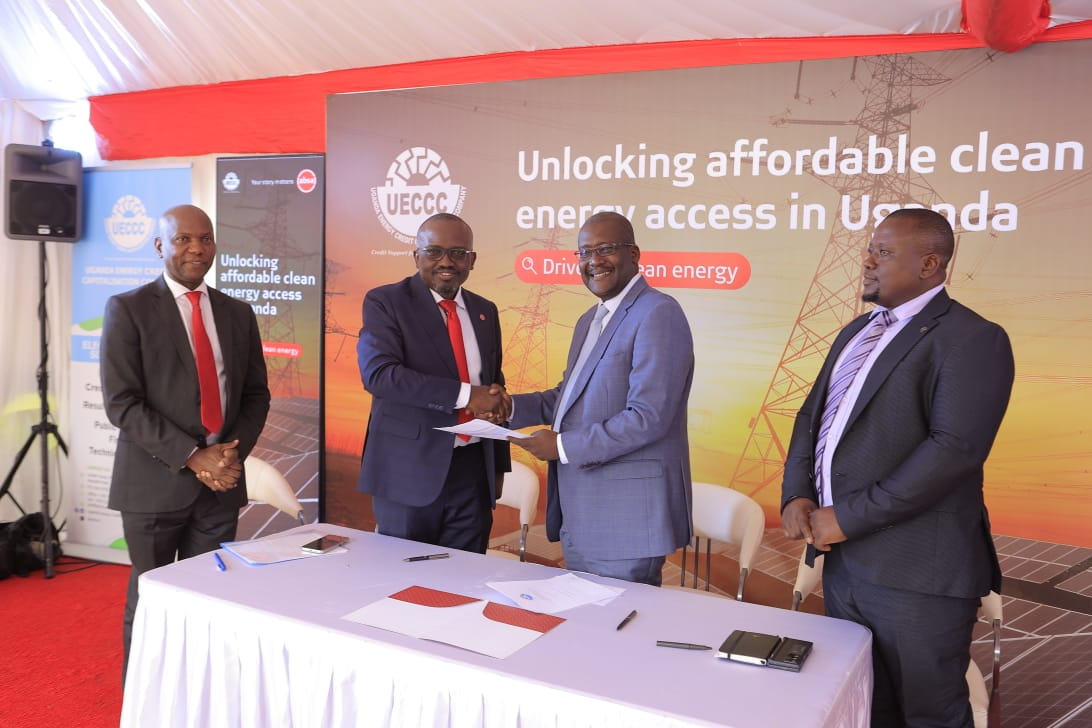
KAMPALA , Uganda – Absa Bank Uganda has announced a partnership with the Uganda Energy Credit Capitalisation Company (UECCC), securing a UGX 11.085 billion concessional line of credit to expand access to affordable clean energy financing and accelerate the adoption of renewable energy solutions in Uganda.
The financing agreement, structured under the Government’s Electricity Access Scale-Up Project (EASP), will enable Absa to finance eligible clean energy companies, supporting the deployment of solar home systems, institutional solar installations, productive-use equipment for small enterprises, and clean cooking technologies.
The partnership comes at a time when Uganda’s energy sector is facing a growing gap between supply and access. While national Installed electricity capacity has grown to over 2,000 megawatts, according to the Electricity Regulatory Authority, overall electrification remains low averaging at 60% with stark disparities between urban (76.4%) and rural communities (42.4%). High connection costs, infrastructure constraints, and limited access to off-grid financing continue to restrict uptake, particularly among households and small businesses.
As a result, more than 90% of Ugandan households still rely on biomass fuels such as firewood and charcoal for cooking, underscoring the scale of unmet demand and the economic and environmental cost of delayed transition to modern energy solutions.
Under the agreement, UECCC will provide concessional capital to Absa through a financial intermediation model, allowing the bank to on-lend to approved Energy Service Companies, including Greenlight Planet Uganda Limited. The facility will provide critical working capital and inventory financing, easing liquidity constraints that have historically limited the sector’s growth.
The partnership is structured over a three-year period and will be disbursed in performance-linked tranches. By lowering the cost of capital at the source and capping on-lending rates to a maximum of 15% per annum, the structure improves affordability for end users while maintaining commercial discipline. It also helps ease liquidity constraints for energy service companies, which have historically faced limited access to affordable working capital from traditional lenders.
David Wandera, Managing Director of Absa Bank Uganda, said the partnership underscores the bank’s commitment to supporting clients in their transition to clean energy while addressing climate-related risks across portfolios.
“This partnership enables us to support clients transitioning to clean energy through more accessible, well- structured financing solutions. By combining concessional capital with our lending expertise, we can better manage climate-related risks while unlocking opportunities in underserved sectors. This approach, reflects our broader commitment as a bank to expanding sustainable finance as we continue to direct capital towards initiatives that drive resilience, support low-carbon growth, and long-term economic value,” he said.
The transaction also aligns with Absa’s broader focus on environmental, social and governance (ESG) considerations in financial decision-making. Through the partnership, the bank is expanding its sustainable finance portfolio while supporting Uganda’s transition to cleaner energy sources, reducing reliance on biomass, and enabling more productive use of energy across the economy.
Roy Nyamutale Baguma, Managing Director of Uganda Energy Credit Capitalisation Company, noted that the partnership marks a significant step in mobilising private sector capital to accelerate investments in Uganda’s renewable energy sector, with a strong focus on deepening private sector participation. He emphasised that the collaboration is aligned with national development priorities and addresses one of the most critical constraints to sector growth access to affordable financing.
“By partnering with Absa Bank Uganda, we are able to channel concessional funding through the banking system, enabling energy companies to scale while ensuring that financing remains accessible and anchored in robust environmental and social standards,” he said.
Beyond its environmental impact, the credit agreement is expected to support SME productivity, expand market reach for clean energy providers, and strengthen the broader energy value chain. The transaction also signals a maturing financing landscape in Uganda, where blended finance structures are increasingly being used to de-risk sectors and unlock private capital at scale.
For Absa, the partnership represents a key milestone in its sustainable finance strategy and positions the bank at the forefront of ESG-aligned lending in Uganda. By combining development capital with commercial banking expertise, Absa is helping to establish a scalable model for financing clean energy—one with the potential for replication across other sectors and markets.