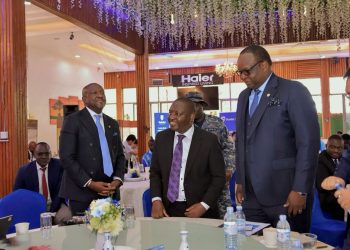



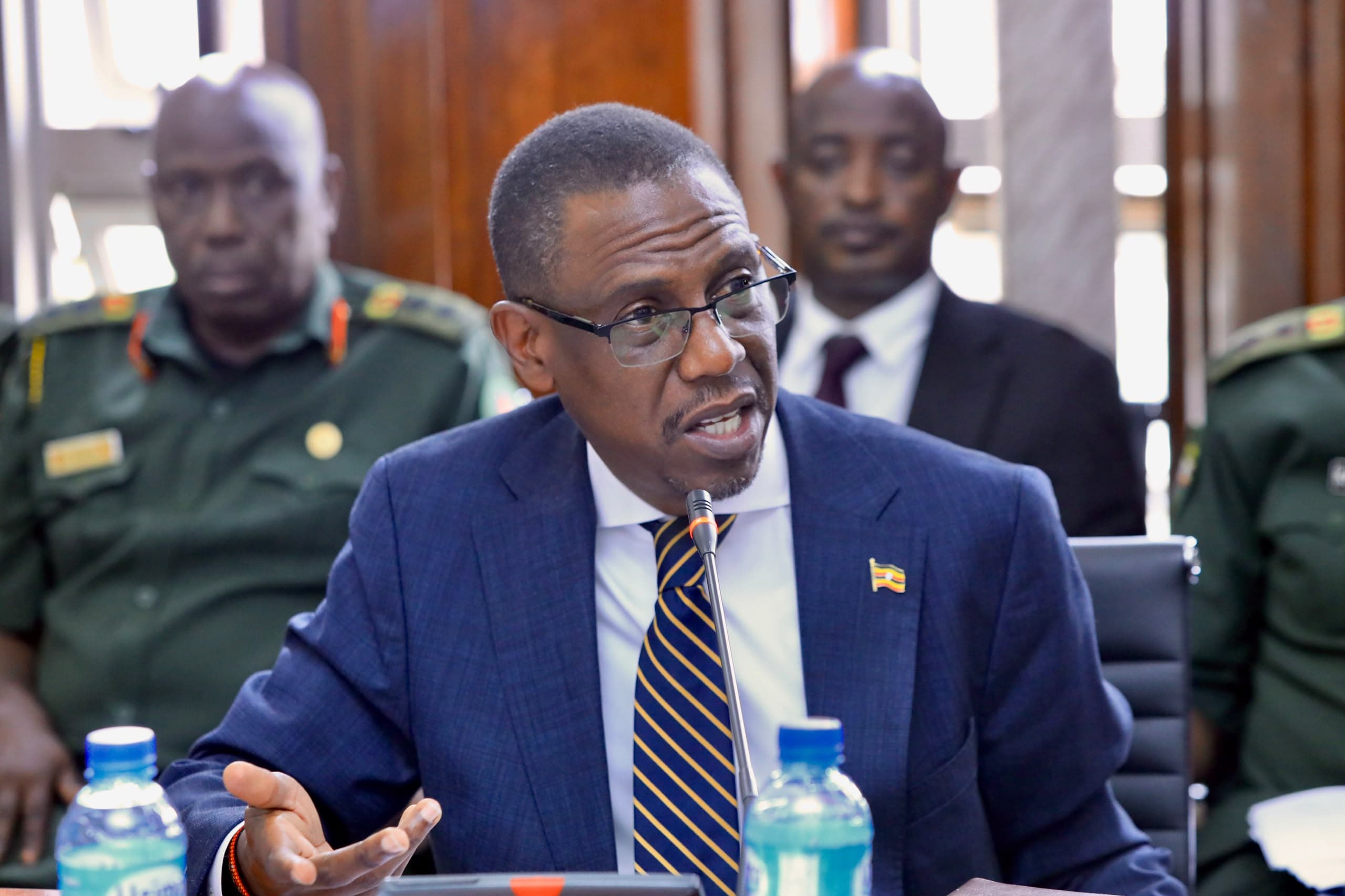
The Minister of Defence and Veterans Affairs, Hon. Kiryowa Kiwanuka, on Tuesday appeared before the Parliamentary Committee on Defence and Internal Affairs, chaired by Hon. Robina Rwakoojo, to present the state of the ministry, accountability and the resource needs of the Ministry of Defence and Veterans Affairs (MODVA)/UPDF.
Appearing with the Minister of State for Defence for Veterans Affairs Hon. Huda Oleru Abason and the Minister of State for Defence for General Duties Hon. Grace Ngabirano Akifeza, the minister briefed the committee on the mandate of the UPDF and key achievements recorded between 2021 and 2026 during the 11th Parliament.
Mr Kiwanuka underscored the constitutional mandate of the UPDF under Article 208 of the 1995 Constitution of the Republic of Uganda, which provides that “there shall be armed forces known as the Uganda Peoples’ Defence Forces, which shall be non-partisan, national in character, patriotic, professional, disciplined, productive and subordinate to the civilian authority as established under the constitution.”
He further stated that members of the UPDF shall be Ugandan citizens of good character.
He said the UPDF is mandated to protect the sovereignty and territorial integrity of Uganda, ensuring non-violability of people and individual rights, the rule of law and good governance.”
Key achievements 2021-2026
The Defence Minister Mr Kiwanuka told the committee that MODVA/UPDF had registered several milestones during the period, including:
Security: Sustained peace and security during elections due to a proactive security posture, and effective control of the internal situation that prevented major disruptions to public order.
Capacity: Acquisition, refurbishment and maintenance of classified and key strategic equipment to enable rapid response to prevailing and emerging security threats.
Recruitment: Consistent recruitment in line with Article 208(2), with an average of 10,000 personnel recruited annually over the past five years to meet manpower requirements under the UPDF establishment.
Training: Continuous professional development both locally and abroad. In 2022, MODVA established the National Defence College – Uganda (NDC -U) for advanced military and strategic training of senior military and civilian officials. Since its establishment, the college has graduated 83 students in four intakes, averaging about 20 students annually. The intake is expected to rise to 30 with the inclusion of other Ministries Departments and Agencies.
Welfare: Phased salary and pension enhancements since 2022 in line with budget allocations. Pensions increased proportionately. The ministry paid Shs 540,459,485,488 in pensions and ensured full and timely payment of the pension payroll.
Health: Continued provision of preventive, curative, rehabilitation, palliative and psychosocial services to UPDF personnel, families and surrounding communities. Construction of a 250-bed UPDF National Referral Hospital, with outpatient services already operational.
Education and welfare: Provision of formal education to children of soldiers and surrounding communities, operation of the Defence Forces Shop on duty-free terms, and infrastructure development including 30,000 housing units for UPDF, joint strategic headquarters office blocks, a new administration block at Air Force Headquarters, and an SFC Airborne administration block.
Logistics: Provision of food, clothing, accommodation, petroleum, oils and lubricants, and maintenance of equipment.
Veterans Affairs: Improved veteran care through payment of gratuity before retirement and timely pensions, and engagement in productive activities for socio-economic development and food security through NEC, the Department of Production and Welfare, and veterans’ SACCOs.
Ongoing programmes: The minister outlined strategic interventions under implementation, including a Shs 1,863,290,218,680 budget for salary enhancement to reach the full target pay in FY 2027/28, automation of logistics and pension systems, the food and feeds programme, and construction of the MODVA/UPDF headquarters expected to be completed and commissioned by 30 September 2026.
Other projects include: the establishment of in-house UPDF fuel storage facilities and the 30,000-unit housing programme, of which 1,000 units have so far been completed.
Requests and challenges:
Mr Kiwanuka tabled issues requiring Parliament’s support, including backing for peace support operations, separate legislation to create an autonomous body for the UPDF National Referral Hospital, and the granting of duty-free status to the Defence Forces Shop. He also asked the committee to continue monitoring national flagship projects to ensure timely delivery.
He cited challenges affecting the ministry, including an inadequate budget, delayed release of AUSSOM funds, macroeconomic pressures such as inflation, geopolitical instability in the Middle East and Eastern Europe, inadequate housing accommodation for UPDF, lack of duty-free status for DFSUL, and limited capitalisation.
“I am calling upon the committee to help the ministry to support us on initiatives and missions on peace and security of the army and ministry to enhance our capacity and status and continue monitoring our projects because these activities sit within your constituencies,” he stated.