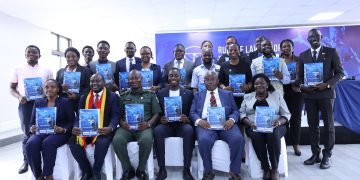




The Uganda Law Society (ULS) has raised concern over what it describes as a continued rise in cases of abduction and illegal detention of civilians, with opposition supporters reportedly among those most affected during the January-to-June 2026 period.
The concerns were raised by ULS Vice President Anthony Asiimwe during the launch of the Society’s State of the Rule of Law – First and Second Quarter Report 2026, held on Thursday at the ULS Secretariat offices in Kamwokya, Kampala.
The report, which covers the period from January to June 2026, examines Uganda’s adherence to constitutionalism, human rights, access to justice, due process and the independence of public institutions.
According to the report, several civilians were allegedly abducted and illegally detained during the electoral period, with some reportedly held incommunicado and not brought before courts of law as required by the Constitution. Former Kampala Lord Mayor Erias Lukwago was cited among those affected by such actions.
The Society said the reported cases of abductions, disappearances and prolonged detention without access to judicial processes raise serious questions about respect for fundamental rights and the rule of law. Asiimwe also raised concern over access to bail, arguing that obtaining bail has increasingly become difficult despite the legal provisions guaranteeing the right to seek it.
He said the report contains both positive and negative developments, including measures aimed at improving access to justice.
One of the positive developments highlighted was the establishment of regional mobile courts, which are intended to bring judicial services closer to communities and reduce barriers that prevent citizens from accessing justice. However, the ULS said continued attention is needed to ensure fair hearings, lawful arrest and detention, equality before the law and adherence to established legal procedures.
Concerns Over Independence of Institutions
The report also questions the independence and effectiveness of some key public institutions, particularly the Electoral Commission and the Uganda Human Rights Commission.
ULS said weaknesses within these institutions have affected their ability to effectively execute their constitutional mandates and provide adequate checks and safeguards for citizens.
The concerns come against the backdrop of a broader assessment of Uganda’s civic and democratic environment during the first half of 2026, including developments surrounding the general elections.
The report is structured around four key pillars: checks and balances; transparency and accountability; human rights; and due process and the climate of legality.
ULS Chief Executive Officer Christine Awori said the report should not merely be viewed as a record of challenges facing the country but as an opportunity for institutions and other stakeholders to identify areas requiring improvement.
Awori said the findings provide a basis for institutions to reflect on their performance and work towards strengthening Uganda’s rule of law.
She said the report is also intended to promote informed public debate, identify areas requiring urgent institutional reform and encourage collaboration among stakeholders committed to constitutional governance.
The launch brought together representatives from the Judiciary, Uganda Police Force, Uganda Prisons Service,
Inspectorate of Government and other stakeholders.
IGG Defends Anti-Corruption Record. The Inspectorate of Government (IGG) welcomed the report’s recognition of its efforts in promoting accountability and fighting corruption.
Hildah Talibba, Director of Legal Affairs in the Office of the Inspector General of Government, said the institution has a constitutional responsibility to promote strict adherence to the rule of law within the areas covered by its mandate. “Our function is to foster and promote strict adherence to the rule of law,” Talibba said.
She explained that the Inspectorate’s jurisdiction covers government, public servants and public funds, making cooperation among public institutions essential in promoting accountability and ensuring that public resources are properly managed.
Talibba cited the prosecution of parliamentary officials as an example of the institution’s work in holding public officials accountable.
Among those prosecuted are Parliament’s Director of Communications Chris Obore, the Director of Public Affairs and seven other officials over alleged mismanagement of public funds.
The officials were arraigned before court and have recently been committed to the High Court for trial.
Talibba said the IGG remains committed to executing its constitutional mandate while working with other institutions to strengthen accountability.
Prison Population Exceeds 82,000
The Uganda Prisons Service used the launch to highlight the severe pressure facing the country’s correctional facilities.
Aliyo Naatukunda, a Senior Commissioner in the Uganda Prisons Service, said that as of Wednesday, August 12, 2026, the country’s prison population stood at 82,339 inmates.
Of these, 44,939 were convicts, representing 54 percent of the prison population, while 36,816 were remand prisoners, accounting for 44.7 percent.
Another 584 inmates were debtors, representing 0.7 percent of the total prison population.
Naatukunda said the prison system is operating under severe overcrowding, with congestion estimated at 351.7 percent.
She, however, acknowledged the role of the Judiciary in improving access to justice, particularly through the use of mobile courts.
She said 20 prison units have also been equipped with Zoom facilities, allowing court proceedings to be conducted remotely.
The technology, she explained, has helped reduce some of the challenges associated with transporting inmates from prisons to courts.
Police Reaffirm Commitment to Human Rights
The Uganda Police Force defended its commitment to protecting human rights while carrying out its constitutional mandate.
Senior Superintendent of Police Dorothy Kyobutungi, Commissioner of Police in charge of Human Rights, said the force recognises its responsibility under Article 212 of the Constitution to uphold the rule of law.
“We execute our mandate respecting the rights of human beings,” Kyobutungi said.
She said the Police has a duty to protect people and property and condemned human rights violations, while acknowledging that the institution, like any other, is not perfect.
Kyobutungi also stressed the importance of decentralising police services to ensure that citizens across the country, including those in remote villages, can access justice.
“We ensure that police services are decentralised so that even the last person in the village can access justice,” she said.
She urged members of the public to report complaints to the relevant authorities so that they can be investigated and addressed.
Kyobutungi added that the Police continues to train its officers and strengthen cooperation with the public and other institutions.
“Without cooperation, nothing can be done. To execute our mandate, we have to collaborate,” she said.
ULS Calls for Greater Institutional Cooperation
Afra Apio, Head of Rule of Law at the Uganda Law Society, reaffirmed the Society’s commitment to working with State institutions, civil society organisations and individuals to address challenges identified in the report.
She said ULS remains open to collaboration with institutions and other stakeholders seeking to strengthen constitutional governance and the rule of law.
The launch provided a platform for dialogue between members of the legal profession, State institutions and other stakeholders on the implications of the report’s findings for Uganda’s constitutional democracy.
The Society said its quarterly Rule of Law Report is designed not only as an assessment of the country’s governance and justice systems but also as an accountability and public engagement tool.
Through the report, ULS seeks to monitor developments, promote advocacy, encourage institutional reform and strengthen public understanding of constitutional rights and obligations.
As Uganda reflects on the findings covering the first half of 2026, the Uganda Law Society has called for renewed commitment to constitutionalism, accountability, protection of fundamental rights and respect for established legal procedures.
The Society said the central question remains whether Uganda’s institutions, laws and public authorities are effectively upholding the constitutional promise of a society governed by law, rights, accountability and justice.