


At Namilyango College, science is increasingly moving beyond the walls of the classroom.
For members of the school’s Science and Technology Club, questions that might ordinarily end with a classroom experiment are becoming starting points for research, debate, innovation and national competition. Their journey through the 2026 Uganda National Science Olympiad (UNSO) has offered a glimpse of what can happen when young learners are given the space to investigate ideas, defend their findings and test their abilities against some of the country’s brightest students.
Under the guidance of club patron Brighton Twesiime, Namilyango College strengthened its participation in the eighth edition of the Uganda National Science Olympiad, turning the competition into more than a contest for medals and certificates. It has become a platform through which learners are developing a deeper interest in scientific inquiry, research and innovation.
Organised by the Science Olympiad Foundation Uganda (SOFU), the 2026 competition brought together hundreds of secondary school learners from across Uganda to compete in scientific research, innovation and problem-solving.
For Namilyango, the results were significant.
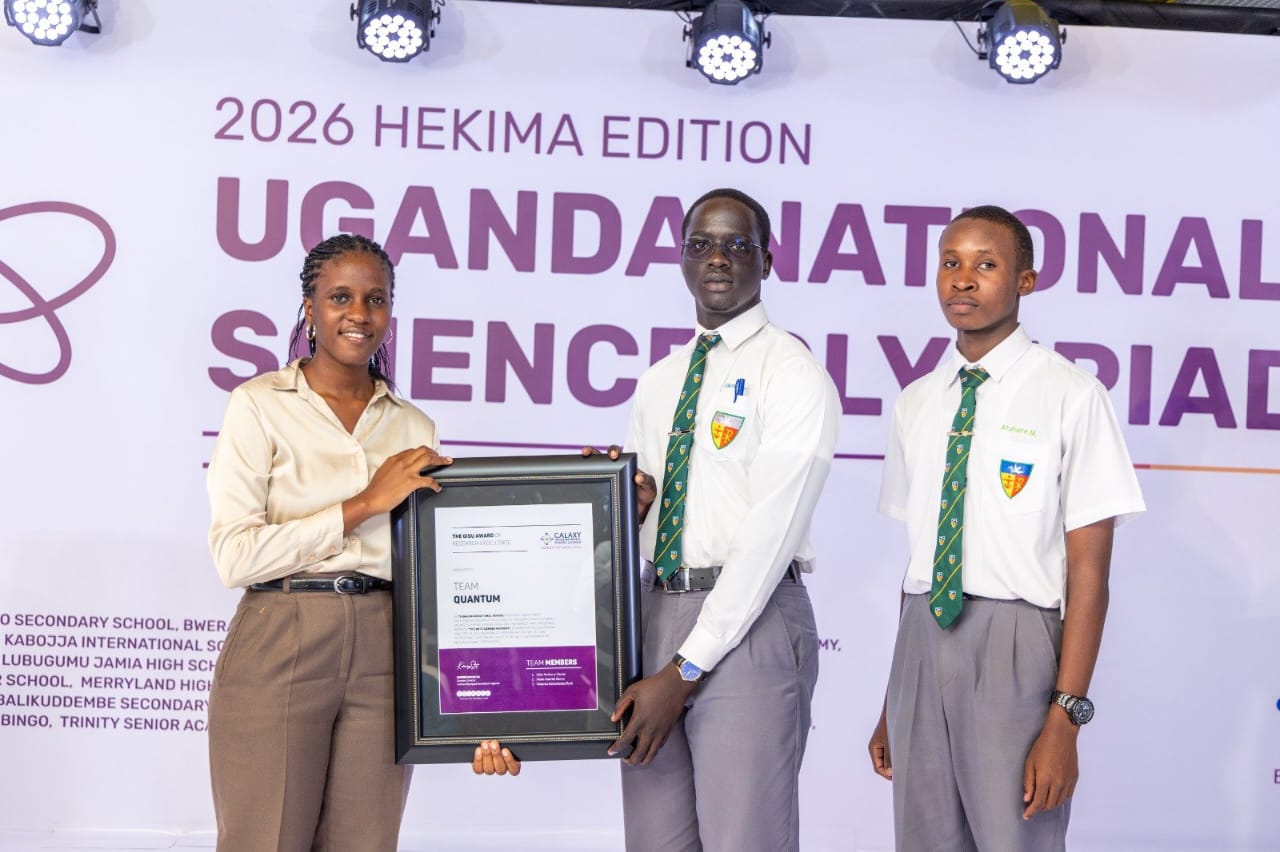
Three of the school’s teams emerged among the Top Research Teams during the research phase of the competition. Safety Mavericks, whose project focused on fermentation, scored 55.0 in Biology. Super Nova, researching ugali hardening, scored 54 in Chemistry, while Team Newton, whose project examined the motorcycle headlamp, scored 55.0 in Physics.
Behind the scores were subjects drawn from everyday life. Fermentation, the changing properties of a familiar food and the science behind a motorcycle headlamp may appear ordinary at first glance, but the learners used them to ask scientific questions and explore problems that connect classroom knowledge with the world around them.
That connection is perhaps one of the most important lessons of the Olympiad. Scientific inquiry does not always begin in a sophisticated laboratory. Sometimes it starts with something as familiar as food, a household experience or a machine used every day.
The success in the research phase opened the door to an even greater challenge, with eight Namilyango teams progressing to the National Round. Mavericks, Team Newton, Supernova, Prodigies, Higgs Bossons, Dark Side, Aristotles and The Bosonites carried the school’s hopes into the next stage of the competition.
The National Round, however, demanded something different.
The competition adopted a Science Fight format designed to resemble a real-world PhD defence. Instead of simply presenting their research, learners had to explain their scientific thinking, defend their work and respond to questions under scrutiny.
For the Namilyango teams, this was where scientific knowledge had to meet communication, confidence and reasoning. Under the specialised coaching of Muhanguzi Solomon, the learners were prepared for a format in which knowing the science was only part of the challenge. They also had to demonstrate that they could explain their ideas clearly and withstand critical questioning.
Such an experience can extend well beyond an Olympiad. The ability to present an argument, defend evidence and respond thoughtfully to criticism are skills that young people can carry into university research, professional presentations, innovation challenges and scientific careers.
Among the strongest performers was Team Mavericks, which finished sixth overall out of 87 competing teams in the National Round.
The team, made up of Senior Six students Ssali Jean-S, Kateega Arthur and Wampamba Jordan, provided one of the defining moments of Namilyango’s 2026 campaign. Their sixth-place finish offered tangible evidence that sustained preparation, teamwork and research can enable students to compete strongly on a national stage.
But the achievements were not confined to team performance.
Kateega Arthur was also recognised by the school as the best learner in the opponents category during the tournament. Meanwhile, younger students demonstrated that the future of the club may already be taking shape. S.3 learner Kyarimpa Raphael ranked seventh out of the 87 participants in his role, while Jeremiah Owens Ayinza, an S.3C learner, ranked sixth out of 87 in his respective role.
Their performances are significant because they challenge the idea that national-level scientific competition belongs primarily to senior students. Early exposure can give younger learners valuable opportunities to develop scientific reasoning, confidence and the ability to perform under pressure.
And that raises a question for the next generation at Namilyango: what might happen if more students begin engaging with research while still in S.1, S.2 and S.3?
The 2026 experience suggests that an early start could help build a stronger pipeline of young researchers capable of progressing from school-level inquiry to national and eventually international scientific platforms.
Yet the real value of the Science and Technology Club’s participation cannot be measured by rankings alone.
The Olympiad has given learners the opportunity to investigate scientific questions, communicate complex ideas, defend their conclusions, work collaboratively and think critically when their arguments are challenged. In the process, science becomes something students do rather than simply something they study.
The journey has not been without challenges. The National Round was postponed following the Ebola Virus Disease outbreak before eventually being rescheduled. The disruption tested the adaptability of learners and organisers alike, but Namilyango ultimately returned to the competition and completed its campaign.
For the school, the experience also highlighted the need for sustained investment in scientific mentorship. Continued support in scientific writing, research design, presentation and defence could help learners move from producing promising projects to developing increasingly sophisticated scientific work.
The ambition now extends beyond Uganda.
According to the club’s report, schools and teams that qualified for and participated in the 2026 National Round are eligible to express interest in selected international competitions in 2027. These include the Hellenic Young Naturalists Tournament in Greece, the International Young Naturalists Tournament in China and the International Young Physicists’ Tournament in New Zealand.
For Namilyango learners, such opportunities offer a possible next step: taking the questions first explored in Ugandan classrooms and laboratories into an international arena.
That possibility has placed renewed attention on the role of mentorship in the club’s development.
Mr. Twiesime Brighton, the club patron, credited the school administration, Science Department, patrons, teachers, trainers and learners for their contribution to the Olympiad journey. Looking ahead, he hopes the experience will help strengthen scientific mentorship, encourage better writing and presentation, support younger learners and open more pathways for students interested in international scientific competitions.
“I strongly believe in the young minds of the students, and would really wish to see many of this type of competitions developing within the country,” he said.
For Namilyango College, therefore, the 2026 Uganda National Science Olympiad may be remembered for more than three Top Research Team recognitions, eight teams reaching the National Round or Mavericks finishing sixth out of 87.
Those achievements matter, but they point to something larger.
They suggest the emergence of a school culture in which curiosity can become research, research can become competition, and competition can become a pathway to innovation.
The challenge now is to sustain that momentum.
If the next generation of Namilyango students can build on the foundation laid in 2026, today’s science projects could become tomorrow’s research breakthroughs, and the questions being asked in school laboratories could eventually travel far beyond the classroom.