






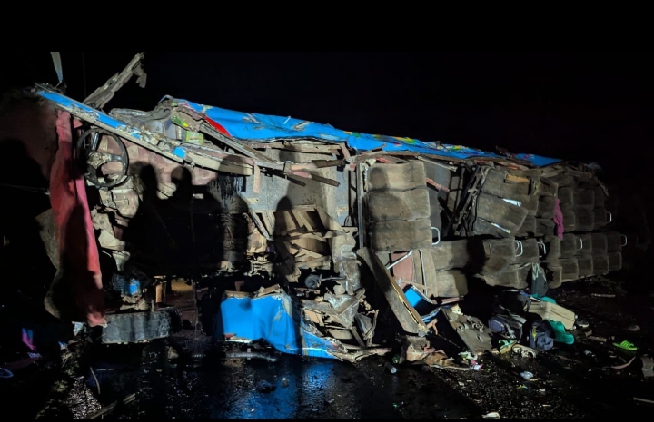
Uganda has unveiled new safety measures and regulations governing school transport after one of the country’s deadliest school bus crashes killed more than 20 children and reignited concerns over weak enforcement of long-standing road safety laws.
The reforms, announced days after a school bus carrying pupils from an educational tour plunged off Chekwatit Hill in the eastern district of Kapchorwa, represent one of the government’s most comprehensive overhauls of school transport safety in years.
While officials describe the measures as a decisive response to the tragedy, they have also acknowledged that many of the requirements mirror regulations introduced in 2025 but never fully enforced.
The July 16, 2026 crash, involving pupils from King David Junior School in Ndejje, Kampala, has become a defining moment in Uganda’s debate over child safety, regulatory oversight and accountability. Investigators say the bus, returning from a study tour to the popular Sipi Falls tourist area, reportedly suffered a mechanical failure before overturning, killing at least 21 pupils and several adults while leaving dozens injured.
As mourning continues across the country, the government has moved swiftly to impose stricter controls on schools, transport operators and regulators, arguing that preventing another such tragedy requires stronger enforcement rather than simply issuing new directives.
Tough nationwide measures
Among the most significant reforms is mandatory government vetting of all drivers transporting learners.
State Minister for Transport Julius Maganda Wandera said every school bus driver must now be cleared by the Ministry of Works and Transport and carry an official government-issued identification badge while on duty.
Drivers operating without accreditation will face arrest, while vehicles may be impounded.
Authorities have also suspended all school trips and educational tours involving road transport until further notice as officials review existing safety systems. In addition, school buses will no longer be permitted to travel at night, a practice safety experts have long identified as increasing the risk of fatal crashes.
Every school vehicle must undergo mechanical inspections before undertaking learner transport, while schools will be required to use only dedicated private vehicles rather than ordinary public taxis or commuter vans.
Government has also introduced mandatory administrative approval for all learner travel.
“The movement of learners for the trip must be explicitly authorised by the respective District Education Officer,” Maganda said.
Officials say the approval process is intended to strengthen oversight by ensuring every educational journey is scrutinised before departure.
The reforms also seek to make school vehicles immediately recognisable.
Under the new policy, buses and vans owned or operated by schools will gradually adopt a standard yellow colour scheme, making them easier for police, road users and emergency responders to identify.
“The government will be moving to strictly enforce standards for schools and vehicles, especially vehicles that will be holding the licence or ownership of schools, so that such vehicles shall have a clear identity that when somebody views a vehicle from a distance, they know this is a school bus or a school van,” Maganda said.
The regulations will apply across the education sector, including nursery schools, kindergartens, primary and secondary schools, tertiary institutions and universities.
The Ministry of Works and Transport, working alongside the Uganda Police Force’s Traffic Directorate, will oversee enforcement.
Authorities have warned that both vehicle owners and operators who fail to comply will face legal action.
Existing rules, limited enforcement
The government’s response has also exposed longstanding weaknesses in the enforcement of school transport regulations.
Officials acknowledge that many of the new directives reinforce safety requirements already contained in Uganda’s Basic Requirements and Minimum Standards for Schools (BRMS) framework issued in May 2025.
Those standards required schools to obtain approval before organising trips, conduct risk assessments, use roadworthy vehicles, avoid overloading, maintain passenger registers and restrict travel to daylight hours. However, compliance remained inconsistent, with oversight often limited by inadequate inspections and weak enforcement.
The Kapchorwa disaster has intensified criticism that existing regulations were allowed to remain largely on paper until tragedy struck.
Accountability beyond the driver
Government says responsibility for learner safety extends well beyond those behind the wheel.
Information Minister Justine Kasule Lumumba said accountability would include school administrators, transport operators, education officials, police officers responsible for inspections and any public officials found to have ignored safety requirements.
The government has also announced the formation of a multi-sector task force to review existing regulations and recommend further reforms aimed at strengthening school transport safety.
A broader road safety challenge
Uganda records thousands of road traffic deaths every year, with poor vehicle maintenance, speeding, dangerous terrain and inadequate enforcement frequently identified as major causes.
School transport has attracted increasing scrutiny as educational excursions become more common across the country, often involving long-distance travel on roads with varying safety standards.
Road safety advocates argue that the latest measures could significantly improve protection for learners if implemented consistently.
However, they caution that meaningful reform will depend on sustained inspections, stronger institutional oversight and adequate resources rather than temporary crackdowns following high-profile accidents.
For many Ugandan families, the Kapchorwa tragedy has become a painful reminder that transporting children safely is as important as educating them.
The government’s latest measures now place renewed emphasis on ensuring that school journeys are governed not only by policy, but by effective enforcement.