


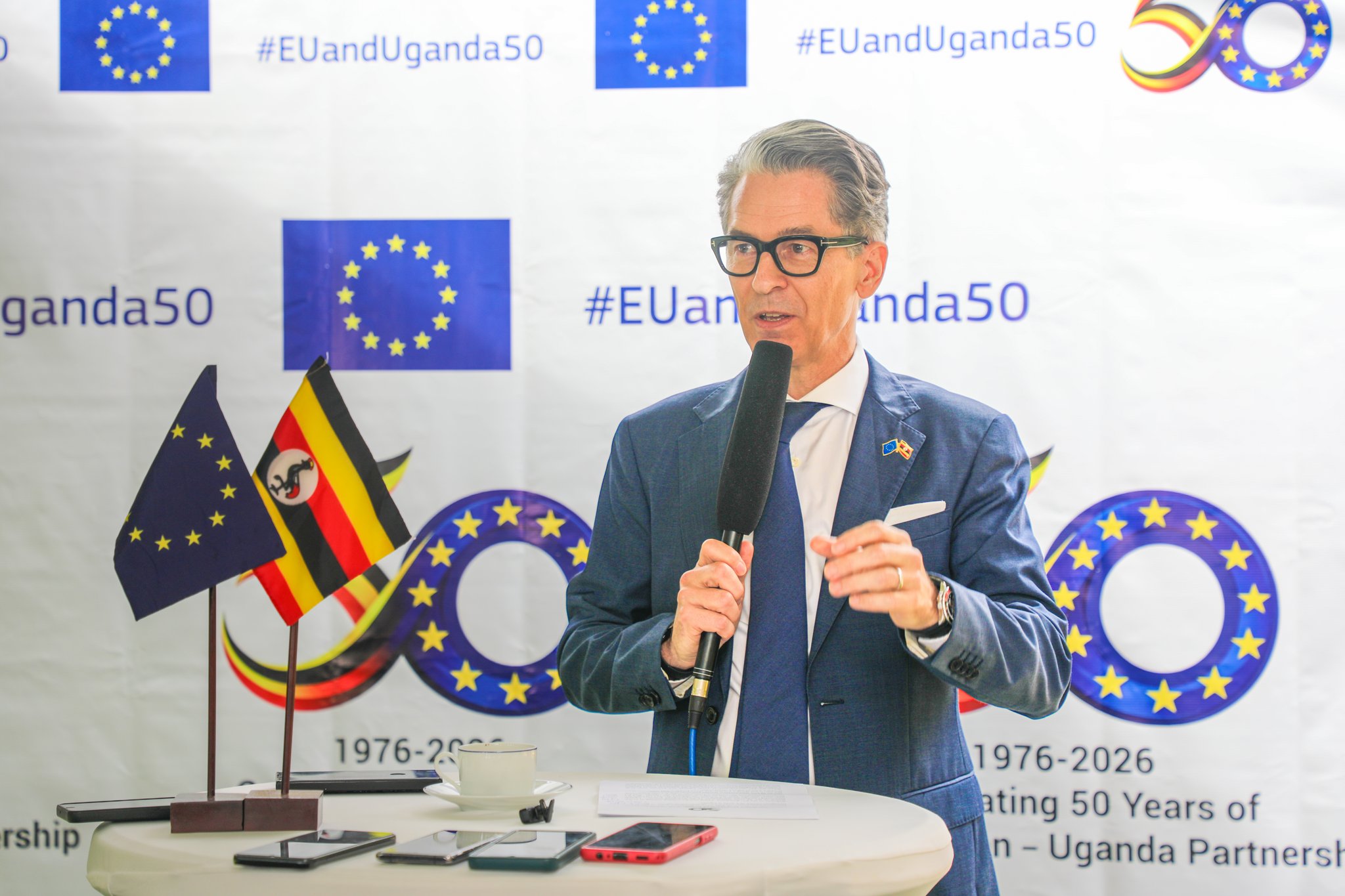
KAMPALA, Uganda — The European Union and Uganda are marking 50 years of partnership, celebrating a relationship that has evolved, adapted, and delivered tangible results since the EU Delegation first opened in Kampala in 1976.
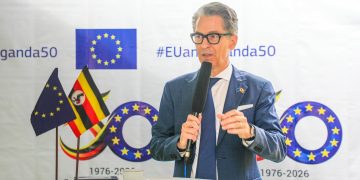
Speaking to journalists today in Kololo, Jan Sadek, the European Union Ambassador to Uganda said that during the past half-century, the European Union has invested more than €5 billion in development cooperation in Uganda. An estimated additional €5 billion in European private investment has flowed into the country during the same period, a powerful blend of public partnership and private enterprise aimed at driving jobs, services, and long-term resilience.
A Partnership Built on Trust
When the EU established its presence in Kampala in 1976, both Europe and Uganda were navigating complex transitions. Today, the European Union has grown into a bloc of 27 Member States, with 10 maintaining diplomatic representation in Uganda. Meanwhile, Uganda has undergone profound transformation, strengthening its regional influence and global voice, including its leadership role within the Non-Aligned Movement.
Through political shifts and economic changes, the partnership has endured — anchored in dialogue, mutual respect, and trust, even during difficult moments.
Investments That Touch Everyday Lives
EU cooperation has translated into visible, everyday impact across Uganda. Investments have supported schools and vocational skills training, health services; particularly maternal and child health, road construction, renewable energy, tourism, and trade development.
In Northern Uganda, where conflict once left deep social and economic scars, EU-backed programmes such as the Development Initiative for Northern Uganda helped rebuild communities, restore livelihoods, and strengthen local governance. The region’s recovery underscored a key lesson: sustainable peace and development go hand in hand.
Beyond the north, EU-funded infrastructure projects have improved connectivity and trade. These include the Kampala Northern Bypass, the Mbarara–Katuna road corridor, and the upgraded Atiak–Laropi link, all of which have strengthened transport networks and economic integration.
Powering Sustainable Growth
Under the EU’s Global Gateway strategy, cooperation is increasingly focused on sustainable growth, climate resilience, and job creation. A flagship example is the rehabilitation of the Nalubaale–Kiira hydropower complex, supported by a €30 million EU grant intended to unlock further financing from the European Investment Bank and partners. Phase one of the project is expected to commence in 2026.
Environmental sustainability is another shared priority. Through the EU–Uganda Forest Partnership, initiatives are promoting landscape restoration and sustainable value chains — creating green jobs while protecting critical ecosystems.
Trade on the Rise
Trade relations between Uganda and the EU have expanded significantly. Uganda benefits from duty-free, quota-free access to the European market under the Everything But Arms arrangement. Since 2019, Ugandan exports to the EU have nearly tripled — rising from approximately €500 million to €1.5 billion. Between 2023 and 2024 alone, exports grew by 58%, with Uganda maintaining a positive trade balance with the EU since 2022.
Coffee remains a flagship export, with EU support helping to strengthen quality standards, certification systems, traceability, and climate resilience. The focus is increasingly on value addition — boosting incomes for farmers and cooperatives while creating more jobs along the value chain.
Diversification is also gaining momentum, following the recent authorization for exports of Ugandan farmed finfish and related products to the EU market — a move expected to generate new opportunities for investment and employment.
Education, Inclusion and Governance
Education and youth empowerment are central pillars of the partnership. Through the Erasmus+ programme and academic exchanges, Ugandan students and researchers have forged strong connections with European institutions, gaining skills and networks that contribute to national development.
The EU also supports safer learning environments, water and sanitation facilities in schools, and programmes addressing gender-based violence. Governance reforms, civil society engagement, and human rights initiatives remain integral components of EU cooperation, reflecting a commitment to accountable institutions and inclusive participation.
Government Applauds EU Contribution
Ambassador John Leonard Mugerwa from Uganda’s Ministry of Foreign Affairs commended the European Union for its sustained commitment over the decades. He highlighted the EU’s significant contributions to education, health, infrastructure development; particularly road construction, tourism, and trade, noting that these investments have played a vital role in Uganda’s socio-economic transformation.
Celebrating the Milestone
The 50-year anniversary celebrations will extend throughout 2026, including activities during Europe Day, the Pearl of Africa Tourism Expo, and the Renewable Energy Conference. Events are planned not only in Kampala but also in other parts of the country, reflecting the nationwide footprint of EU–Uganda cooperation.
The EU Delegation is also preparing to relocate to a newly renovated standalone office later this year — a symbolic step into the next chapter of the partnership.
As both sides reflect on five decades of collaboration, the message is clear: this anniversary is not simply about marking time, but about celebrating people, progress, and possibility.
Fifty years on, the EU–Uganda partnership remains strong and its next chapter will be written together.