


President Yoweri Museveni and First Lady Janet Museveni energized thousands of supporters in Madi-Okollo District on Monday, delivering a strong message that the National Resistance Movement (NRM) remains the driving force behind Uganda’s peace, development, and prosperity.
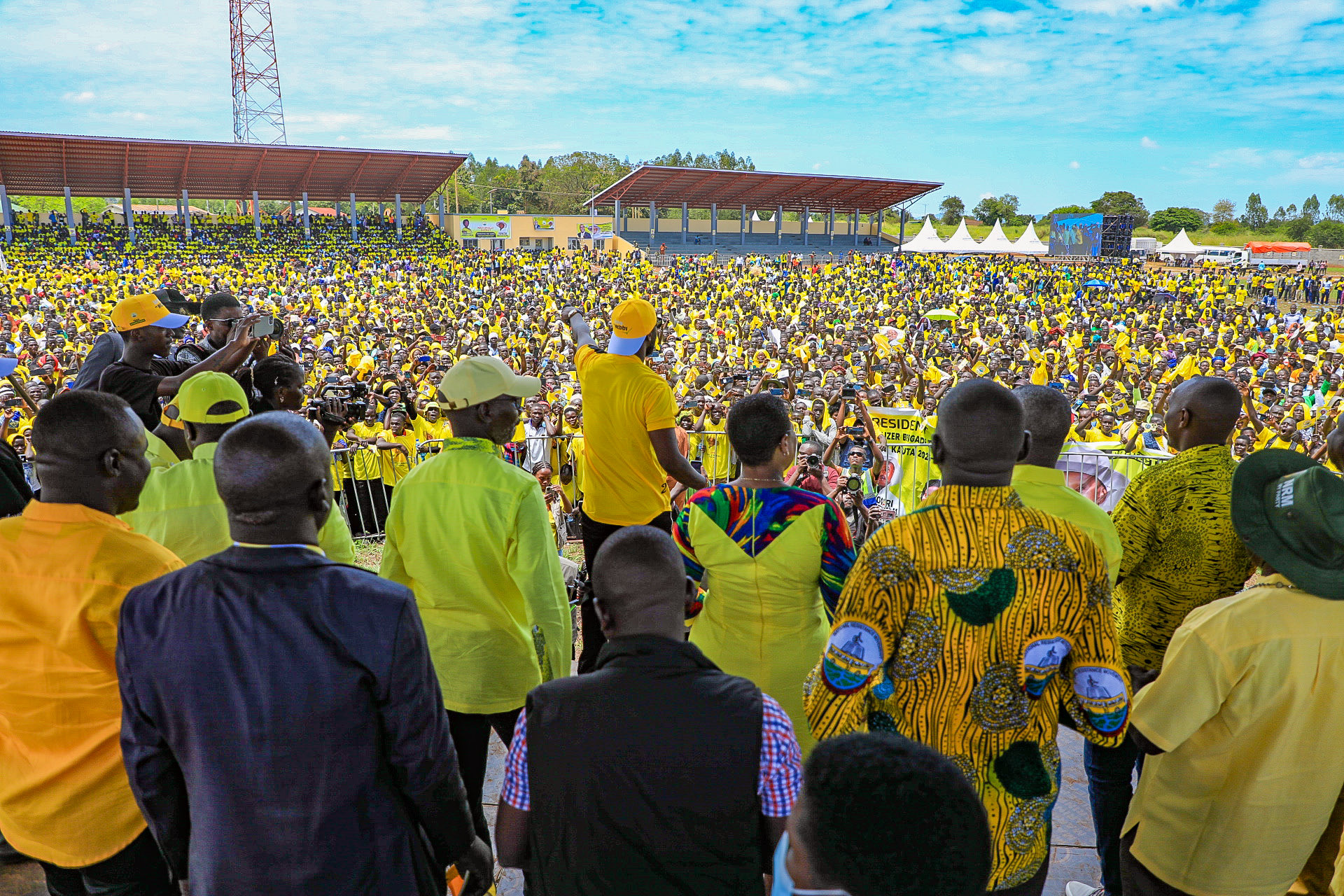
Speaking before a packed crowd at Ajai Sports Stadium, the First Lady expressed gratitude to residents for their overwhelming turnout, describing it as a clear demonstration of the party’s growing support ahead of the upcoming general elections.
“This is good because it shows the country the numbers of NRM supporters,” Mrs Museveni said. She praised the party for laying the foundation upon which Uganda’s progress rests: improved education, accessible healthcare, expanding infrastructure, and poverty alleviation efforts reaching families across the nation.
Calling on voters to fully engage in the electoral process, Janet Museveni urged them to rally behind President Museveni and all NRM candidates, emphasizing the collective responsibility Ugandans bear to safeguard their country’s future.
“We must take responsibility to make sure that we are doing it for our families, our districts, for Uganda, and for future generations,” she said. “Vote for the President, vote for all the NRM candidates, and may God bless you.”
President Museveni highlighted three pillars that he said have defined NRM’s transformative four-decade tenure: peace, infrastructure development, and social service delivery.
“The first major contribution of the NRM is peace,” the President asserted. “Before NRM, there was war. Many of you were refugees in Congo and South Sudan. Today, Uganda is peaceful, and others seek refuge here. That peace is because of our politics of unity, rejecting tribalism, religious divisions, and gender discrimination.”
He underscored notable progress in expanding economic infrastructure across West Nile and beyond, praising the proliferation of electricity poles and the increasing use of mobile phones as visible signs of national growth.
“I feel happy when I see electricity poles here and phones in your hands,” Museveni said. He also reiterated government efforts to improve critical road networks, including the routes linking Karuma to West Nile and local roads within Madi-Okollo.
On education, the President acknowledged current challenges while reaffirming the government’s commitment to universal access. Noting that 69 government primary schools and six secondary schools currently serve the district, Museveni highlighted the need to address the 14 parishes without primary schools and six sub-counties lacking secondary education.
“To fix this, we plan to recruit 50,000 more teachers to close the staffing gap, so that no school has an excuse to charge learners,” he explained, lamenting ongoing illegal fees despite the free education policy enacted in 1996.
Museveni also spotlighted the Presidential Skilling Hubs, vocational training centers offering fully sponsored courses in trades such as tailoring, carpentry, mechanics, and agribusiness. Initiated under State House, these hubs aim to equip youth with practical skills that foster self-reliance.
“I was frustrated that some officials failed to implement my vision of free education, so I used my powers under State House to start the Presidential Skilling Hubs,” he said, citing the hub in Zombo as a model for empowering Uganda’s youth.
Turning to healthcare and poverty eradication, Museveni acknowledged progress but admitted that many Ugandans still face hardships.
“The poverty you left in the morning is still waiting for you at home,” he said. “You don’t have sugar, proper clothes, or good houses. That is why we must keep working, and we can only do that if you support NRM.”
In closing, the President urged full voter turnout, stressing the importance of collective participation in securing Uganda’s future.
“Let all our votes come out. Nobody should stay home on voting day,” Museveni added. “We need to secure Uganda’s future and continue this journey of transformation.”