


DUBAI, UAE : The Emirates Group has announced a new record half-year financial performance, posting a profit before tax of AED 12.2 billion (US$ 3.3 billion) for the first six months of 2025–26 — marking the fourth consecutive year of record profitability for the half-year reporting period.
After accounting for income tax charges, the Group’s profit after tax was AED 10.6 billion (US$ 2.9 billion), up 13% from last year.
Illustrating its strong operating performance, the Group maintained a robust EBITDA of AED 21.1 billion (US$ 5.7 billion), 3% higher than the AED 20.4 billion (US$ 5.6 billion) reported for the same period last year.
Group revenue stood at AED 75.4 billion (US$ 20.6 billion) for the first six months of 2025–26, up 4% from AED 70.8 billion (US$ 19.3 billion) last year.
The Group closed the first half of 2025–26 with a record cash position of AED 56.0 billion (US$ 15.2 billion) as of 30 September 2025, compared to AED 53.4 billion (US$ 14.6 billion) on 31 March 2025. The Group has been able to draw on its strong cash reserves to support business needs, including funding for new aircraft deliveries and servicing existing debt obligations.
The Group also paid the remaining AED 2 billion (US$ 545 million) dividend to its owner, part of the AED 6 billion (US$ 1.6 billion) declared during the 2024–25 financial year.

HH Sheikh Ahmed bin Saeed Al Maktoum, Chairman and Chief Executive, Emirates Airline and Group, said; “The Group has once again delivered an outstanding performance, surpassing our half-year results from last year to achieve a new record profit for H1 2025–26. I’m delighted to note that Emirates maintains its position as the world’s most profitable airline for this half-year reporting period.
“This performance was primarily driven by the unflagging demand and growing customer preference for our products and services, which boosted revenue growth and profitability.
“Emirates and dnata have invested billions to continually enhance our products and services, bring new offerings to market, improve operations through innovation and technology, and look after our employees who ensure our customers’ safety and satisfaction. These are core to our DNA.
“The Group’s strong profitability enables us to continue making these investments and to scale up our proven business models in line with Dubai’s growth as a global city of choice for talent, businesses, and tourists.”
HH Sheikh Ahmed added that “Global demand for air transport and travel services has been buoyant despite geopolitical events and economic concerns in some markets. We expect this demand resilience to continue for the rest of 2025–26 and look forward to increasing our capacity to grow revenues as new A350 aircraft join the Emirates fleet and new facilities come online at dnata.”
To support increased operations and business activities, the Emirates Group’s employee base grew by 3% compared to 31 March 2025, reaching 124,927 as of 30 September 2025. Both Emirates and dnata have ongoing recruitment drives to support future requirements.
Emirates Airline
Emirates continued to enhance its network and connectivity through its Dubai hub. During the first half of 2025–26, Emirates launched new flight services to Danang, Siem Reap, Shenzhen, and Hangzhou. As of 30 September, Emirates’ passenger and cargo network spanned 153 airports in 81 countries and territories.
The airline strengthened its network connectivity by deploying 28 additional weekly flights to Antananarivo, Johannesburg, Muscat, Rome, Riyadh, and Taipei.
To offer even more connection options for customers, during the first six months of 2025–26, Emirates entered into agreements with three codeshare and interline partners: Air Seychelles, Condor, and Aurigny.
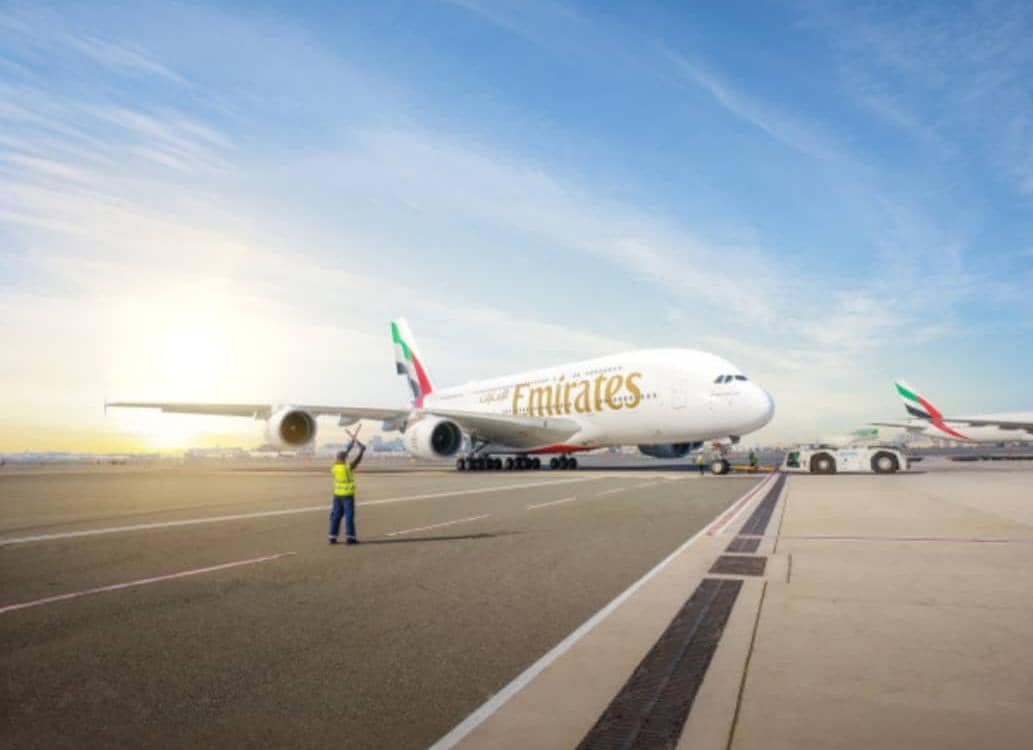
Between 1 April and 30 September, Emirates received five new A350 aircraft, adding more Business Class and Premium Economy seats to its inventory. During this period, 23 aircraft (6 A380s and 17 Boeing 777s) with fully refreshed interiors rolled out of the airline’s US$ 5 billion retrofit programme, enabling Emirates to bring its latest cabin products to even more markets, including its industry-leading Premium Economy. By 30 September, Emirates Premium Economy was available to customers flying between Dubai and 61 cities.
On the ground, “Emirates First” opened at Dubai Airport, offering First Class customers and Platinum Skywards members a luxurious private check-in experience. In the first six months of 2025–26, Emirates accelerated the roll-out of its retail strategy with new concept travel stores in Accra, Bangkok, Geneva, Jakarta, Mauritius, Osaka, Seoul, and Singapore.
Emirates continued to advance its environmental initiatives, uplifting sustainable aviation fuel (SAF) where available — including at 37 airports. In April, Emirates joined the Aviation Circularity Consortium (ACC), a network of organisations committed to building a circular economy for aviation and creating new pathways to accelerate decarbonisation through high-value circularity in the global supply chain.
In the first half of 2025–26, Emirates made notable investments to boost its global brand visibility. The airline signed multi-year sponsorship deals to become Platinum Partner of FC Bayern München, Official Main Sponsor of Real Madrid Basketball, and Premium Partner and Official Airline Partner of the Investec Champions Cup and EPCR Challenge Cup. Emirates also extended its partnership with the ATP as Premier Partner and Official Airline of the ATP Tour until 2030, and renewed its shirt sponsorship with Olympique Lyonnais until 2030.
Overall capacity during the first six months of the year increased by 5% to 31.3 billion Available Tonne Kilometres (ATKM) due to expanded flight operations. Capacity measured in Available Seat Kilometres (ASKM) increased by 5%, while passenger traffic carried, measured in Revenue Passenger Kilometres (RPKM), was up 4%, with an average Passenger Seat Factor of 79.5%, compared to 80.0% during the same period last year. Emirates carried 27.8 million passengers between 1 April and 30 September 2025, up 4% year-on-year.
Emirates SkyCargo transported 1.25 million tonnes in the first six months of the year, up 4% compared to the same period last year. Customer demand for Emirates SkyCargo’s specialised products and its strong network of freighter and bellyhold cargo operations remained steady. However, cargo yields decreased by 6% due to softening demand in some market segments amid tariff concerns.
Emirates SkyCargo added capacity with three new Boeing 777 freighters delivered. In April, the cargo division launched Emirates Courier Express, an innovative product that leverages the airline’s global network to provide door-to-door express shipping services for businesses.
Cementing its position as the world’s most profitable airline for the half-year reporting period, Emirates’ profit before tax for the first half of 2025–26 reached a new record of AED 11.4 billion (US$ 3.1 billion), compared to AED 9.7 billion (US$ 2.6 billion) last year. Emirates’ profit after tax was AED 9.9 billion (US$ 2.7 billion), up 13% from last year.
Emirates’ revenue, including other operating income, was AED 65.6 billion (US$ 17.9 billion), up 6% compared with AED 62.2 billion (US$ 16.9 billion) for the same period last year. The airline’s record revenue can be attributed to strong travel demand across markets and customer preference for Emirates’ products and services, particularly its premium cabins.
Emirates’ operating costs (including fuel) grew by 4% in line with increased operations. Fuel remained the largest component of the airline’s operating cost at 30%.
Driven by customer demand and increased operations during the six months, Emirates’ EBITDA of AED 19.7 billion (US$ 5.4 billion) remained strong, up 3% compared to AED 19.1 billion (US$ 5.2 billion) for the same period last year.
Emirates Flight Catering grew revenue from external customers by 13% to AED 555 million (US$ 151 million), uplifting 7.7 million meals (up 2%) for 116 airlines during the period.
Emirates Leisure Retail acquired the remaining 25% stake in Air Ventures LLC in the US, securing full ownership of the entity, which operates airport retail and F&B outlets.
 dnata
dnata
dnata saw strong growth in the first six months of 2025–26, as it continued to ramp up operations across its cargo and ground handling, catering and retail, and travel services businesses.
In the first half of 2025–26, dnata’s airport services and catering and retail divisions won several significant new contracts and grew existing customer relationships across its international operations. This demonstrates dnata’s ability to meet the diverse requirements of its airline customers with high safety standards and consistently high-quality products and services.
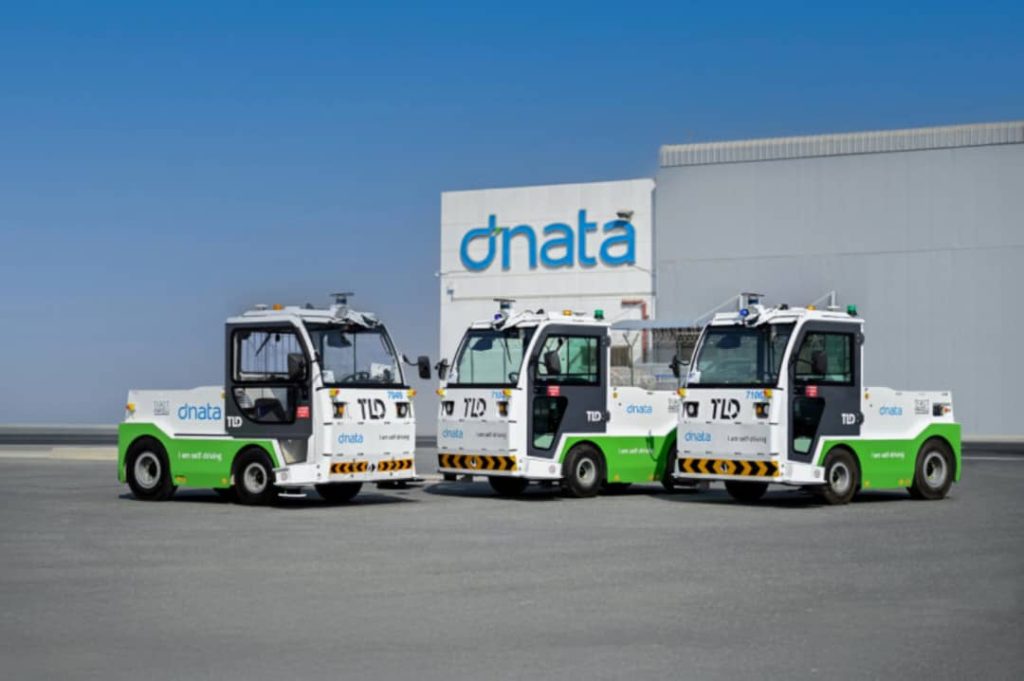
dnata continued to make strategic investments in its business to respond to customer needs and capitalise on market opportunities. It announced plans to deploy 800 new ground support equipment (GSE) units across its global network in 2025 — an investment valued at US$ 110 million — to enhance operational performance and secure a steady supply of advanced, lower-emission equipment supporting dnata’s growth and sustainability targets.
Other highlights in the first half of 2025–26 include the launch of its airport hospitality brand, marhaba, in the United Kingdom; a €3 million minority stake investment in WonderMiles, an advanced NDC-enabled booking platform to strengthen dnata Travel’s corporate offering; and the disposal of its 75% stake in Super Bus, which operates sightseeing tours in the UAE.
dnata also entered its first major sports sponsorship partnership, signing a three-year agreement with Dubai Basketball to become a Founding Partner of the city’s first professional basketball franchise.
dnata achieved a new record half-year revenue, surpassing the US$ 3.0 billion mark for the first time for this reporting period. dnata’s revenue, including other operating income, was AED 11.7 billion (US$ 3.2 billion), an increase of 13% compared to AED 10.4 billion (US$ 2.8 billion) in the same period last year.
Overall profit before tax for dnata was AED 843 million (US$ 230 million), up 17% from the same period last year. dnata’s profit after tax was AED 697 million (US$ 190 million), up 22% from last year.
Illustrating its operating performance, dnata’s EBITDA was AED 1.4 billion (US$ 372 million), up 5% from last year’s AED 1.3 billion (US$ 354 million).
dnata’s airport operations remained the largest contributor to revenue with AED 5.5 billion (US$ 1.5 billion), a 15% increase compared to the same period last year, as its airline customers’ operations continued to pick up — particularly in Italy, Australia, the UK, and the UAE. Across its operations, the number of aircraft turns handled by dnata increased by 15% to 450,903, bolstered by its newly launched operations at Rome Fiumicino Airport. It also recorded 1.59 million tonnes of cargo handled, up 3% due to additional cargo activity driven by its UAE operations.
dnata’s flight catering and retail operations contributed AED 4.1 billion (US$ 1.1 billion) to revenue, up 11%, as retail product sales grew significantly as part of the division’s strategy, catering production increased in Australia and the UK to meet customer demand, and revised contracts reflected rising supply costs. The total number of meals uplifted decreased slightly by 1% to 60.0 million compared to last year.
dnata’s travel division contributed AED 2.0 billion (US$ 538 million) to revenue, up 11% compared to AED 1.8 billion (US$ 483 million) for the same period last year. The division reported an underlying total transactional value (TTV) of AED 5.0 billion (US$ 1.4 billion), compared to AED 4.5 billion (US$ 1.2 billion), up 9% year-on-year.