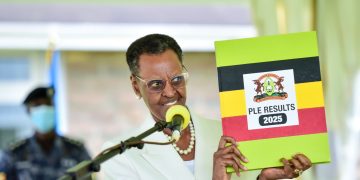




EDUCATION: The Minister of Education and Sports and First Lady, Janet Kataaha Museveni, has called on teachers across the country to adjust their teaching methods to align with the changing realities of Uganda’s education system, as she officially released the 2025 Primary Leaving Examination (PLE) results.
Speaking at the release ceremony, Mrs Museveni said the 2025 PLE marked the first set of national examination results released this year by the Uganda National Examinations Board (UNEB), in line with its legal mandate. She noted that the majority of candidates who sat the examination are beneficiaries of the Universal Primary Education (UPE) programme introduced by the NRM government 30 years ago.
She highlighted that since the inception of UPE, hundreds of thousands of children who would otherwise have missed out on education due to school fees have been able to complete primary school. She reaffirmed the government’s commitment to sustaining UPE following the renewed mandate given to the NRM government by Ugandans, stressing that primary education will remain completely free for all children.
“I take this opportunity to thank the people of Uganda for the overwhelming vote of confidence in the NRM government to guide our country on a steady path of socio-economic transformation and towards high middle-income status,” she said.
The Minister applauded the increasing number of pupils completing the primary education cycle, noting a reduction in dropout rates. However, she expressed concern over the declining proportion of boys completing primary education compared to girls and called for evidence-based research to understand the trend.
Mrs Museveni also commended the inclusion of learners with special educational needs, noting that when provided with the right learning environment, they perform just as well as their peers without disabilities. She described this as a positive sign that the government’s inclusive education policy is yielding results. She further praised the Uganda Prisons Service for enabling inmates to sit for PLE, describing education as a powerful tool for rehabilitation and reintegration.
According to UNEB statistics, more candidates passed in Division One compared to the 2024 PLE cycle. Although the overall pass rate slightly declined proportionally, the absolute number of pupils who passed increased, reflecting higher candidature.
To support the growing number of learners transitioning from primary to secondary education, the government has continued investing in seed secondary schools. Since 2019, 204 out of the targeted 259 seed secondary schools have been completed and operationalised under the Uganda Intergovernmental Fiscal Transfers (UgIFT) programme, with 55 still under construction.
The Minister also pointed to alternative pathways created by the enactment of the Technical Vocational Education and Training (TVET) Act 2025. She explained that learners completing Primary Seven can enrol in community polytechnics, where a three-year programme leads to a certificate equivalent to O-Level education. She encouraged learners who fail to transition immediately to secondary or vocational education to repeat Primary Seven to obtain certification of basic competencies.
Mrs Museveni welcomed UNEB’s continued emphasis on competency-based assessment, which focuses on knowledge, understanding, and application of skills to real-life community challenges. She said this approach prepares learners for the competency-based curriculum at lower secondary level and requires teachers to adjust their instructional methods accordingly.
She noted that the Ministry of Education and Sports is implementing teacher capacity-building interventions under the National Teacher Policy 2019, including targeted training for teachers in low-performing districts. Plans are also underway to expand these interventions nationwide under the U-LEARN project with support from the Global Partnership for Education.
The Minister revealed that the primary school curriculum is being reviewed to align it with the revised lower secondary curriculum and to improve assessment and monitoring of learning outcomes.
While commending local government officials, inspectors, security agencies and other stakeholders for ensuring the smooth conduct of the 2025 examinations, Mrs Museveni expressed concern over persistent examination malpractices. These include irregular deployment of invigilators, inadequate supervision of examination rooms, and fraudulent registration of private candidates as UPE pupils. She described such practices as unacceptable and directed the Ministry to close loopholes in the operations of private examination bureaus.
She also warned against teacher absenteeism, calling on parents and communities to speak out when teachers neglect their duties despite being on the government payroll. She tasked the Directorate of Education Standards to utilise technology to monitor teacher attendance and classroom instruction.
Mrs Museveni also announced that the Senior One selection exercise will take place on 12th and 13th February 2026, while the first term for the 2026 Senior One cohort will begin on Monday, 2nd March 2026.