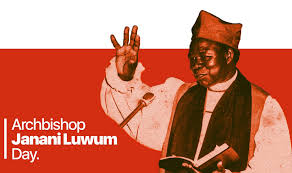



As Uganda marks Archbishop Janani Luwum Day, we pause to honor a fearless beacon of faith-based nonviolence, whose unyielding stand against tyranny transformed spiritual conviction into shrewd political strategy.
Far beyond a mere martyr, Luwum emerged as a masterful nonviolent strategist under Idi Amin’s brutal dictatorship, orchestrating organized and coordinated resistance through the Anglican Church to expose and challenge systemic oppression.
His pivotal leadership in meticulously documenting human rights abuses—such as arbitrary killings, disappearances, and the regime’s weaponization of power against its own people—culminated in the bold 1977 memorandum, a calculated political maneuver that served not just as a spiritual testimony but as a defiant call for accountability amid repression, ultimately sealing his fate in assassination that same year.
Far from a mere historical footnote, Luwum’s story is a clarion call for contemporary societies grappling with injustice, urging us to embrace nonviolent resistance
The region’s history of underdevelopment—exacerbated later by the Lord’s Resistance Army insurgency—mirrored the broader struggles of Northern Uganda, where poverty, displacement, and violence have long hindered progress.
Luwum’s story reminds us that true progress begins with civic participation, mobilizing citizens to dismantle oppressive regimes, and demand accountable governance through organized, nonviolent resistance. Central to Luwum’s ethos was faith-based nonviolence, a principle he drew from biblical teachings and global icons like Martin Luther King Jr. and Mahatma Gandhi.
He believed that violence begets violence, and that Christians must resist evil through moral suasion, prayer, and peaceful protest. As Provincial Secretary in 1966 and Bishop of Northern Uganda in 1969, Luwum navigated Uganda’s turbulent politics with this conviction.
The 1971 coup by Idi Amin, who initially courted church leaders, soon devolved into a reign of terror marked by extrajudicial killings, disappearances, and ethnic purges. Luwum, elevated to Archbishop in 1974, refused to remain silent.
He viewed human rights as divinely ordained, echoing the biblical mandate to “defend the rights of the poor and needy” (Proverbs 31:9).
Luwum’s advocacy for human rights was inseparable from his nonviolent stance. He led ecumenical efforts, uniting Anglican, Catholic, and Muslim leaders to document abuses and petition Amin. In a bold 1977 memorandum, church leaders condemned the regime’s atrocities, demanding accountability.
This act of prophetic witness exemplified faith-based nonviolence; confronting power without arms, relying on truth and conscience. Luwum’s model posits that religious institutions must engage in nonviolent confrontation—such as public truth-telling, collective protest letters, and moral exposure of abuses—to challenge oppressors
His martyrdom, far from quelling dissent, ignited global outrage and accelerated Amin’s downfall in 1979.
Luwum’s legacy endures in an era of national and global conflicts and human rights crises. In Uganda today, this legacy resonates powerfully amid a sharply constricted civic space and escalating political tensions, particularly evident around the January 2026 general elections
Recent months have seen widespread reports of shrinking democratic freedoms: arbitrary suspensions of at least seven prominent civil society organizations (including key human rights and election-monitoring groups) just days before polling, nationwide internet blackouts that silenced independent reporting and citizen coordination, arbitrary detentions of opposition figures and activists, and broader repression through laws enabling surveillance, restricted assembly, and selective enforcement against dissent
The integration of faith, rights show how nonviolence can yield tangible progress. Yet, we must ask: Are we living up to Luwum’s vision? In a world where violence often masquerades as security, his martyrdom reminds us that true power lies in moral courage.
Churches and civil society must reclaim their prophetic role, advocating uncompromisingly for the marginalized, the oppressed, and victims of state abuses—yet many religious institutions in Uganda today have tragically diverted from this path, often remaining silent on widespread repression, endorsing or aligning with those in power, or even perpetuating cycles of oppression and abuse through complicity, self-censorship, or direct involvement in partisan politics that legitimizes tyranny rather than confronting it.
As seen in criticisms of religious leaders’ muted responses to electoral violence, arbitrary detentions, and shrinking civic space ahead of and after the 2026 elections—coupled with instances where some clergy have been accused of campaigning for the ruling party or failing to condemn documented human rights violations—this departure betrays the bold, truth-telling witness exemplified by Archbishop Janani Luwum, demanding urgent renewal so that faith communities once again stand as fearless voices for justice, accountability, and the voiceless instead of enablers of the status quo.
As we celebrate Archbishop Janani Luwum Day, let churches and civil society rise boldly in Luwum’s spirit- reject complacency, organize collectively, confront oppression through principled nonviolence, and persist in building a Uganda where justice, freedom, and genuine participation prevail. His martyrdom was not the end of resistance—it was a call to continue it, disciplined and unafraid