


KAMPALA, Uganda— Airtel Uganda has delivered a record-breaking financial performance for the year ended December 31, 2025, posting a 41.1% increase in profit after tax to Ushs 446.9 billion, underscoring a decisive shift in Uganda’s digital economy.
The telecom giant’s results reflect more than strong balance-sheet growth. They signal a structural transformation in how Ugandans connect, communicate and consume services — with data now firmly at the center of that evolution.
Data Revenue Surpasses Voice for the First Time
In a historic first for Uganda’s telecommunications sector, data revenue overtook voice revenue during the year. Data earnings rose to Ushs 1,101.7 billion, surpassing voice revenue of Ushs 1,026.8 billion.
Data revenue grew by 22.4%, fueled by a 19.6% increase in data customers and a 14.8% rise in average usage per subscriber. While voice services remain significant, the company’s revenue center of gravity has clearly shifted toward broadband and digital services.
This performance came despite regulatory headwinds, including a reduction in local interconnect rates from Ushs 45 to Ushs 26 in late 2024 — a move that compressed margins across the sector. Airtel’s disciplined cost management and operational efficiency helped cushion that impact.
Managing Director and CEO Soumendra Sahu attributed the growth to customer-focused investments and network improvements.
“Through our relentless focus on improving the customer experience, we have reported a 13.3% growth in revenue and a 24.5% growth in EBITDA, with margins increasing to 54.9%,” Sahu said. “This was supported by our commitment to continuous improvement of our network and service to our valued customers — the reason we exist.”
Expanding Network Footprint and 5G Rollout
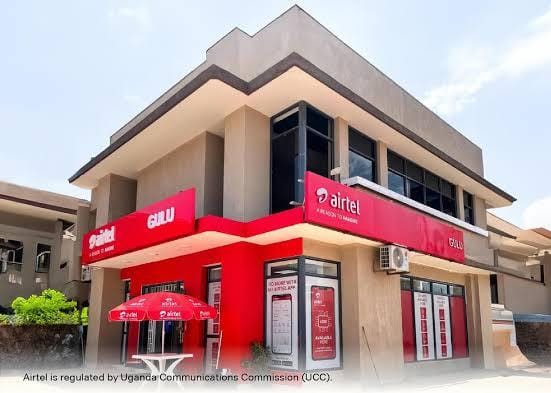
Airtel continued aggressive infrastructure expansion in 2025, adding 290 new 4G sites and expanding its 5G footprint to 365 sites across major cities including Kampala, Wakiso, Jinja, Mbale, Masaka, Lira, Gulu, Mbarara, Fort Portal and Mityana.
The company’s 4G network now covers 98.9% of Uganda’s population, placing the country among the continent’s broadband coverage leaders.
However, the latest report by the GSMA highlights a persistent challenge: while Uganda has achieved 96% 4G population coverage, the usage gap stands at 75%, meaning many covered citizens are not yet actively using mobile internet services.
Closing that gap — by promoting smartphone adoption, expanding home broadband and improving affordability — is now Airtel’s central strategic priority for 2026.
Enterprise Growth and Network as a Service
Beyond retail consumers, Airtel is expanding its footprint in enterprise solutions through its Network as a Service (NaaS) model. Under this framework, Airtel Business manages connectivity, cybersecurity firewalls and ICT infrastructure for organizations, allowing enterprises to focus on their core operations.
One flagship example is its partnership with SUMMA Contractors during construction of the Hoima City Stadium, where Airtel delivered end-to-end connectivity solutions.
This diversification into business-to-business services has strengthened revenue resilience, reducing exposure to fluctuations in traditional voice markets.
Innovation in Network Quality and Cybersecurity
In 2025, Airtel rolled out 258 new 4G sites in rural and peri-urban areas to improve network availability and data throughput.
The company also introduced Africa’s first AI-powered Spam Alert service in April, designed to notify customers of suspicious SMS messages — addressing rising cybersecurity concerns. Trials to combat spam calls are in advanced stages.
Voice over LTE (VoLTE) adoption continued to grow, now accounting for over 20% of total smartphone voice traffic, enabling high-definition calls without interrupting mobile data sessions.
Strong Macroeconomic Tailwinds
Airtel’s performance was supported by improving macroeconomic conditions. Uganda’s GDP growth stood at approximately 4.8% in 2025, with inflation easing to 3–4% amid stable food prices.
Sahu noted that these indicators reinforce confidence in Airtel’s long-term strategy as a key player in Uganda’s digital agenda.
Shareholder Rewards
Investors on the Uganda Securities Exchange are set to benefit from the strong results. The Board recommended a final dividend of Ushs 3.55 per share, bringing the full-year dividend to Ushs 11.15 per share, a 41.6% increase from the previous year.
Social Impact and Digital Inclusion
Through the Airtel Africa Foundation, the company expanded connectivity to 223 public schools by December 2025, enhancing access to digital learning resources. Airtel also partnered with UNICEF Uganda during the International Day of Digital Learning to promote safe and inclusive internet use.
Cultural engagement remained a priority, with continued support for the Kabaka Birthday Run and the Masaza Cup, reinforcing community ties and youth empowerment initiatives.
As Uganda moves from coverage expansion to meaningful usage, Airtel is positioning itself not just as a telecom provider but as an integrated technology partner powering enterprises, public institutions and households.
“In 2026, Airtel Uganda is set for a transformative year as we accelerate our leadership in Uganda’s digital revolution through targeted strategic investments,” Sahu said.
With data consumption accelerating, enterprise services expanding and cybersecurity innovation gaining traction, Airtel Uganda’s FY2025 results may well mark a defining moment in the country’s digital transformation journey.