




KAMPALA, Uganda – Uganda will require livestock farmers to contribute toward the cost of vaccinating their animals against Foot-and-Mouth Disease (FMD) beginning in July 2026, as the government seeks to strengthen disease control measures and protect a livestock industry that has become an increasingly important source of export earnings.
The policy, approved by Cabinet under the FMD Vaccine Cost Recovery Scheme, introduces mandatory vaccination fees for farmers while making inoculation against the highly contagious animal disease compulsory nationwide. Authorities say the initiative is designed to establish a sustainable financing mechanism for vaccination campaigns, improve disease surveillance and support the long-term growth of Uganda’s livestock sector.
Under the scheme, farmers will pay UGX 8,000 (about US$2) for every cow and pig vaccinated and UGX 4,000 (about US$1) for each goat and sheep during every vaccination cycle.
The fees will be collected through Housing Finance Bank and Pearl Bank as part of efforts to ensure transparency and accountability in the vaccination process.
To underpin the programme, the government has secured 53.6 million doses of high-potency quadrivalent FMD vaccines designed to protect livestock against the four major virus strains circulating in the region — Serotype O, Serotype A, SAT 1 and SAT 2. The vaccines will be deployed through a nationwide vaccination campaign conducted every six months, targeting Uganda’s estimated 44.5 million susceptible animals.
Officials argue that the new approach is necessary to tackle recurring outbreaks of Foot-and-Mouth Disease, which have repeatedly disrupted livestock trade, restricted animal movements and caused significant economic losses for farmers across the country.
According to the Minister of State for Animal Husbandry, Bright Rwamirama the new policy establishes a standardized framework for managing vaccination campaigns and strengthening animal health services. He said improved disease control would not only protect farmers’ livelihoods but also enhance Uganda’s ability to access regional and international livestock markets.
As part of the programme, all livestock farmers will be required to register with district or sub-county veterinary authorities. Their details will be entered into a national database that will track vaccine payments, vaccination records and animal health information, providing authorities with a more comprehensive system for monitoring disease prevention efforts.
The government has coupled the programme with strict enforcement measures. Farmers who fail to vaccinate their animals risk losing access to livestock markets and livestock-product markets, while unvaccinated animals will face movement restrictions.
Authorities say only animals with verified vaccination records will be permitted to move across districts and other parts of the country.
The policy affects a substantial portion of Uganda’s agricultural economy. Government statistics indicate that the country has approximately 44.5 million animals susceptible to Foot-and-Mouth Disease, including 15.5 million cattle, 17.4 million goats, 4.4 million sheep and 7.1 million pigs.
Rwamirama said the livestock sector is becoming an increasingly important driver of foreign exchange earnings and economic growth.
According to the minister, Uganda generated approximately US$285 million from livestock exports in 2024, supported by rising milk production, increased value addition and expanding access to regional and international markets. The country also earned about US$12.9 million from exports of hides and skins, while gelatin and related products generated an additional US$6.5 million.
Rwamirama said revenue collected through the vaccination programme would be channelled into a dedicated revolving fund managed by the Bank of Uganda, ensuring that all proceeds are reinvested in the procurement of vaccines. The arrangement, he said, is intended to guarantee a reliable supply of vaccines and reduce the risk of shortages during future vaccination cycles.
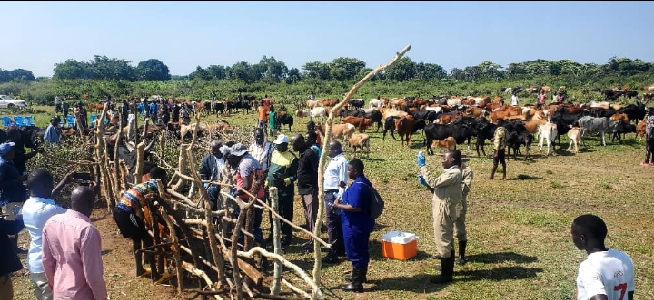
The Ministry of Agriculture, Animal Industry and Fisheries has intensified mobilization efforts in collaboration with district veterinary teams ahead of the programme’s rollout in July.
As of June 12, 2026, officials reported that more than 20,000 farmers had been successfully onboarded onto the national FMD vaccination system, while approximately 3.5 million animals had already been registered for vaccination.
With livestock exports gaining momentum and demand for disease-free animal products rising in regional and global markets, Ugandan authorities view the vaccination drive as a critical investment in the future of the sector. For millions of rural households that depend on livestock for income and food security, the programme represents both a new financial obligation and a pivotal test of the country’s ability to control one of the most persistent threats to agricultural productivity.