


What began as a social media exchange has rapidly evolved into a diplomatic flashpoint, exposing growing tensions between Uganda and the United States over free speech, military leadership and the limits of foreign influence in domestic affairs.
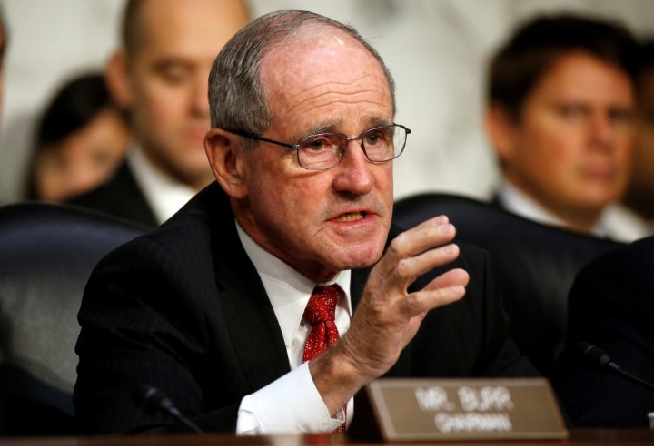
At the centre of the dispute is Uganda’s Chief of Defence Forces, Gen. Muhoozi Kainerugaba, following the closure of the Nation Media Group outlets and his outspoken posts on X which prompted an unusually sharp rebuke from U.S. Senator Jim Risch, Chairman of the Senate Foreign Relations Committee.
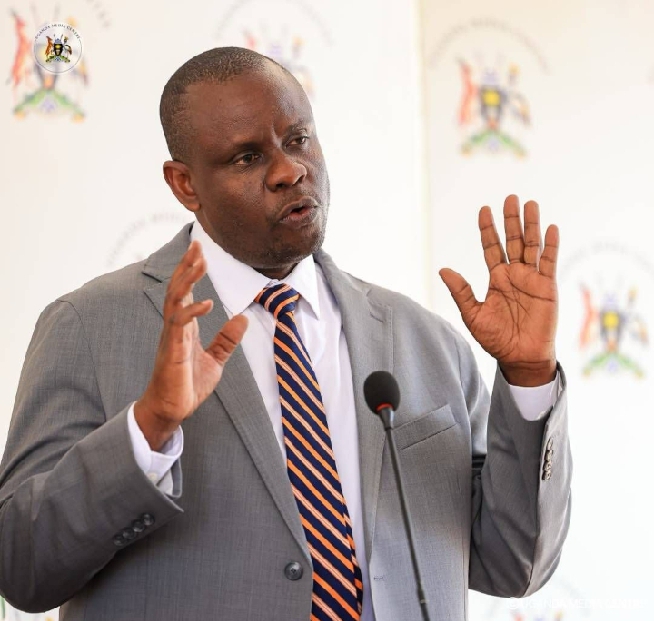
But Kampala has responded with equal force, with Local Government Minister Balaam Barugahara insisting that Uganda’s sovereignty is not open to foreign direction.
“Uganda is a sovereign nation,” Balaam said while responding to Senator Risch’s criticism on X formerly twitter. “Our security decisions are made in Kampala, not Washington. We expect our international partners to respect our institutions and refrain from making sweeping statements about Uganda’s internal affairs.”
The exchange followed Senator Risch’s declaration, that Gen. Muhoozi and the Uganda People’s Defence Forces had become “unfit partners” for the United States after the military ordered the closure of Nation Media Group operations, including NTV Uganda and the Daily Monitor, accusing the media house of activities deemed prejudicial to national security.
Writing on his X, the influential Republican senator argued that attacks on press freedom undermine regional security and urged the Trump administration to review its security partnership with Uganda, saying Washington should only work with allies that strengthen democratic values and stability.
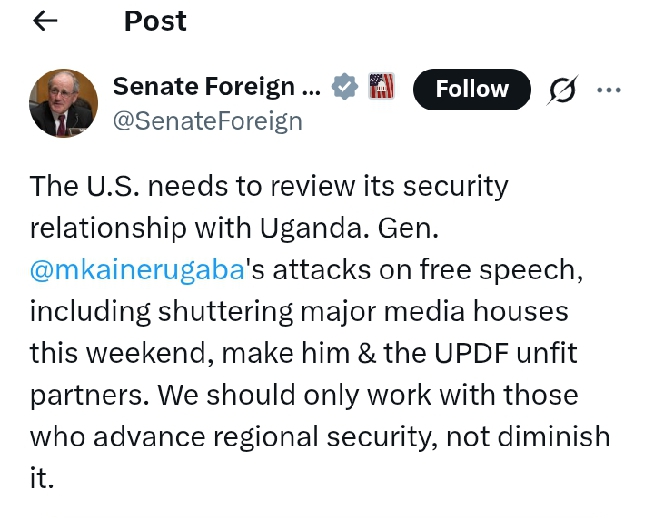
His intervention is significant not only because of his position as chairman of the powerful Senate Foreign Relations Committee, but also because it comes from a leading Republican at a time when President Donald Trump’s foreign policy has largely emphasised reduced American involvement in the domestic affairs of other countries.
That a senior Republican has publicly questioned Uganda’s military partnership with Washington has been viewed by analysts as an indication that concerns over Uganda’s governance are attracting bipartisan attention within the U.S. political establishment.
However, Balaam dismissed the criticism as unwarranted interference, maintaining that Uganda’s security agencies have a constitutional responsibility to safeguard national stability.
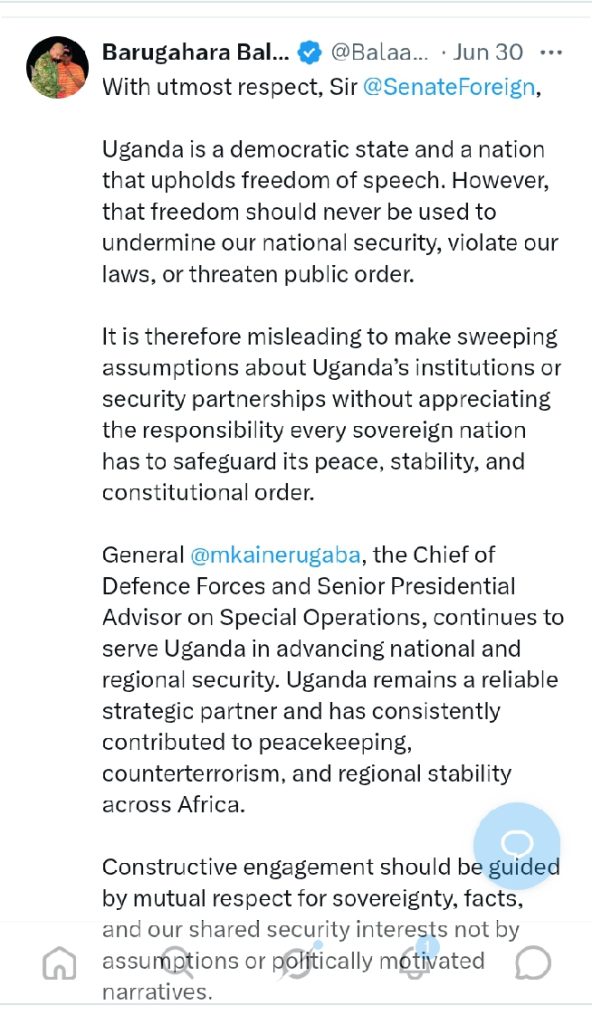
He defended Gen. Muhoozi’s leadership, describing him as a committed patriot focused on protecting Uganda’s interests rather than seeking approval from foreign governments.
The minister’s response was echoed by other government supporters, including Kasambya County MP David Kabanda, who accused Western leaders of applying double standards by criticising Uganda while remaining silent on controversial military actions undertaken by major global powers.
The diplomatic exchange comes after months in which Gen. Muhoozi’s social media activity has repeatedly drawn international attention. Earlier this year, the army chief accused the U.S. Embassy in Kampala of backing opposition leader Robert Kyagulanyi, popularly known as Bobi Wine, before briefly announcing a suspension of military cooperation with the embassy.
He later withdrew the statement, saying it had been based on incorrect information. The episode prompted Senator Risch to warn that Muhoozi’s conduct had crossed “a red line” in relations between Kampala and Washington.
Gen. Muhoozi has also used his X account to comment on sensitive political and security matters, often attracting criticism from diplomats and rights groups while earning praise from supporters who argue he speaks candidly in defence of Uganda’s sovereignty.
The latest dispute unfolded after security agencies moved against Nation Media Group following coverage authorities considered harmful to national security. The action reignited international concern over media freedom in Uganda, while government officials maintained that no media organisation is above the law where national security is concerned.
The disagreement has widened into a broader debate over sovereignty, democracy and international partnerships.
While Washington has increasingly linked its security cooperation with governance and human rights considerations, Ugandan officials insist that national security decisions remain an internal matter that cannot be dictated by foreign governments.
Whether the exchange remains a war of words or develops into a broader diplomatic disagreement will likely depend on how both governments navigate the coming weeks. With Uganda remaining a key security partner in the Great Lakes region and the Horn of Africa, analysts say neither Kampala nor Washington is likely to welcome a prolonged deterioration in relations, even as both sides continue to defend sharply different views on governance, security and freedom of expression.