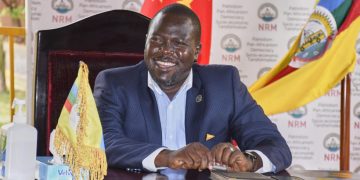





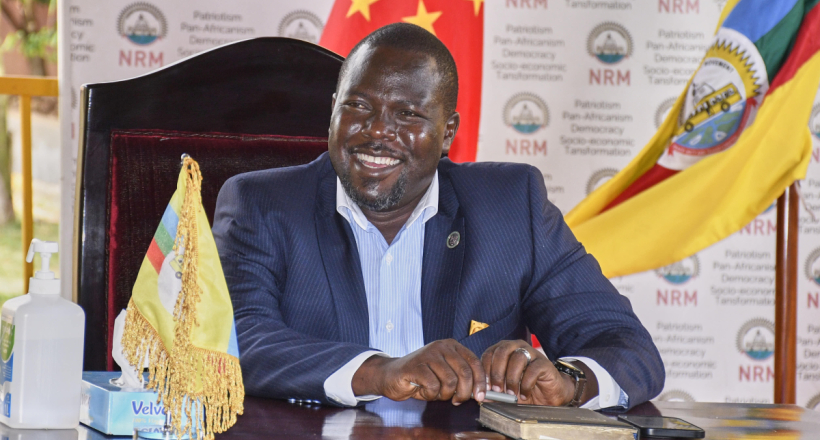
In an era where politics is increasingly defined by spectacle and noise, Richard Todwong has built his influence differently.
Soft-spoken, approachable, and remarkably humble for a man occupying one of the most powerful positions in Uganda’s ruling party, Todwong has become one of the most consequential political figures in contemporary Uganda—not because he seeks the spotlight, but because he has consistently positioned himself at the centre of some of the country’s most important political transitions.
Today, as Secretary General of the National Resistance Movement (NRM), Todwong is widely regarded as one of the Movement’s most effective political strategists and organizers. Yet those who know him best often describe him first as simple, down-to-earth, and deeply committed to consensus-building.
Behind that modest exterior, however, lies a seasoned political operator whose journey from rural Northern Uganda to the highest levels of party leadership mirrors the story of resilience, organisation, and political conviction.
Humble Beginnings
Born in 1973 during one of Uganda’s most turbulent political periods, Todwong grew up in a large polygamous family in Northern Uganda. His childhood was shaped by political instability and uncertainty.
His father, a former prison warder and local political mobiliser, was frequently forced into hiding during the political upheavals of the 1970s, leaving the family to navigate difficult circumstances. Those experiences left a lasting impression on the young Todwong, teaching him the values of unity, teamwork, community service, and perseverance.
Political unrest interrupted his education for several years, but he eventually completed his primary and secondary education before proceeding to Makerere University, where he earned a degree in Economics and Political Science. He later returned to pursue a Master’s degree in International Relations and Diplomacy.
While at Makerere, Todwong immersed himself in student leadership and politics, developing an early appreciation for public affairs and governance.
A Career Defined by Political Work
Unlike many leaders who transition into politics from other professions, Todwong’s career has largely been defined by political organisation and public service.
After graduating, he briefly worked with the Uganda Revenue Authority, where he was elected leader of the staff union. However, his passion increasingly gravitated toward governance and national leadership.
At just 28 years old, he was appointed to serve on the Constitutional Review Commission, becoming part of a historic process that helped shape Uganda’s political evolution.
During this period, Todwong participated in some of the country’s most consequential constitutional and political debates. He was among the leaders involved in discussions that culminated in the reintroduction of multi-party politics in Uganda and played a role in the broader political processes that shaped constitutional reforms, including debates surrounding presidential term limits.
These experiences exposed him to the inner workings of statecraft and placed him at the centre of major national conversations on governance, democracy, decentralization, political representation, and constitutional development.
Reflecting on that period, Todwong often notes that it was there that he developed a lasting appreciation for political organisation as a vehicle for national transformation.
“I realised that politics was not merely about holding office,” he has said on several occasions. “It was about building institutions, shaping ideas, and creating opportunities for people.”
From Parliament to National Mobilisation
After serving in several political and advisory roles, Todwong successfully contested for the Nwoya County parliamentary seat in 2011.
His election to Parliament marked another significant milestone in his political journey. Shortly thereafter, he was appointed Minister for Political Mobilisation, a role that allowed him to focus on strengthening political organisation and citizen engagement across the country.
The appointment formalised what had already become his defining strength: political mobilisation.
Over the years, Todwong would become known within the NRM as one of the party’s most dependable organisers, capable of translating policy, ideology, and political strategy into effective grassroots action.
Whether serving in government, Parliament, or the party secretariat, his work consistently revolved around building structures, mobilising communities, strengthening institutions, and fostering political participation.
Architect of Electoral Success
Todwong’s reputation as a political tactician was cemented through years of electoral organisation and mobilisation.
Party insiders credit him with playing a significant role in numerous by-election victories and political recoveries in areas previously considered challenging for the NRM.
His approach has always been rooted in organisation rather than rhetoric.
Rather than relying on temporary campaign structures, he has consistently advocated for strong grassroots networks, active village-level leadership, and continuous political engagement between elections.
That philosophy reached its highest expression during preparations for Uganda’s 2026 General Election.
Following concerns that the party’s grassroots structures had weakened over time, the NRM Secretariat embarked on an ambitious programme of organisational renewal under Todwong’s leadership.
The strategy focused on rebuilding party structures from the village level upwards, empowering local cadres, strengthening ideological mobilisation, and restoring ownership of campaigns to formal party organs.
The result was one of the most comprehensive grassroots mobilisation efforts in the Movement’s history and a significant electoral rebound that restored confidence within the party.
For many observers, the campaign demonstrated Todwong’s ability not only to manage political processes but also to transform organisational discipline into electoral success.
A Bridge Builder Beyond Uganda
While much attention focuses on his domestic political role, Todwong has also emerged as an important figure in strengthening relations between liberation movements and governing parties across Africa.
Under his stewardship at the NRM Secretariat, several fraternal revolutionary parties and liberation movements renewed and deepened their engagement with the NRM.
This growing network of political cooperation was visible during President Yoweri Museveni’s most recent swearing-in ceremony, which attracted representation from more than fifteen political parties and liberation movements from across the continent.
Party officials attribute much of this renewed engagement to Todwong’s deliberate efforts to strengthen ideological partnerships, foster dialogue, and promote Pan-African cooperation among like-minded political movements.
For him, political solidarity remains an important instrument for advancing African unity, stability, and development.
Strengthening Uganda’s Democratic Space
Beyond partisan politics, Todwong has earned recognition for his role in fostering dialogue across Uganda’s political spectrum.
His contribution to the Inter-Party Organisation for Dialogue (IPOD) is frequently cited as one of his most important achievements in promoting political engagement and coexistence.
As chairman of IPOD for an extended period, he played a central role in maintaining dialogue among political parties during some of Uganda’s most politically sensitive moments.
Even after the rotational leadership of IPOD moved to other parties, political actors across the divide continued to seek his involvement because of the trust and confidence he had built over time.
Colleagues often describe him as a leader capable of balancing firmness with openness—someone who can defend his convictions while maintaining channels of communication with those who hold opposing views.
Many credit this combination of simplicity, accessibility, and principled leadership with contributing to a stronger and more inclusive democratic space in Uganda.
Leadership Through Humility
Despite his rise through the ranks of government and party leadership, Todwong has maintained a reputation for humility and accessibility.
Those who work with him often point to his willingness to listen, his preference for consensus over confrontation, and his belief that leadership is ultimately about service rather than status.
It is perhaps this combination of humility, discipline, and strategic thinking that has enabled him to remain relevant through successive phases of Uganda’s political evolution.
From a young boy growing up amidst political turmoil in Northern Uganda to becoming Secretary General of the country’s dominant political party, Richard Todwong’s story is one of perseverance, organisation, and public service.
And while history may ultimately judge him by the elections won, the institutions strengthened, and the movements organised, those closest to him suggest that his most enduring legacy may be something simpler: proving that political influence does not always require the loudest voice in the room.