



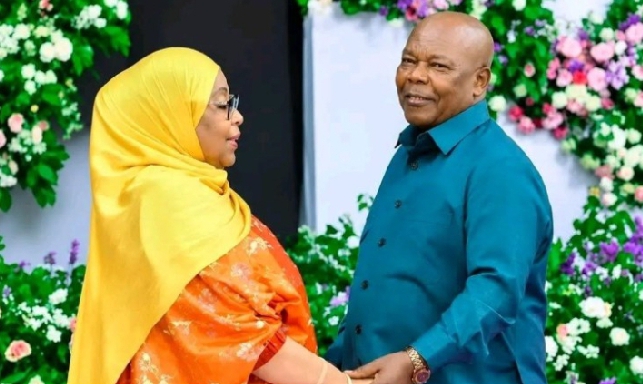
For more than four decades, Hafidh Ameir Hassan stood beside a woman whose political journey would eventually take her to the highest office in Tanzania, yet he largely remained a man outside the glare that followed her every step.
That quiet chapter ended in sorrow on Monday, September 7, when Tanzania’s First Gentleman died in Zanzibar while receiving treatment for a heart condition.
His death has left President Samia Suluhu Hassan without the lifelong companion who shared her journey from their marriage in 1978 through her rise in public service and, ultimately, her historic emergence as Tanzania’s first woman president.
Vice President Deogratius Ndejembi announced Ameir’s death, saying he had died at about 8am while undergoing treatment in Zanzibar. Funeral preparations were subsequently made in Kizimkazi, South Unguja, where he was laid to rest later that day, being a Muslim community.
The passing has triggered an outpouring of grief across Tanzania and the wider East African region, with political leaders describing Ameir not simply as the husband of a head of state, but as a father, companion and son of Tanzania whose life unfolded largely away from political spectacle.
The man behind a historic title
Ameir entered the history books almost by circumstance.
When Samia assumed the presidency in March 2021 following the death of President John Magufuli, Ameir became Tanzania’s first “First Gentleman” the male equivalent of the traditionally used title First Lady.
Unlike many spouses of political leaders, however, he did not transform the position into a platform for political visibility.
Before his wife reached State House, Ameir was known primarily for his work in agriculture. Accounts of his professional life describe him as an agricultural specialist, academic and former government officer in Zanzibar.
His public profile remained remarkably restrained even after Samia became one of Africa’s most recognisable female political leaders.
That contrast, a president increasingly at the centre of national and international affairs and a husband who preferred to remain in the background, became one of the defining features of their public life together.
A marriage that predated the presidency
Ameir and Samia married in 1978, long before either could have known that their family would eventually occupy such a prominent place in Tanzanian political history.
The couple raised four children, three sons and a daughter.
Their daughter, Wanu Hafidh Ameir, has followed her mother and father into public life.
She is a Member of Parliament for Makunduchi and currently serves as Tanzania’s Deputy Minister for Education, Science and Technology.
Official Tanzanian government records list her among the ministry’s leaders, while parliamentary records identify her as the MP for Makunduchi.
Wanu has remained active in government affairs in 2026, including work on higher education, science, technology and education policy.
The family’s public footprint therefore extends well beyond the presidency, a legacy that has now acquired a deeply personal dimension following Ameir’s death.
A private life under extraordinary circumstances
Being married to a president can turn an otherwise private individual into a permanent subject of public attention.
Ameir appeared to navigate that reality differently.
Reports following his death repeatedly described him as a private man who rarely sought the political spotlight despite occupying a historically significant position.
His significance was therefore less about speeches, political campaigns or public office and more about the extraordinary historical position he occupied alongside Tanzania’s first female president.
For President Samia, his death represents a profoundly personal loss at a time when she remains one of East Africa’s most influential political figures.
Regional leaders rally around Samia
The condolences quickly moved beyond Tanzania’s borders.
Kenyan President William Ruto expressed sorrow on behalf of Kenya, describing Ameir as President Samia’s “lifelong companion”, a beloved father to their children and a distinguished son of Tanzania.
Ruto said Kenya stood with Tanzania during the period of mourning and prayed for strength and comfort for the bereaved family.
Burundian President Evariste Ndayishimiye also mourned the death, saying Burundi stood firmly with Tanzania and President Samia during the difficult moment.
The African Union joined the regional expressions of sympathy.
African Union Commission Chairperson Mahmoud Ali Youssouf conveyed his deepest condolences to President Samia, her family and the Tanzanian people, wishing them strength, courage and solace following Ameir’s death.
The tributes underline the significance of the loss beyond the walls of the presidential residence: Ameir’s death has become a regional moment of mourning because of the family and office with which his life became historically intertwined.
Zanzibar receives its son
For all the history attached to his name, Ameir’s final journey returned him to the place from which his family roots stretched.
Kizimkazi, in Zanzibar, became the setting for his final farewell after his death in hospital.
Funeral prayers were attended by senior Tanzanian political, governmental and religious figures, including Vice President Ndejembi, Zanzibar President Hussein Ali Mwinyi and Prime Minister Mwigulu Nchemba. It was a fitting close to the life of a man whose identity remained closely connected to Zanzibar even as his marriage placed him at the heart of Tanzania’s national story.
A legacy measured in more than a title
Hafidh Ameir Hassan may forever be remembered as Tanzania’s first First Gentleman.
But the title tells only part of the story.
Behind it was an agricultural professional, a husband who shared more than four decades of marriage with a woman who broke one of Tanzania’s most visible political barriers, and a father whose children have themselves entered public service.
His was a rare kind of political legacy, one built largely without political ambition of his own.
As Tanzania mourns, President Samia faces a loss that no office can shield a person from: the death of the partner who walked with her long before the presidential motorcades, State House ceremonies and international summits.
For a nation accustomed to seeing Samia as president, the mourning period offers another view of her, as a wife, mother and lifelong companion now grieving the man who stood beside her before history gave her a title.
May Hafidh Ameir Hassan rest in peace.