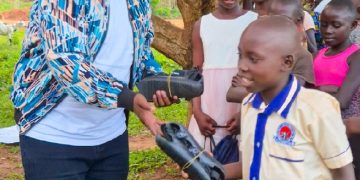



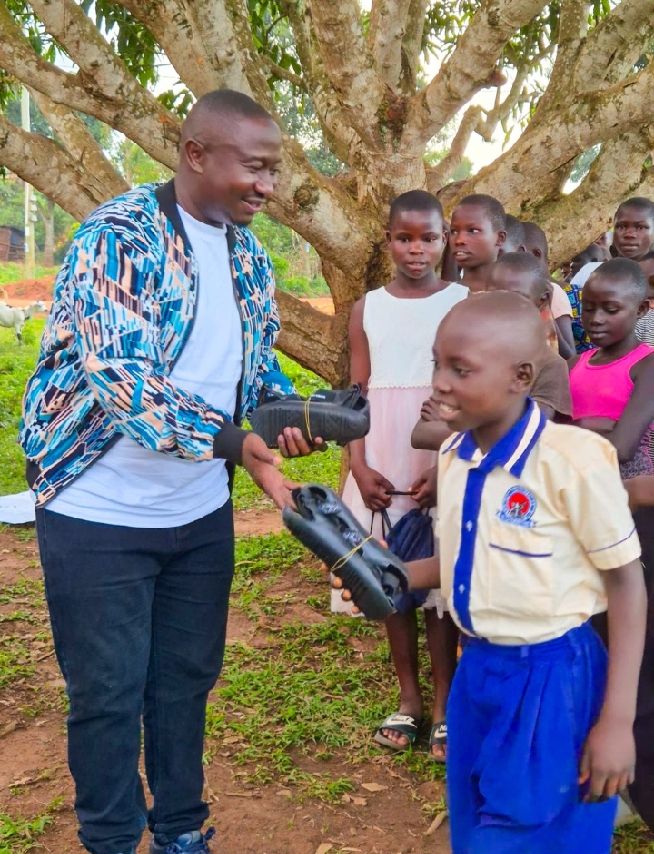
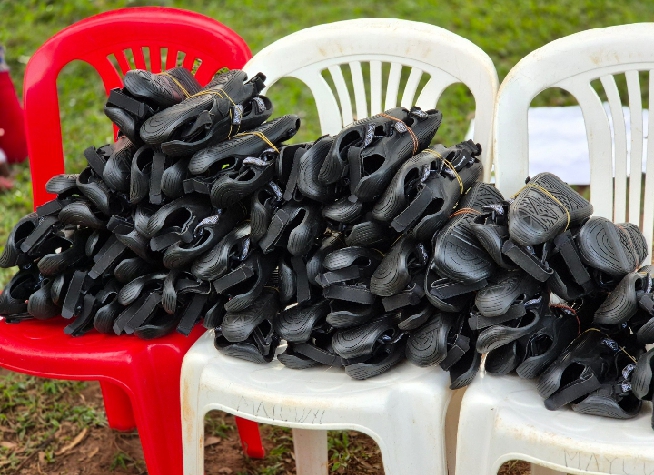
For some children in Bamutakudde Village, Mukono District, a pair of school shoes was once beyond the reach of their families. That changed when 100 children received new shoes in an initiative designed to support vulnerable households and help keep pupils in class.
Community leaders said some of the beneficiaries had never owned shoes for school.
The programme, led by Bamutakudde LC1 Chairperson Solom Sserwanjja, also provided women and school-going girls with reusable sanitary products. The support is intended to help them manage menstruation with dignity and reduce interruptions to their education.
The Melissa Prandi Children Foundation supported the initiative, offering families practical help with necessities that can determine whether children attend school regularly.
Yet the shoes and sanitary products form only one part of a wider programme Sserwanjja has begun developing since becoming LC1 chairperson.
From newsroom to the village
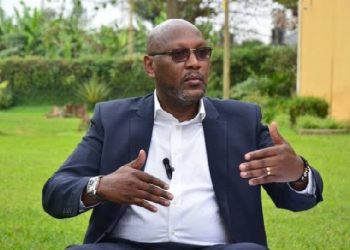
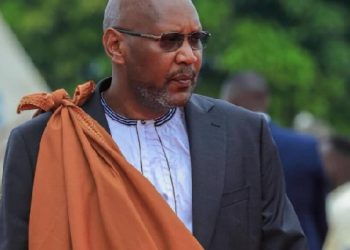
Sserwanjja entered local leadership after about 15 years in journalism, including investigative reporting and television news. His work in the media was shaped by persistent questioning, evidence-gathering and scrutiny of how public institutions serve citizens.
He worked in Uganda’s television news industry and became known for investigative journalism. He is also Executive Director of the African Institute for Investigative Journalism and received the BBC News Komla Dumor Award in 2019.
 His reporting has covered accountability, corruption, health rights and governance.
The move from journalism to village leadership has brought those concerns into a more immediate setting. Instead of investigating problems from a newsroom, Sserwanjja is now expected to help residents confront them directly.
In Bamutakudde, his priorities include basic services, education, livelihoods, safety of children, and community organisation.
Sserwanjja was elected LC1 chairperson in July 2026 after a closely fought contest, winning by one vote. He has since outlined a five-year development plan for the village, focusing on clean water, household incomes, youth skills, community enterprises and resource mobilisation.
Investing in women and livelihoods
A central part of the plan is to help women and young people gain skills that can generate income.
One proposal is a professional catering enterprise in which experienced chefs are training women in cooking, food presentation, and other services.
The aim is not simply to improve household cooking. The programme is intended to help participants offer catering services, secure contracts and potentially establish their own businesses.
Village leaders have also proposed an events-management enterprise as another source of employment and income.
For young people, the proposed training includes plumbing, painting, basic electrical wiring, tiling, landscaping and gardening. Beekeeping is also under consideration, with Mukono District Local Government expected to support the establishment of 50 beehives.
The broader objective is to provide skills that can lead either to employment or to small-scale enterprise.
Clean water is another priority. Bamutakudde has been facing water shortages, and the village leadership has identified the construction of at least three wells as an early target. Two of them are expected to receive support from Mukono District Local Government.
Residents have also begun community clean-up activities, meeting every Saturday mornings to clear their surroundings and discuss local concerns.
The leadership is seeking to link residents to government programmes such as the Parish Development Model and the Youth Livelihood Programme. It is also mobilising support for older people.
The approach is based on helping residents organise themselves and make better use of services and opportunities that already exist.
Grassroots leadership presents a different test for a journalist accustomed to working in newsrooms and questioning public officials.
In one of the interviews with a local newspaper, Sserwanjja described the contrast between dealing with sources as a reporter and serving people who are also his neighbours. As LC1 chairperson, he said, leadership requires patience because decisions affect people with whom he lives and interacts every day.
He has also introduced measures aimed at strengthening financial accountability. According to his account, the village opened a bank account and appointed a finance manager, with quarterly audits planned. He said his responsibility is to approve expenditure and sign requisitions, rather than handle village funds personally.
That focus on oversight reflects a principle that ran through his journalism career.
But the success of his leadership will be judged less by the plans themselves than by the changes residents can see and feel.
For the children who received shoes, the benefit is immediate. For girls receiving reusable sanitary products, it may mean fewer missed lessons and greater confidence at school. For women learning catering and other income-generating skills, the hoped-for gains are more gradual: turning knowledge into reliable livelihoods.
For Bamutakudde, the larger question is whether these interventions can grow into programmes that the community can sustain. He works closely with the district authorities, and engages several organisations to lobby for his people.
Sserwanjja describes his role in straightforward terms: he is an LC1 chairperson responsible for serving his village.
After years of asking questions as an investigative journalist, he now faces a different test, whether local leadership can convert community needs into results that residents can measure.
In years to come, he wants Bamutakudde to be a model village.