


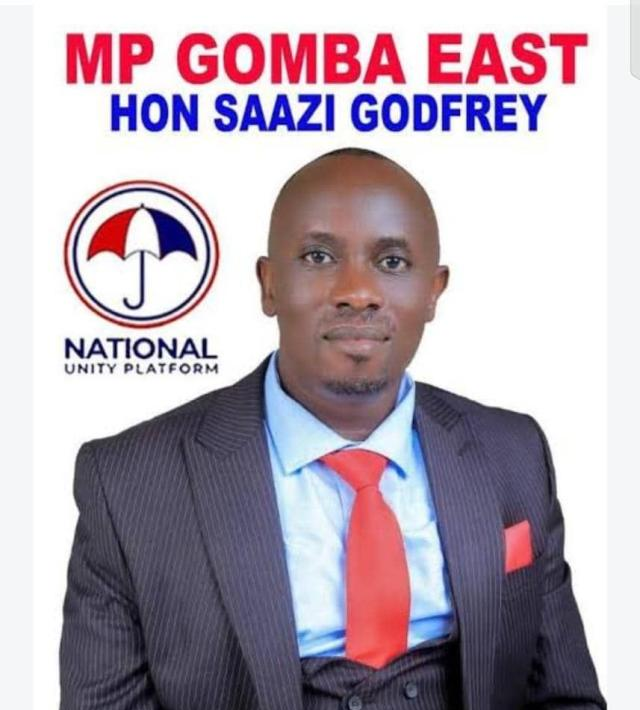
KAMPALA, Uganda (UGNEWSLINE) – The High Court in Mpigi has nullified the election of Gomba East Member of Parliament Godfrey Saazi and ordered the Electoral Commission to organise a fresh election after finding that the destruction of electoral materials at nine polling stations substantially affected the outcome.
In a judgment delivered by email on Monday, Justice Jamson Karemani set aside Saazi’s victory, declared the parliamentary seat vacant and directed the Electoral Commission to conduct a new poll in Gomba District.
The ruling followed an election petition filed by NRM candidate Henry Harris Kirumira Kalule, who challenged Saazi’s victory in the January 15, 2026 parliamentary election, citing irregularities and the exclusion of results from several polling stations.
Saazi was declared the winner with 10,907 votes against Kalule’s 9,156, giving him a margin of 1,751 votes.
Kalule argued that results from four polling stations were excluded from the final tally, while voting was disrupted and electoral materials destroyed at nine other stations, leaving thousands of voters unable to exercise their right to vote.
The judge found that although the omission of results from the four polling stations was an electoral irregularity, it did not substantially affect the outcome because Saazi would still have won after the votes were added.
The four stations had 959 registered voters. Their declaration forms showed that Kalule received 453 votes, while Saazi obtained 366.
Including these votes would have increased Kalule’s total to 9,609 and Saazi’s to 11,273, leaving Saazi with a reduced winning margin of 1,664 votes.
However, Justice Karemani ruled that the destruction of electoral materials and disruption of voting at nine other polling stations had a substantial effect on the election.
The affected stations were Ttaba Trading Centre, Buyebeyi Church of Uganda, Kimbo Catholic Church (A-NAKA), Kimbo Catholic Church (NAKE-Z), Serumbe UMEA Primary School A in Golola A, Jumbi Church of Uganda, Serumbe UMEA Primary School B in Kibaka, Kindimunda Playground and St Peter Primary School in Ngeribalya.
The judge observed that the electoral choices of 4,387 registered voters at the affected stations could not be established because the votes cast could not be ascertained.
Although the respondents argued that it would be speculative to assume all the registered voters had turned up or would have voted for Kalule, the judge noted that the candidates would have received votes, as they did at other polling stations.
Justice Karemani said it was impossible to determine how the missing votes would have affected the final results.
Citing the case of Apollo Kantinti against Sitenda Sebalu and another, the judge said courts must consider the number of affected voters in relation to the winning margin when deciding whether electoral irregularities substantially affected an election.
In this case, the judge noted that Saazi’s winning margin of 1,664 votes was less than half the number of registered voters whose electoral choices remained unknown.
He consequently concluded that the failure to comply with electoral laws and principles had substantially affected the outcome of the election.
Saazi had maintained that the election was substantially free and fair and that the declared results reflected the will of the majority. He denied responsibility for the disruption at the nine polling stations and blamed Kalule, his agents and supporters for the chaos that allegedly led to the destruction of electoral materials.
The Gomba District Returning Officer and the Electoral Commission attributed the omission of results from the four polling stations to a technical glitch discovered after polling. They argued that the omission did not affect the outcome and that the destruction of materials at the other nine stations affected all candidates equally.
However, Justice Karemani found that the failure by the returning officer and the Electoral Commission to safeguard the electoral process contributed to the irregularities.
The court ordered the election to be nullified and directed the Electoral Commission to organise a fresh poll. Each party was ordered to meet its own legal costs.