


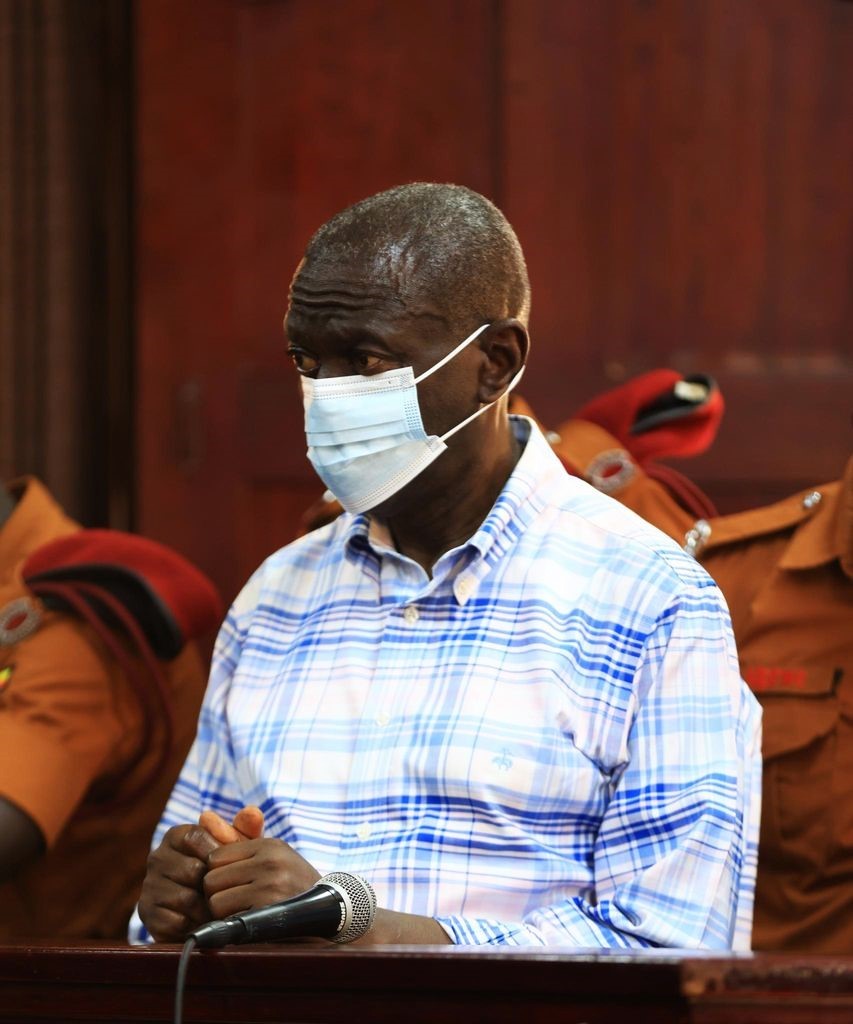
KAMPALA, Uganda (UGNEWSLINE) — Concealed cameras disguised as everyday objects have become a key focus of the treason trial of opposition politician Kizza Besigye, as prosecutors seek to use recordings allegedly captured during meetings abroad to support claims of a plot against the Ugandan government.
A police investigator told the High Court that the equipment, which included a camera hidden in a wall socket, a flash drive and a necklace, was handed to him by a man identified as Andrew Wilson, also known as Orlando, who allegedly recorded meetings involving Besigye and other individuals in Geneva, Athens and Nairobi.
Detective Inspector Benedict Odyek, the third prosecution witness, testified that he documented the devices and coordinated the processing of electronic material obtained during the investigation. The equipment also included camera-equipped watches, mobile phones, listening devices and a power bank fitted with a concealed camera.
The prosecution says the recordings form part of its evidence in the case against Besigye, his aide Obeid Lutale and Uganda People’s Defence Forces officer Captain Denis Oola. The three face treason-related charges over an alleged conspiracy to overthrow the government, accusations they are entitled to challenge in court.
But the technology at the heart of the prosecution’s case has also raised questions about how digital evidence is collected, preserved and authenticated before it can be relied upon in criminal proceedings.
Odyek told the court that investigators obtained a judicial order authorising the police cybercrime unit to examine a flash disk containing the recordings. The material was subsequently processed, with relevant audio and video files extracted for further analysis.
Some of the recordings were sent to Makerere University’s School of Languages for transcription. The court heard that the material submitted for the exercise ran for more than 24 hours and that the university quoted Shs59.32 million for the work.
The transcription process has since become another point of contention. Makerere University senior lecturer Medadi Ssentanda, who led the team responsible for converting the recordings into written transcripts, told the court that some sections were inaudible and could not be transcribed confidently.
The defence has also questioned inconsistencies in the dates displayed in electronic file properties, arguing that the discrepancies require closer examination. Ssentanda said the university’s role was to transcribe the material supplied to it, rather than determine when the recordings were made or who recorded them.
The disputes follow an earlier ruling in which trial judge Emmanuel Baguma rejected an attempt to formally admit a flash disk and an envelope containing recordings after finding that the witness presenting them had not established the necessary foundation. The items were allowed to remain on the court record for identification purposes.
The distinction is important: admitting an exhibit does not automatically establish that its contents are authentic or that the prosecution’s interpretation of those contents is correct. Those questions may be examined as the trial proceeds and the defence challenges the evidence.
The prosecution alleges that meetings held in several cities outside Uganda were linked to efforts to obtain funding, acquire weapons and organise operations against the government. The recordings are intended to support that account, but the allegations remain matters for the court to determine.
The proceedings have also been marked by wider disputes over the accused persons’ right to a fair trial, disclosure of prosecution evidence and the handling of witnesses. In March, the defence opposed a state application to conceal the identities of some prosecution witnesses, arguing that restrictions on disclosure could undermine its ability to challenge the case.
Besigye, a long-time critic of President Yoweri Museveni, was arrested in Kenya in November 2024 and subsequently brought to Uganda. His prosecution has attracted attention beyond Uganda because of the political prominence of the accused and the legal questions surrounding the proceedings.
As the trial continues, the central issue will be whether the prosecution can establish a reliable evidential link between the electronic material, the people allegedly recorded and the criminal allegations before the court. The devices may provide investigators with recordings, but their ultimate significance will depend on the evidence presented and the court’s assessment of its reliability.