


BUSINESS (UGNEWSLINE) – What if the answer to more affordable housing in Uganda lies partly in the soil beneath our feet and the agricultural waste we often overlook? For Kaneene Leslie, this possibility has become the focus of an innovation that challenges conventional approaches to building and asks an important question: can Uganda use more of its own resources to make decent housing accessible to more families?
Leslie, a Quantity Surveying graduate from Makerere University Kampala, is developing CoolBricks, a construction innovation that uses locally available soils and agricultural waste to produce bio-stabilised earth bricks. By eliminating conventional cement as a stabilising ingredient and avoiding energy-intensive firing, the technology seeks to offer a more affordable, lower-carbon alternative to conventional building materials.
His work is driven by a challenge that extends beyond construction. For many Ugandan households, the aspiration to own a home is constrained by the cost of building. Finding ways to reduce that cost without compromising structural performance, durability or comfort remains an important part of expanding access to decent housing.
For Leslie, developing an alternative brick is only the beginning. The bigger question is whether the technology can work beyond the research environment, compete on cost and gain the confidence of builders and prospective homeowners.
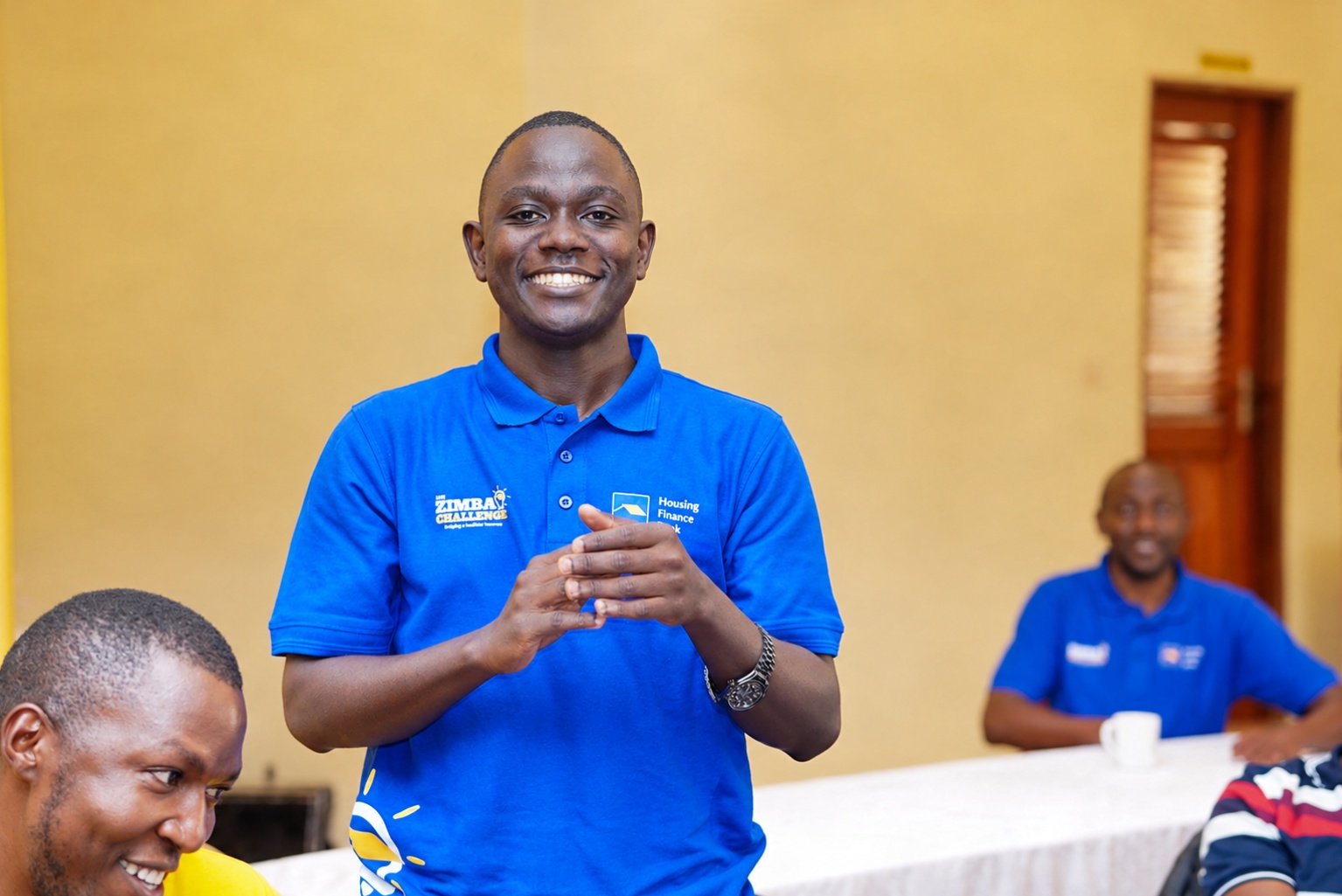
That is where the Housing Finance Bank Zimba Challenge comes in. Having developed and refined CoolBricks through academic research and early pilot projects, Leslie sees the challenge as an opportunity to test the innovation against the practical demands of housing delivery, including affordability, adoption and the ability to scale.
The project targets reductions of up to 50 per cent in construction costs and up to 90 per cent in carbon emissions. These are ambitious targets whose significance will depend on how the technology performs in practical applications and how the results compare with conventional construction methods.
Achieving them requires a careful balance. A building material may be inexpensive to produce, but that advantage means little if it cannot deliver the strength and durability required for safe, permanent homes. Leslie’s work has therefore involved testing different soil compositions and biopolymer formulations, supported by collaboration involving Makerere University and Delft University of Technology in the Netherlands.
The experience has reinforced his belief that innovation must be judged by what it can deliver in practice, not simply by the promise of an idea.
“Ideas alone are not enough. Execution is everything. A solution only matters if it can survive contact with reality, cost constraints, material limits, and human behavior included,” Leslie says.
That principle is central to CoolBricks, whose ambition extends beyond the production of building materials. The project envisages decentralised production hubs that could bring brick manufacturing closer to communities and construction sites, while creating opportunities for local enterprises, youth employment and practical skills development.
The model could also connect agriculture to construction in a new way. By creating potential markets for agricultural by-products, it offers a route through which materials that might otherwise go unused could acquire economic value. Farmers, producers, builders and local communities could all have a role in the wider supply chain.
For this vision to become commercially viable, however, CoolBricks must demonstrate that its materials can be produced consistently, supplied reliably and adopted by the construction industry. The technology must also meet applicable building requirements and earn the confidence of the people expected to use it.
There is a further consideration: reducing the cost of construction does not automatically make homeownership affordable. Households still need financing arrangements that reflect their incomes and ability to pay.
Leslie sees potential in models such as rent-to-own arrangements, potentially developed in partnership with institutions such as Housing Finance Bank. Such approaches could complement lower-cost construction by giving eligible households a more manageable route towards owning a home. Their effectiveness would depend on the terms of the financing, the cost of the completed homes and the financial circumstances of prospective homeowners.
This is what makes the CoolBricks proposition broader than a materials innovation. It explores how local resources, construction methods, skills development and appropriate financing could work together to address different barriers to homeownership.
Leslie’s approach to innovation is also shaped by interests beyond his technical work. He reads the Bible and plays chess, pursuits that reflect his appreciation for perspective, patience and strategic thinking. These qualities are relevant to a process that requires experimentation, collaboration and a willingness to refine an idea when the evidence demands it.
His advice to aspiring innovators is straightforward: start with a real problem, understand the people experiencing it and develop a solution that can work where it is needed most.
For CoolBricks, the next test is whether its promise can translate into a reliable and commercially sustainable construction system. If successful, the innovation could contribute to lower-cost building, new opportunities for local enterprise and a more sustainable use of Uganda’s resources.
The larger question is whether Uganda can turn locally available materials into a practical advantage in addressing its housing needs. Leslie is working to show that it is possible, one carefully tested brick at a time.