


KAMPALA, Uganda (UGNEWSLINE)— The government has called on creatives in Uganda to treat the creative industry as a strategic economic sector capable of generating employment, creating wealth and providing sustainable livelihoods for young people.
The Commissioner for Culture and Family Affairs at the Ministry of Gender, Labour and Social Development, Mr. Bernard Bakaye Lubega, says the government is developing a national strategy to harness the economic potential of the creative industry.
He says the sector should be viewed in the same way as agriculture, manufacturing and tourism, noting that creativity can be transformed into businesses, cultural products and services that generate income.
He called for increased government investment in infrastructure, financing and policies that support the growth of creative enterprises.
“We must look at it strategically as an economic sector where government must invest broadly in infrastructure and financing to enable the sector to grow.”
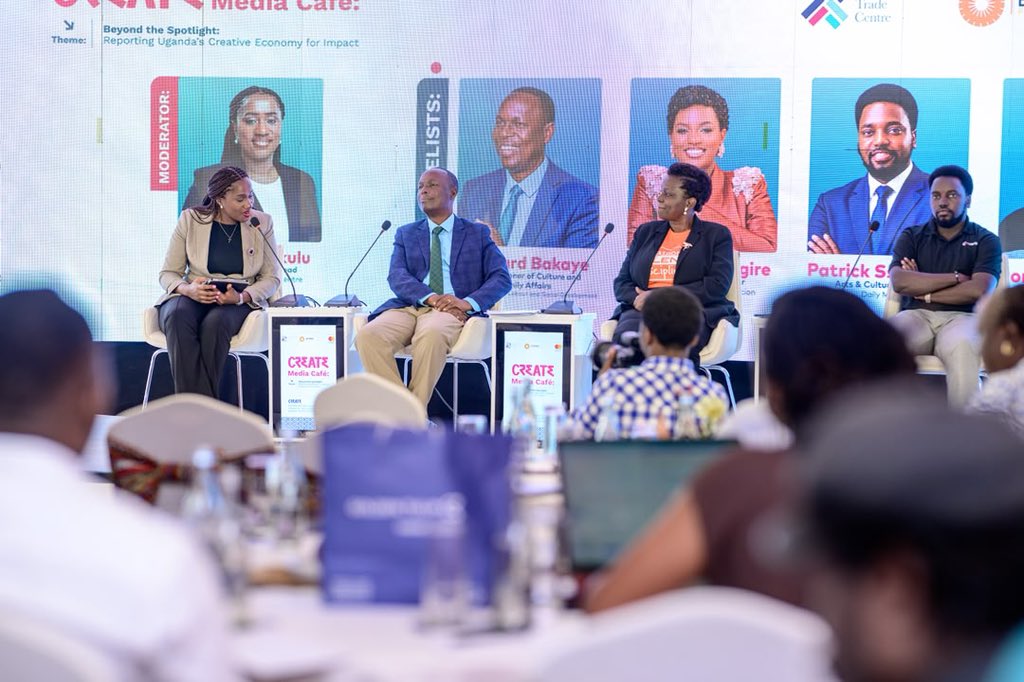
The commissioner made the remarks during an engagement that brought together creative industry stakeholders, media practitioners and government officials to discuss strategies and opportunities for developing Uganda’s creative economy.
He said the draft National Strategy for the Creative Industry is intended to provide a coordinated framework to guide stakeholders and address fragmentation within the sector.
He observed that many creatives operate without proper management structures, with some musicians handling everything from management to revenue collection, a situation he said limits professionalism and business growth.
The Commissioner also revealed that the government has committed approximately 28 billion shillings to the creative sector since last year, with part of the funding intended to provide creatives with access to soft loans through savings and credit cooperative organisations, commonly known as SACCOs.
However, he cautioned creatives against treating government funding as handouts, urging them to use the financing to establish and expand sustainable businesses.
Lubega emphasised that the government’s role should include creating a favourable operating environment through appropriate policies, laws, tax measures and access to financing, allowing private-sector players to thrive.
“Government has the will, and I think we are going to strengthen the financing of creative businesses. But we must do business.”
Lubega further encouraged creatives to establish professional management teams to improve their relationships with the media, saying organised communication structures would help promote their work and manage public engagement.
The meeting was organised under the CREAT programme, a three-year initiative led by the International Trade Centre (ITC) in partnership with Bayimba Foundation and the Mastercard Foundation under its Young Africa Works strategy.
The programme seeks to equip young women in the creative economy with market-relevant skills, business development support and access to inclusive finance to help them secure dignified and fulfilling work.
CREAT targets 84,000 young women
In her opening remarks, Deborah Asikiet, Project Manager at the International Trade Centre, said the programme aims to reach 84,000 young women in the creative industry over three years, with at least 40,000 expected to access dignified and fulfilling employment.
She said the initiative also targets to train at least 76,000 women in market-relevant skills, focusing on creative subsectors including fashion and textiles, crafts, audiovisual production, digital media, performing arts and theatre.
The programme is being implemented in 13 districts covering both urban and rural communities, including Kampala, Jinja, Mbarara, Buikwe, Mukono, Kayunga, Arua, Kitgum, Moroto, Butaleja, Mbale, Bundibugyo and Fort Portal.
Asikiet said CREAT was designed to address barriers that have historically limited young women’s participation in the creative economy, including inadequate access to finance, fragmented policies, limited market opportunities, weak intellectual property protection and the informal nature of many creative businesses.
“The overall goal is to turn creative talent into dignified and fulfilling work through market-relevant skills, business support, market linkages and inclusive finance,” she said.
She emphasised that securing employment alone was not enough, noting that decent work should also provide satisfaction, respect and opportunities for individuals to earn a sustainable income.
Programme records progress in first year
Asikiet reported that CREAT had made progress during its first year, reaching 5,521 young people through work-enabling outreach initiatives, while 699 had accessed work opportunities.
She added that 61 creative enterprises had received support to grow and formalise their operations.
The programme has also developed a draft National Creative Industries Strategy, which has been submitted to the government to guide support, financing and regulation of the sector.
According to Asikiet, the strategy is intended to provide a framework for addressing the challenges faced by creative businesses and strengthening the industry’s long-term development.
She explained that the initiative goes beyond training, incorporating entrepreneurship development, market access and financial support to help creatives transform their talents into sustainable businesses.
“Skilling alone is not sufficient. You can train someone to make a beautiful dress, but the next question is how they get it to the market and reach customers who can afford it,” she said.
The programme is also preparing to introduce financing opportunities, including grants for 750 businesses and concessional financing for 1,900 businesses. It further plans to strengthen financial institutions’ understanding of the creative economy to improve access to appropriate financial services.
Inclusion and safety remain priorities
Asikiet said the programme places particular emphasis on safeguarding, accessibility and inclusion to ensure young women can participate in the creative industry without facing unnecessary risks or discrimination.
She noted that young women, persons with disabilities and refugees often encounter additional barriers when seeking training, employment and business opportunities.
The initiative therefore requires partners to promote safe working environments, assess the accessibility of venues, provide sign-language interpretation where needed and consider support such as childcare to enable more women to participate.
Asikiet said the programme also seeks to promote responsible media coverage of young women in the creative industry, urging journalists to obtain informed consent before publishing photographs, videos or personal accounts.
She cautioned against exposing participants to risks by disclosing sensitive personal information or reporting stories without respecting their choices and privacy.
She also called for responsible reporting on children, refugees, persons with disabilities and survivors of abuse, emphasising the need for respectful language and protection from potential harm.
Mariam Ndagire calls for stronger support for creatives
Mariam Ndagire, a prominent figure in Uganda’s creative industry and a representative of the Mariam Ndagire Foundation, was among the stakeholders associated with the programme’s implementation.
The foundation is part of the wider network of partners working to expand opportunities for young creatives through skills development and other forms of industry support.
The engagement provided a platform for stakeholders to examine how government institutions, the media, training providers and creative organisations can work together to address barriers to growth and improve opportunities for young women.
The discussions also highlighted the importance of connecting creative talent to markets, strengthening business skills and ensuring that creatives can access financing to grow their enterprises.
Media urged to tell responsible stories
Asikiet identified the media as a key partner in raising awareness about opportunities in the creative economy and showcasing young women as skilled workers, entrepreneurs and professionals.
She urged journalists to move beyond portraying creatives solely as entertainers and instead highlight the economic value of their work, business achievements and contribution to employment.
She also stressed that media coverage should protect the dignity and safety of participants, particularly when stories involve children, vulnerable groups or people working in sensitive circumstances.
The engagement comes as stakeholders seek to strengthen the structures supporting Uganda’s creative economy, which encompasses a wide range of activities, from fashion and crafts to digital content, film, music, theatre and other performing arts.
Through CREAT, the implementing partners aim to build a more inclusive creative ecosystem in which young women can develop their skills, access markets and finance, and turn their talents into sustainable livelihoods.
The programme is being implemented as a three-year pilot, with its results expected to inform future decisions on expanding support for the creative sector.