


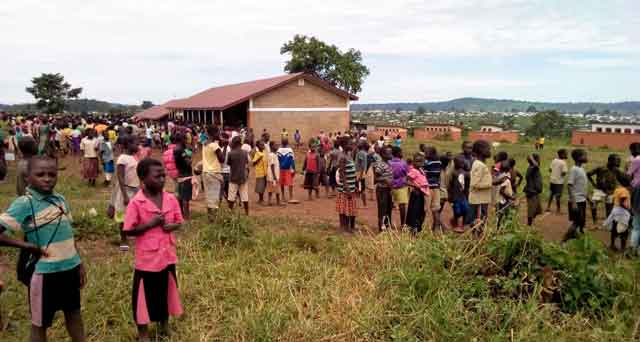
HOIMA, Uganda (UGNEWSLINE) – Children living in Kyangwali Refugee Settlement in Kikuube District are carrying deep psychological scars from conflicts in their countries of origin, with an art-based mental health assessment revealing drawings of guns, dead people and coffins among some learners.
The findings are contained in an art-based mental health and psychosocial support survey conducted by Faces Up Uganda in November 2025 involving 506 children and adolescents in four primary schools.
The assessment used art and creative expression to help children communicate their emotions, fears, experiences and concerns, particularly where they may find it difficult to express them verbally.
The findings were presented during the national stakeholders’ consultation on first aid, mental health and psychosocial support for children in Kyangwali Refugee Settlement, held on October 1, 2026, at Golden Castle Hotel in Hoima.
The consultation was organized by Community Integrated Development Initiatives (CIDI) under its three-year Kids for Kids project, which started in November 2025 with support from Danish People’s Aid.
CIDI Project Lead Inviola Nambi said the artwork provided an important insight into the experiences and fears of refugee children, including trauma associated with conflicts they witnessed before arriving in Uganda.
She said some learners produced drawings depicting guns and other forms of ammunition, while others drew coffins and dead people.
According to Nambi, the drawings suggest that some children continue to think about experiences associated with violence and conflict in their countries of origin.
She said the assessment also found that some children fear losing their parents or have already experienced the loss of parents as a result of conflict.
“Children drawing coffins, children drawing dead people” were among the images observed during the assessment, Nambi said, adding that some artworks also reflected disturbing ideas about violence.
She cited one piece of artwork in which a child expressed the thought: “If I killed him, they’ll never know.”
Nambi said the findings demonstrate the need for stakeholders to understand what children are experiencing and strengthen mental health and psychosocial support services within refugee settlements and host communities.
Hunger also affecting children’s mental health
The assessment also highlighted hunger and lack of school meals as major challenges affecting learners.
Nambi said many children in the refugee settlement attend school without a meal, affecting their concentration in class and potentially worsening their mental well-being.
She called for stronger collaboration among education, health and other stakeholders to address school feeding, saying children need access to food to concentrate on learning and participate meaningfully in school activities.
The consultation also heard concerns about the mental health of teachers, who face pressure arising from inadequate resources, contractual uncertainty and challenges within schools.
Nambi said some teachers were becoming distressed as they struggled to cope with the challenges affecting learners while dealing with their own difficulties.
She proposed that schools establish a dedicated mental health hour at least once a week, giving learners an opportunity to interact, discuss issues affecting them and participate in activities that help them express themselves and build resilience.
Project reaches more than 3,000 learners
Nambi said the Kids for Kids project is currently targeting learners in seven schools in Kyangwali, including six refugee schools and one host-community school.
The approach is intended to promote peaceful coexistence and integration between refugee and host-community children while creating a common understanding of mental health and first aid.
So far, she said, the project has reached more than 3,000 learners, including children in and out of school, as well as community champions.
The community structures include local leaders, Village Health Teams, head teachers and senior women and senior men teachers.
The project has also established peer learning groups in schools, where children are trained to support one another in first aid and psychosocial support.
Nambi said the programme uses methods that children can easily understand, including drama, art therapy and peer-to-peer learning.
Teachers use skills to support injured learners
Biira Eve, a senior woman teacher at Kavule Primary School in Kyangwali Refugee Settlement, said the programme has already helped children respond to emergencies.
She gave an example of a learner who sustained serious injuries while playing at school.
Children who had been trained under the programme moved the injured learner away from the scene and provided initial support before notifying teachers, who later organised further medical assistance.
Eve said the training has also strengthened teachers’ ability to provide guidance, counselling and psychosocial support to fellow teachers and learners.
However, she said schools continue to face challenges, including inadequate first aid kits and limited time for learners to participate in peer-support activities alongside their normal classwork.
She also noted that some teachers, particularly those employed on contracts, experience stress because of uncertainty surrounding the duration of their employment.
Eve said refugee children face additional challenges, including hunger, lack of scholastic materials and social exclusion, which can affect their ability to concentrate and participate fully in school.
District calls for coordinated response
Kikuube District Education Officer,
Deogratias Byakagaba said the growing number of refugees in Kyangwali has brought additional challenges affecting learners, teachers and the wider community.
He said some children have experienced severe trauma and may react with fear to situations that other people may consider ordinary.
Byakagaba cited an incident in which learners reportedly became frightened after seeing a vehicle at school because they associated it with an immunisation exercise they had heard about.
He said the reaction demonstrated the level of fear and anxiety that some children may carry.
Byakagaba said schools need stronger guidance and counselling services, referral systems and support for both learners and teachers.
He called for a multisectoral response involving education, health, community development, local leaders and agricultural officers, particularly in addressing hunger and other social factors affecting children.
He said the district was committed to supporting interventions aimed at improving the mental well-being of learners and communities.
Parliamentary Forum calls for stronger support
The Uganda Parliamentary Forum on Mental Health also called for stronger mental health and psychosocial support systems for children living in refugee settlements and host communities.
The call was made on behalf of Forum Chairperson and Terego Woman MP Rose Obiga by Fred Kyagera, Assistant Coordinator of the Forum, during the consultation.
Kyagera said children in refugee settlements require coordinated, child-centred services that focus not only on responding to mental health challenges after they occur, but also on prevention, early identification, resilience and access to appropriate support.
He called for stronger collaboration between government, Parliament, humanitarian organisations, health and education institutions, local governments and communities.
The Forum welcomed the work being undertaken by CIDI, with support from Danish People’s Aid, to strengthen resilience, first aid and psychosocial support among children in schools and communities.
Kyagera said the findings from the mental health assessment, together with the children’s artwork and creative expressions, provide important evidence that should inform interventions.
He also called for stronger referral systems linking schools, communities, health facilities, child protection structures and humanitarian organisations so that children experiencing emotional distress or protection concerns can receive timely support.
OPM commits to integrating mental health
The consultation also called for mental health and first aid to be incorporated into programmes implemented in refugee settlements rather than being treated as separate interventions.
The stakeholders said continued collaboration between the Office of the Prime Minister, Ministry of Health, Ministry of Education and Sports, Ministry of Gender, Labour and Social Development, Parliament, UNHCR, Uganda Red Cross Society, local governments, refugee leaders, schools and communities would be critical to strengthening support for children.