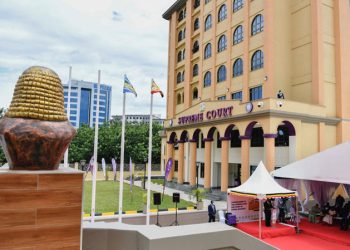



COURT (UGNEWSLINE) – The Constitutional Court has declared two provisions of Uganda’s Penal Code Act discriminatory and unconstitutional for protecting only women and girls,from indecent assault and acts insulting their modesty.
The court also declared unconstitutional parts of the Magistrates Courts Act that allowed the same magistrate to prepare charges and preside over a private prosecution.
In a unanimous judgment delivered on November 4, 2026, a five-justice panel led by Justice Cheborion Barishaki ruled that Section 115(1) and (3) of the Penal Code Act and Section 42 of the Magistrates Courts Act are inconsistent with the 1995 Constitution.
The ruling arose from consolidated Constitutional Petitions No. 003 and 008 of 2025, filed by Kalali Steven, Kirya Martins and Aboneka Michael against the Attorney General.
Other members of the panel were Justices B. Kihika, M. Tibulya, C.K. Sabiiti and M. Ssekaana, who all concurred with the lead judgment.
In challenging Section 115 of the Penal Code, advocate Kalali argued that the law, which criminalises indecent assault and insulting the modesty of a woman or girl, discriminates against men by failing to provide them with similar protection.
Under the provision, indecent assault attracts a maximum sentence of 14 years in prison, while insulting the modesty of a woman or girl carries a one-year prison sentence.
The court agreed with the petitioner, finding that limiting the protection to women and girls violates the constitutional guarantees of equality and non-discrimination.
It consequently ordered that the words “any woman or girl” wherever they appear in Section 115 be replaced with “any person”.
The court also directed the Attorney General to introduce a Bill in Parliament within 12 months to amend the provision and extend its protection to everyone regardless of gender.
The proposed amendment should also clearly define the conduct prohibited under subsection (3) to comply with the constitutional requirement that criminal offences must be clearly defined.
On the Magistrates Courts Act, the petitioners challenged provisions governing private prosecutions, arguing that they gave one magistrate powers to investigate a complaint, determine whether a case had been established, prepare charges and subsequently hear the same case.
They argued that this arrangement compromised the independence and impartiality of the court and violated the constitutional right to a fair hearing.
However, the Attorney General, through State Attorney Raymond Nganzi, defended the procedure, arguing that the magistrate’s initial involvement was only meant to establish territorial jurisdiction and whether a complaint disclosed a prima facie case.
Nganzi maintained that investigations remained the responsibility of the police and that the accused person’s rights to be presumed innocent and to legal representation were protected.
The Constitutional Court rejected the government’s arguments, ruling that the procedure created a conflict by allowing the same judicial officer to participate in initiating a prosecution and later determine the accused person’s guilt or innocence.
The court declared Sections 42(1)(c), (2), (3), (4), (5) and (6) of the Magistrates Courts Act unconstitutional to the extent that they allowed the same magistrate who consults local leaders and determines whether a prima facie case exists to prepare the charge sheet and preside over the subsequent trial.
To address the situation pending Parliament’s amendment of the law, the court ordered that a formal charge in a private prosecution should instead be prepared by the complainant or their lawyer, or referred to the Director of Public Prosecutions for consideration.
The magistrate receiving the complaint will retain the responsibility of assessing whether the court has jurisdiction and whether the complaint discloses a prima facie case.