


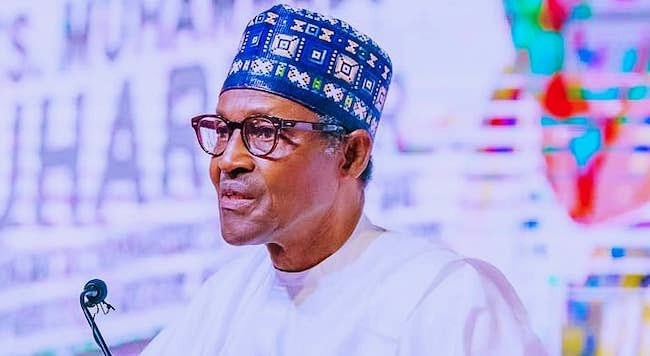
Muhammadu Buhari, the austere general who once seized power in a coup and decades later returned to lead Nigeria as an elected president, died Saturday in London after a prolonged illness. He was 82.
The announcement came Sunday from the office of President Bola Tinubu, who described his predecessor as “a man of deep conviction” whose life “was defined by service, discipline, and resolve.”
Buhari passed away around 4:30 p.m. local time, according to the statement shared on the social media platform X.
Buhari’s death marks the end of an era for Nigeria, a country whose post-independence history is inseparable from the man who came to symbolize both the promises and pitfalls of its leadership.
Born on December 17, 1942, in Daura, a quiet town in northern Nigeria’s Katsina State, Muhammadu Buhari grew up steeped in Islamic tradition and rural simplicity.
He was the 23rd child in a large Fulani family. His father, a local chief, died when Buhari was just four. Raised by his mother and later by a relative of the former Emir of Katsina, Buhari developed a sense of personal discipline that would define his life.
His education began in Qur’anic school and continued in Katsina’s elite institutions, where he stood out as head boy and house captain.
Though initially drawn to medicine, he was steered toward the military by his influential cousin, Mamman Daura.
At 19, Buhari entered the Nigerian Military Training College, then continued his officer training at Mons Officer Cadet School in England. When he returned to Nigeria as a second lieutenant in 1963, he stepped into a country on the brink of internal strife.
During the Nigerian Civil War (1967–1970), Buhari served with distinction under the 1st Division, fighting in some of the conflict’s most intense theatres.
His battalion advanced toward the Biafran capital of Enugu and later pushed through the embattled Abagana-Onitsha axis. The war tested Buhari’s resolve and left him with a hardened military worldview.
By the early 1980s, he had risen through the ranks to become a major general. Then, on December 31, 1983, amid growing public frustration over corruption and economic mismanagement, Buhari led a coup that ousted the democratically elected government.
As Nigeria’s military ruler from 1983 to 1985, he governed with an iron fist, jailing politicians, silencing dissent, and imposing strict economic controls.
Supporters praised his war on corruption and discipline; critics condemned his authoritarianism. In August 1985, Buhari was overthrown by his own chief of army staff, General Ibrahim Babangida.
For nearly two decades, Buhari remained a peripheral figure, resurfacing only occasionally in political debates. But in 2003, he launched a presidential bid as a civilian, branding himself a reformer. He lost that year, and again in 2007 and 2011.
Then, in 2015, history turned. Riding a wave of public discontent and backed by the newly formed All Progressives Congress (APC), Buhari defeated incumbent Goodluck Jonathan.
It was the first time in Nigeria’s history that a sitting president was unseated at the ballot box.
The election was hailed globally as a milestone for African democracy.
“I belong to everybody and I belong to nobody,” Buhari declared in his inaugural speech, a signal of his intention to govern above political interests. But that posture would soon be tested.
Buhari took office in the shadow of Boko Haram’s deadly insurgency, which had decimated swaths of the northeast.
He promised to crush the extremists, fight corruption, and reboot the economy. Progress was mixed. Boko Haram splintered but persisted. New security threats emerged, from ISIL-linked factions in the northeast to bandit gangs and separatist groups elsewhere.
On the economic front, Buhari’s policies were criticized as inflexible. His insistence on defending the naira and managing foreign exchange rates created distortions, while his administration oversaw two recessions.
Oil sabotage in the Niger Delta, the COVID-19 pandemic, and global shocks battered the economy further. Nigeria, once Africa’s largest economy, fell to fourth place by the time Buhari left office in 2023.
Yet, his political base, especially in the north, remained fiercely loyal. His austere lifestyle, firm rhetoric, and perceived incorruptibility continued to resonate with millions.
Buhari’s life traced the arc of Nigeria itself: from colonial-era birth to civil war soldier, military dictator to elected democrat.
He straddled a country caught between authoritarian pasts and democratic aspirations, between global ambitions and local struggles.
To some, he was a symbol of moral rectitude in a corrupt system; to others, a distant leader unable to deliver on grand promises.
Still, his role in reshaping Nigerian democracy is undeniable. In both military fatigues and flowing kaftans, Muhammadu Buhari left a legacy of paradox, an unyielding leader in a nation that often demands compromise.
He is survived by his wife, Aisha Buhari, and their children.