


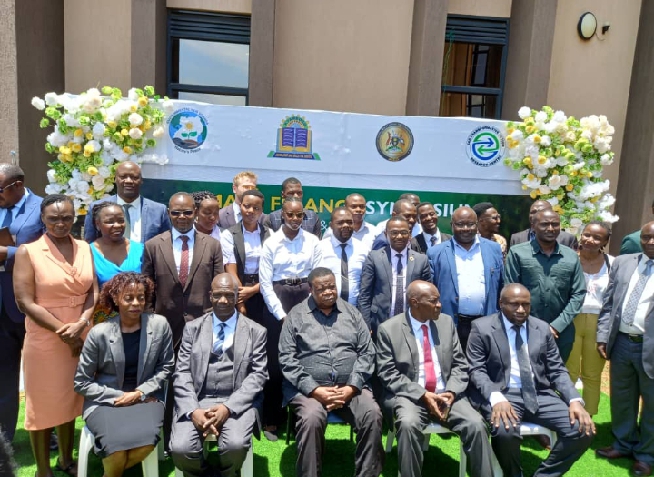
Kyambogo University has launched the Kyambogo University Climate Finance Catalyst Hub, positioning the institution as a new platform for mobilising climate finance, promoting environmental protection and equipping young people and women with the skills needed to participate in Uganda’s transition to a greener economy.
The hub was launched by the Minister of Water and Environment, Rtd Gen. Kahinda Otafire, during the official opening of the Climate Finance Symposium for Youth and Women at the university’s Central Teaching Facility auditorium.
The one-day symposium, held under the theme, “Unlocking Green Capital: Empowering Uganda’s Green Transition Through Innovation, Partnerships and Investment,” brought together government ministries, departments and agencies, policymakers, academics, researchers, university students, civil society organisations and the media.
At the centre of the discussions was a challenge that continues to confront Uganda and many developing countries: how to turn growing awareness of climate change into practical investments capable of protecting communities, creating jobs and strengthening economic resilience.
Launching the hub, Otafire called on stakeholders to intensify efforts to protect the environment from unnecessary destruction, saying climate action must be supported by access to affordable and appropriate financing.
He congratulated Kyambogo University for establishing the facility and urged its managers and partners to use it to sensitise communities and other stakeholders about the importance of environmental conservation while helping them access funding for activities that support sustainable development.
For Uganda, the need for such interventions is becoming increasingly urgent. Climate change is affecting agricultural production, water availability, livelihoods and infrastructure, while extreme weather events continue to expose communities to flooding, drought and other environmental stresses.
For young people and women, who form a significant part of the population dependent on natural resources and agriculture, limited access to finance can make it difficult to invest in climate-resilient enterprises and technologies.
Climate finance therefore goes beyond funding environmental projects. It can support renewable energy, climate-smart agriculture, water management, restoration of degraded ecosystems, waste management, green businesses and technologies designed to reduce greenhouse-gas emissions or help communities adapt to changing climatic conditions.
The establishment of the Kyambogo hub is expected to create a platform through which students, researchers, entrepreneurs and other stakeholders can better understand the climate-finance landscape, develop innovative projects and build partnerships capable of attracting investment.
Otafire used the occasion to revisit his long-standing interest in addressing water and food-security challenges, particularly in the Karamoja region.
He recalled that about 23 years ago, when he previously served as Minister of Environment, he had considered influencing policy and legislation to facilitate the channelling of water from some of Uganda’s major rivers towards Karamoja to address drought and transform the region into a major food-producing area.
He said the idea had generated discussions but was frustrated by people he did not name. Returning to the same cabinet portfolio, Otafire said he intended to pursue the proposal again, arguing that increased access to water could help address drought, agricultural challenges and food insecurity in the region.
He also raised concerns about pressures surrounding the management and use of Nile waters, warning that decisions on water releases and management should take into account their possible consequences for communities downstream.
Rather than focusing only on the interests of states that share the Nile waters, Otafire argued that Uganda should strengthen its capacity to manage its water resources and explore ways of using part of the available water to increase agricultural productivity in water-stressed regions such as Karamoja.
He questioned how a country endowed with major water bodies, including the Nile, could continue to experience hunger and loss of life associated with drought in some of its communities.
As the minister responsible for water and environment, Otafire said he would engage other members of government and stakeholders in efforts to address what he described as a long-standing challenge.
His remarks brought the climate-finance debate into the wider question of how Uganda can turn its natural resources into sustainable development opportunities while protecting them from degradation.
For the young people attending the symposium, the conversation also centred on the economic opportunities emerging from the climate crisis. As governments, financial institutions and development partners increasingly direct resources towards climate adaptation and mitigation, universities are being called upon to prepare a generation capable of developing bankable green projects and implementing them.
Kyambogo University Vice-Chancellor Prof. Eli Katunguka welcomed the establishment of the hub, saying it would create new opportunities for young people and contribute to job creation.
He said the initiative could help connect education, innovation and investment while enabling students and communities to participate more meaningfully in the emerging green economy.
The leader of the Kyambogo University Climate Finance Catalyst Hub, Dr Simon Peter Musinguzi, together with Environmental Hub Uganda team leader Rodrick Muhumure, thanked the government for supporting the initiative and encouraged young people to take advantage of the facility.
They said the hub should be used to foster economic development within the university and surrounding communities, particularly by helping young innovators turn environmental challenges into opportunities for enterprise and employment.
The organisers also acknowledged the contribution of development partners and institutions, including government ministries, departments and agencies, higher education institutions, Centenary Bank, Elevate Her, GAYO, Climate Action Network, AGHnet and Kyambogo University.
More than 300 participants, largely students of environmental sciences and related disciplines, attended the symposium, which featured discussions, a live debate and contributions from civil society organisations and other stakeholders.
The gathering underscored a growing recognition that Uganda’s climate response cannot depend solely on government programmes. Universities, financial institutions, civil society, private investors, development partners and communities all have a role to play in mobilising resources and turning climate commitments into projects with measurable social, environmental and economic benefits.
The Kyambogo hub now enters that space with a mandate that extends beyond the university campus: to help bridge the gap between climate ideas and climate investment, while giving young people and women a greater stake in the country’s green transition.
Its success, however, will ultimately depend on whether the knowledge, partnerships and financing opportunities generated through the hub can translate into practical interventions—from restoring degraded landscapes and improving water management to supporting climate-smart agriculture, renewable energy and green enterprises.
As Uganda confronts the combined pressures of climate change, food insecurity, environmental degradation and unemployment among its growing youth population, initiatives that bring finance, innovation and environmental action together could become an important part of the country’s response.