


According to media reports, Mauritanian artisanal fishermen are facing an increasingly bleak future 15 years after the country signed a major fishing agreement with China. The 25-year deal, inked in June 2010, opened Mauritania’s waters to industrial Chinese trawlers. Today, depleted fish stocks and a surge in fishmeal and fish oil factories have left local fishermen struggling to make ends meet.
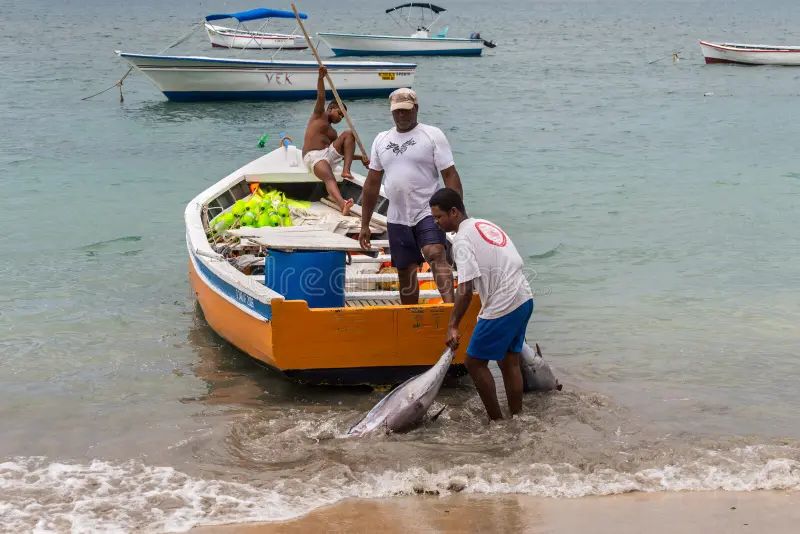
Ould Sidi, whose family has fished Mauritania’s coastal waters for generations, said artisanal fishers are now forced to travel much farther offshore to find fish, increasing both the cost and danger of their work.
“I was born into a family where fishing is the only income-generating activity we practice,” Sidi, a pseudonym, told Global Voices. “This activity has always supported us. But since our authorities signed this agreement with the Chinese, everything has gone to hell. We can spend days at sea and come back empty-handed. Octopus and yellow mullet, two species we used to catch regularly, have disappeared. It’s sad for our business.”
The Poly Hong Dong Pelagic Fishery deal, ratified in 2011, sparked immediate backlash. Fishermen protested fiercely, even throwing eggs at lawmakers who backed the agreement in Parliament. The deal exempted the Chinese company from import duties and faced criticism for lacking transparency and sufficient safeguards for marine resources. Opposition lawmakers boycotted the vote.
Reuters reported that Cheikhany Ould Amar, then head of Mauritania’s industrial fishing association, voiced concern at the time that the agreement failed to provide protections for already-overexploited deep-sea fish stocks. “The agreement gives no guarantee on controls,” Amar warned.
As part of the deal, Mauritania received a $100 million investment from China for the construction and operation of a new wharf and processing facility in Nouadhibou, the country’s economic hub. The resulting factories process hundreds of thousands of tons of fish annually into fishmeal and fish oil, products mostly destined for export and used in animal feed and aquaculture.
“My neighbors come to me and complain because they haven’t caught anything,” Sheikh Muhammed Salim Biram told southworld.net. “But what can I do against the government? They brought the Chinese into the country. They steal our fish and make meals for their pigs while our people don’t have enough to eat.”
The expansion of fishmeal factories has long faced opposition across West Africa. In The Gambia, for instance, protestors torched a Chinese-owned fishmeal plant over its environmental impact. These factories often leave surrounding areas so polluted that tourism and local economies suffer, while overfishing of key species worsens food insecurity.
Once primarily consumed locally, much of Mauritania’s fish is now exported. Nouadhibou alone processes around 550,000 tons of fish annually in fishmeal and fish oil plants. “There are 30 fishmeal factories in the city and another ten in southern Mauritania,” Aziz Boughourbal, managing director of Mauritanian Holding Pelagic, told southworld.net. “It is evident that there are too many; our neighbor Morocco, which has a coastline twice as long as ours, only has ten.”
According to analysts Jean Sovon and Vivian Wu, writing for Global Voices, China’s increasing grip on Mauritania’s fisheries has hindered local development. Unchecked illegal, unreported and unregulated (IUU) fishing—mostly by Chinese vessels—has endangered the livelihoods of roughly 300,000 people who depend directly or indirectly on the fishing sector. China currently ranks as the world’s worst offender in IUU fishing, according to the IUU Fishing Risk Index.
Civil society groups and international environmental organizations such as Greenpeace Africa have urged the Mauritanian government to protect its marine resources and the livelihoods of its fishermen.
“As long as the Chinese are present in this sector, Mauritanian fishing is at a dead end,” one local fisherman told Global Voices. “And the consequences will be very serious for the whole country if nothing is done. Today, with this agreement signed with China, Mauritanian fishermen are largely excluded and marginalized. What will become of us when this agreement ends? The authorities must reconsider their policies and recognize our role in the country’s socio-economic development.”