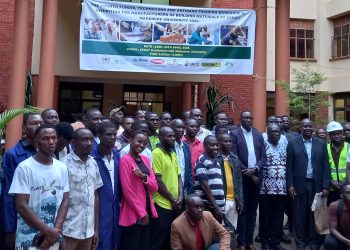




In a move to strengthen skills development, youth employability, and a workforce that is responsive to the needs of Uganda’s growing economy, the Ministry of Gender, Labour and Social Development (MGLSD) has inaugurated the Sector Apprenticeship Committees for Agriculture, Oil & Gas, Manufacturing and Construction as the key priority sectors. These committees will work through the National Apprenticeship Programme.
The inauguration ceremony was conducted at Golden Tulip Hotel in Kampala. The committees will be responsible for identifying sector-specific occupational standards, while reporting to National Apprenticeship Steering Committee (NASC) on the progress of implementation of apprenticeship training within their respective sectors.
The NAP is a flagship initiative, launched in 2018, to tackle the country’s youth unemployment crisis through quality apprenticeships and structured graduate volunteering as critical pathways for enhancing employability and labour productivity of the young labour force aged 16 to 35 years.
The programme is also a critical component of government’s strategy to address youth unemployment, strengthen skills development, and promote decent work. It directly contributes to Uganda’s long-term vision of expanding the economy from USD 53 billion to USD 500 billion by 2040, with apprenticeship programmes playing a pivotal role in building a skilled workforce for export-oriented industries.
During the inauguration ceremony of the committees today, Mr Aggrey David Kibenge, the Permanent Secretary for MGLSD, said the legal mandate for regulating apprenticeships is provided under Regulation 36 of the Employment Regulations, 2011, which empowers the MGLSD to establish and oversee apprenticeship schemes in line with National Employment Policies.
In his remarks delivered by Assistant Commissioner Labour Productivity, Hillary Businge, Kibenge said government approved the Uganda National Apprenticeship Framework (UNAF) of 2018, which provides a coherent structure for implementing and managing apprenticeships across sectors.
The Framework outlines the roles and responsibilities of all stakeholders, government, training institutions, employers, industry bodies, NASC and the Sectoral Apprenticeship Committees, among others.
“The Government of Uganda further recognizes that one of the major challenges facing our labour market is the mismatch between skills acquired through training and those demanded by employers,” said Kibenge. “Many young people complete training without sufficient workplace experience, making the transition into employment difficult, which on average is 31 months to obtain employment after graduation in a given academic field.”
He added that NAP was established to address this challenge by providing structured work-based learning opportunities that combine practical workplace experience with formal training.
Kibenge urged the committees to ensure apprenticeship training remains relevant, industry-driven, and aligned with occupational standards and labour market needs.
“As committee members, you will be expected to provide strategic guidance on sector priorities, support the identification of apprenticeship opportunities, advise on occupational standards and curricula, promote employer participation, and contribute to quality assurance mechanisms within the apprenticeship system,” he said.
Currently, 984 apprentices have successfully participated in apprenticeship training, with core training focus in high-demand trades in the hotel & tourism sector including Housekeeping, front office, food production, food & beverage service, and solar energy installation.
Furthermore, 784 graduates (79.6% placement rate) have transitioned directly into formal employment; whereas 242 Graduate Volunteers have been placed in 47 public and private institutions. Approximately 75% of those who have completed their one-year placement secured formal jobs during or immediately after their training.