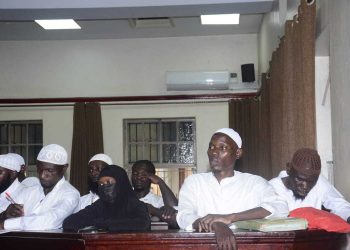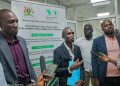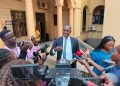



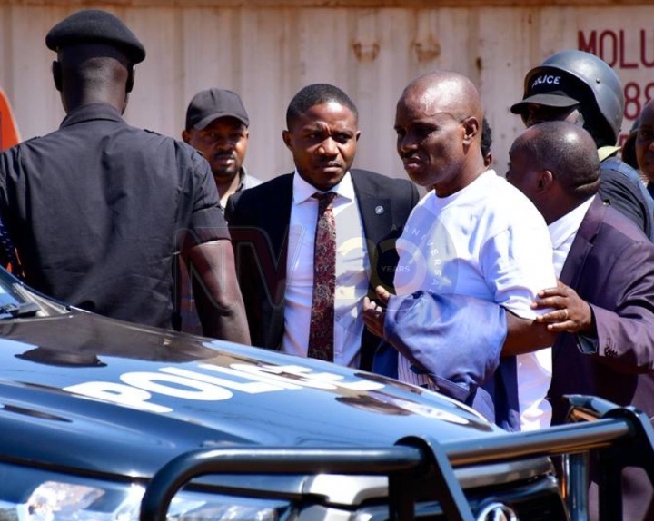
A high-profile legal and political confrontation is unfolding in Uganda after former Kampala Lord Mayor and opposition figure Erias Lukwago was produced before a magistrates’ court in Makindye on allegations of misprision of treason, escalating tensions in an already sensitive treason-related case involving opposition leader Kizza Besigye.
Lukwago, who also serves as President of the People’s Front for Freedom (PFF) is accused by the state of allegedly concealing knowledge of an intended act of treason without reporting it to authorities.
The charge places him at the center of a widening legal drama tied to Besigye’s ongoing prosecution for alleged conspiracy to overthrow the government alongside co-accused individuals facing claims of paramilitary involvement.
The court appearance comes in the aftermath of dramatic claims by Lukwago’s family and legal team, who argue that his detention followed what they describe as a forceful nighttime operation carried out by armed men allegedly dressed in military uniform. According to sworn statements filed before the High Court, the operatives reportedly stormed his home in Kampala’s Lubaga area in the early hours of June 15, 2026 forcibly took him without presenting a warrant, and transported him to an undisclosed location in a mini bus commonly referred to locally as a “drone.”
His wife maintains that neither family members nor lawyers were informed of his whereabouts for hours after the incident, intensifying fears over enforced disappearance.
She further alleges that security officials later circulated images of Lukwago in custody, which the family says depicted him in a weakened and distressed condition, raising concerns of possible humiliation and degrading treatment.
At the heart of the legal challenge is a habeas corpus application filed in the High Court, in which Lukwago’s lawyers are demanding that security agencies disclose his exact location and justify the legality of his detention.
The application names senior state officials, including the Chief of Defence Forces, the Inspector General of Police, and the Attorney General, as respondents.
The legal team argues that Lukwago, a civilian lawyer and former Member of Parliament, has been held without access to family, legal counsel, or medical care, in violation of constitutional protections requiring that any arrested person be presented before a court within 48 hours.
They also question the involvement of military personnel in what they describe as a civilian matter, raising broader concerns about the boundaries between security operations and civilian judicial process.
The family has further warned that Lukwago’s health may be at risk, citing ongoing recovery from a spinal surgery and a chronic gastritis condition that requires regulated medication and dietary care.
The case has quickly evolved into a wider debate over due process, the role of security agencies in political investigations, and the protection of constitutional rights in high-profile prosecutions.
As the court prepares to hear the habeas corpus application, the proceedings are expected to draw significant national and international attention given Lukwago’s political stature and the broader implications for Uganda’s legal and political landscape.