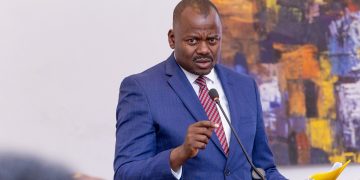



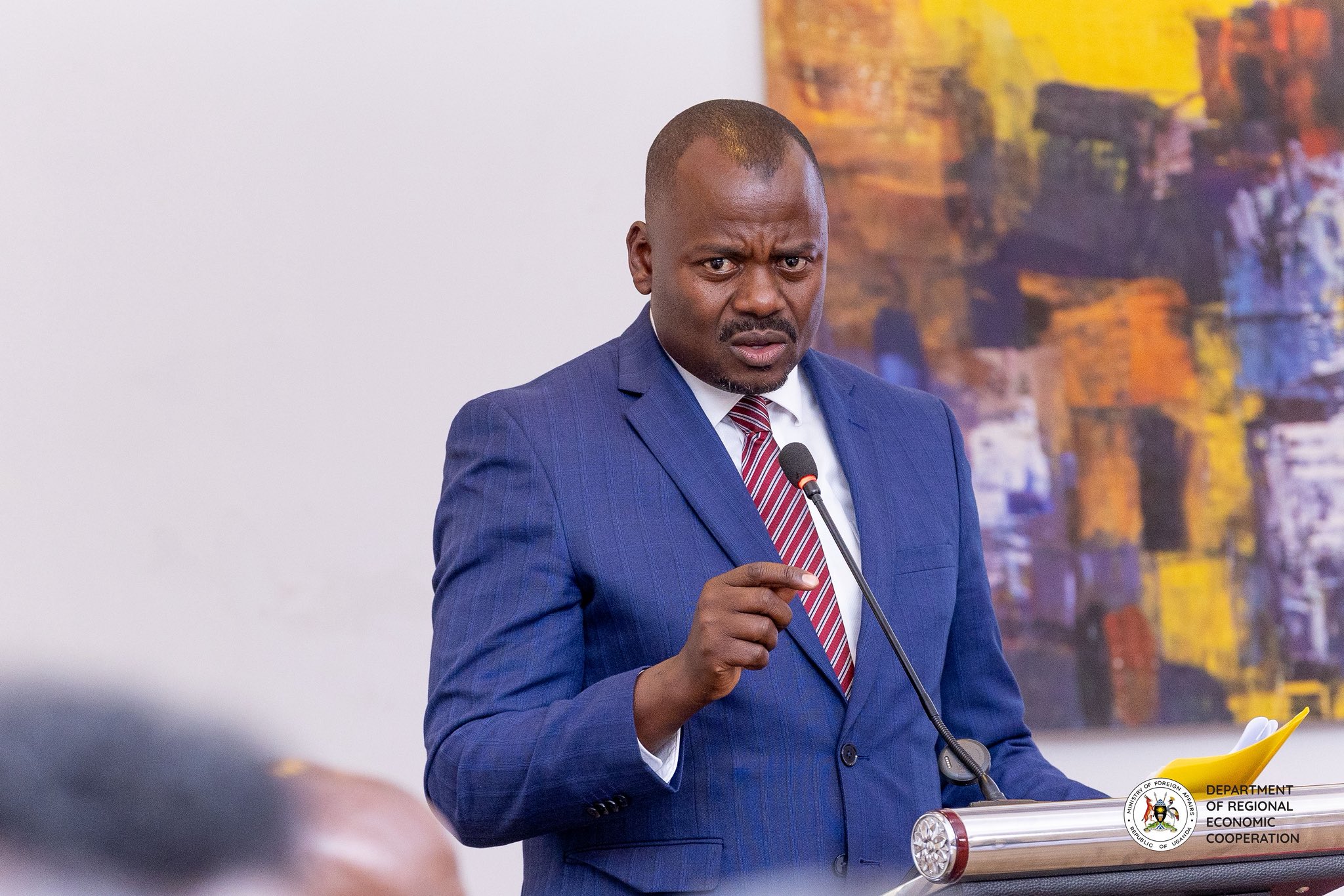
Acting Minister of Foreign Affairs Hajji Haruna Kasolo Kyeyune has issued a stern warning to accounting officers at Uganda’s missions abroad who undermine Heads of Mission, saying the practice must stop immediately.
Kasolo said some accounting officers have become “too powerful,” withholding financial information from ambassadors.
Speaking while closing the Ministry of Foreign Affairs’ three-day Economic and Commercial Diplomacy (ECD) retreat at Mestil Hotel in Kampala, Kasolo said reports reaching him indicate that some accounting officers receive funds, fail to share bank statements, and spend public money without adequately informing Heads of Mission.
“The Head of Mission is the overall representative of the President. Yes, the accounting officer is responsible for expenditure, but the Head of Mission chairs the finance committee. I have been informed that some accounting officers think they are bigger than the Heads of Mission. They receive money, don’t inform their supervisors, and even refuse to present bank statements. This must stop,” Kasolo said.
He revealed that he has scheduled a meeting with accounting officers next week and said the matter will also be discussed during the upcoming Ambassadors’ Conference, adding that President Yoweri Museveni has already been briefed about the irregularities.
“The Head of Mission does not need to be in the kitchen counting tomatoes, but as the head of the family, they must know how government money is being spent,” he said.
The minister also challenged Uganda’s diplomats to shift from traditional diplomacy to economic and commercial diplomacy by aggressively promoting Uganda’s exports and attracting investment.
“Our missions abroad are not simply Uganda’s political representatives; they are increasingly this country’s commercial frontline. If there is no business coming back home, then there is little value in what we are doing abroad,” he said.
Kasolo directed all missions to prioritize finding markets for Uganda’s key exports, including coffee, dairy products, fresh fruits, fish and other agricultural commodities.
He said the work of Uganda’s foreign missions is central to delivering the government’s wealth creation agenda under Vision 2040 and the Ten-Fold Growth Strategy.
The minister further linked Economic and Commercial Diplomacy to the Parish Development Model (PDM), saying the two programmes are complementary.
“PDM organizes production at the parish level while Economic and Commercial Diplomacy must find markets for those products abroad. It is our duty to ensure that what farmers produce gets access to international markets,” he said.
Kasolo cited his recent visit to the United Kingdom, where he found a small 10-kilogram box of Ugandan matooke selling for about £20, equivalent to nearly Shs100,000, compared to less than Shs10,000 for a full bunch in Uganda.
“This demonstrates the enormous export opportunities available if our missions actively identify buyers and investors,” he noted.
However, he cautioned that market access alone is not enough unless Uganda can consistently produce quality goods.
He directed the Ministry of Foreign Affairs to work closely with the Ministry of Agriculture, Ministry of Local Government and the PDM Secretariat to ensure export opportunities identified abroad are matched with reliable producer groups at home.
Kasolo also instructed diplomats to begin measuring their performance based on tangible outcomes such as export contracts secured, investments attracted and jobs created, rather than the number of meetings attended or VIPs received.
Addressing the same meeting, the Permanent Secretary and Secretary to the Treasury (PSST), Dr Ramathan Ggoobi, challenged Uganda’s Ambassadors and Heads of Missions abroad to move beyond ceremonial diaspora engagements and focus on highly organized, measurable economic operations.
“Economic diplomacy is no longer a polite supplement to political duties; it is the frontline of Uganda’s economic transformation,” Dr Ggoobi said.
Dr Ggoobi emphasized that diplomats must develop expertise in trade analytics, investment sourcing, and rapid-response investor aftercare. He noted that Uganda’s foreign policy now carries an explicit economic mandate, one measured by the value of investments secured, volumes and value of exports generated, numbers of tourists attracted, and foreign exchange receipts brought into the country.
He further stressed that Uganda’s Missions abroad must actively secure strategic partnerships capable of advancing the country’s ambition of building a US$500 billion economy.
On accountability, the PSST stated that budget prioritization for Missions abroad will increasingly be tied to verifiable performance and tangible economic results.
Earlier, Ambassador Richard Kabonero said the Regional Economic Cooperation Department plays a critical role in advancing Uganda’s economic and commercial diplomacy agenda.
He said the department coordinates Uganda’s participation in regional and continental integration frameworks, including the East African Community (EAC), COMESA, the African Continental Free Trade Area (AfCFTA) and the African Union, while supporting 16 regional missions across Africa.
Also speaking during the retreat, Permanent Secretary at the Ministry of Agriculture, Animal Industry and Fisheries, Maj. Gen. David Kasura Kyomukama, urged diplomats to promote value addition instead of exporting raw agricultural products.
He highlighted coffee, dairy, cocoa, vanilla, fish, horticulture and vegetable oils as key products with significant export potential.
Kasura noted that Uganda’s coffee exports are now worth about US$1.4 billion, while cocoa has become the country’s second-largest export by value, followed by fish.
He also encouraged Ugandans investing in coffee farming to carry out soil testing, confirm land suitability and ensure reliable water sources to sustain production, saying increased and consistent production is essential if Uganda is to meet growing international demand.