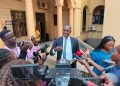




Justice sector stakeholders in the Mpigi High Court Circuit have called for stronger coordination, timely communication and shared responsibility to improve the administration and delivery of justice.
The call was made during a Regional Court Coordinating Committee (RCC) meeting at the Mpigi High Court premises to review the circuit’s performance, address challenges affecting the justice system and agree on measures to improve coordination among justice sector institutions.
The meeting was chaired by the Head of the Mpigi High Court Circuit, Justice Anthony Oyuko Ojok, who urged stakeholders to strengthen communication and work collectively to ensure cases are handled efficiently.
Justice Ojok, who was accompanied by the Circuit Deputy Registrar, Her Worship Goretti Arinaitwe, said effective coordination among justice sector institutions was essential to improving access to justice and service delivery across the circuit.
The meeting brought together judicial officers from across the circuit and representatives from the Office of the Director of Public Prosecutions (ODPP), Uganda Police Force, Uganda Prisons Service, Probation and Social Welfare, Community Service, Land Registration, State Brief Advocates, Resident District Commissioners, religious leaders and other stakeholders.
Stakeholders welcomed progress made in reducing the criminal case backlog and commended the efforts of judicial officers, State Attorneys and State Brief Advocates.
They, however, called for sustained cooperation and timely preparation of cases to maintain the progress and prevent new backlogs from emerging.
Particular attention was given to cause-list management, with stakeholders urging each institution to carefully review cause lists circulated by the court registry and identify, before hearing dates, any issues that could prevent cases from proceeding.
These include the availability of witnesses, investigating officers, prisoners, lawyers and case files.
Concerns over prisoners, files and exhibits
The meeting also examined challenges affecting the smooth handling of cases, including the late production of prisoners in court, prolonged remand, missing police files and exhibits, as well as delays in dealing with juvenile matters.
Relevant institutions agreed to strengthen coordination and communication to address the challenges and minimise unnecessary delays in the disposal of cases.
Stakeholders also called for increased public awareness of mediation, alternative dispute resolution and Community Service as mechanisms that can help resolve disputes and reduce pressure on the formal court system.
Religious and community leaders were encouraged to play a greater role in sensitising the public about these avenues of justice.
Infrastructure concerns
The meeting further highlighted infrastructure challenges at Gomba/Kanoni, including inadequate court and office space, unreliable electricity, limited parking and insufficient sanitary facilities.
Stakeholders said addressing the infrastructure gaps would improve the working environment for justice sector personnel and enhance service delivery to court users.
The meeting also recognised the Uganda Police Force for its support in maintaining security, including during the handling of election petitions.
The stakeholders resolved to maintain closer collaboration and regular communication as they work towards improving the efficiency, accessibility and timely delivery of justice within the Mpigi High Court Circuit.


From classroom curiosity to national spotlight: Namilyango’s science club builds momentum
At Namilyango College, science is increasingly moving beyond the walls of the classroom. For members of the school’s Science and...