

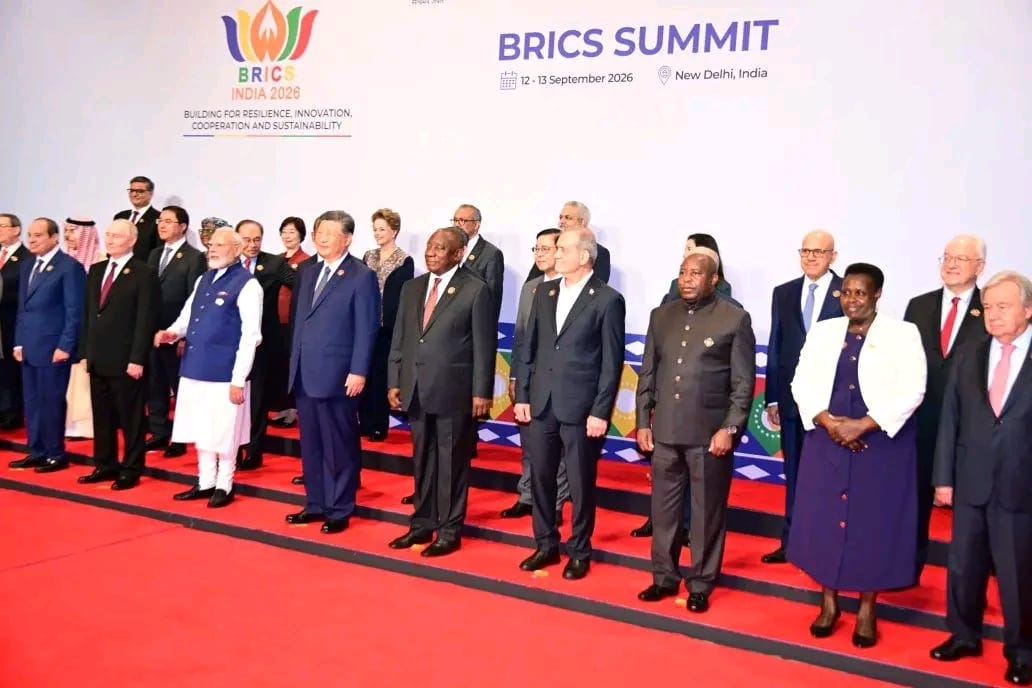
President Museveni has called on the BRICS bloc to consolidate solidarity and spearhead equitable global growth, describing the group as a vital counterweight to historical Western “chauvinism and parasitism.”
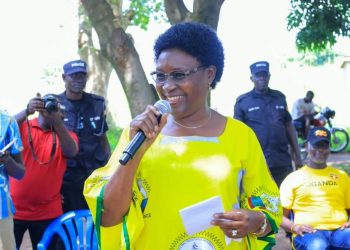
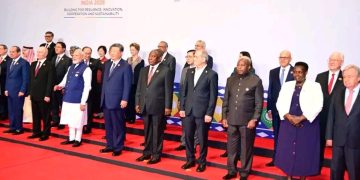
In a statement read on his behalf by Vice President Jessica Alupo at the 18th BRICS Summit in New Delhi, India, President Museveni highlighted the historic economic transformation of the Global South while contrasting it with centuries of Western exploitation.
Tracing global economic imbalances back to the 15th century, Mr Museveni noted that Western powers—spurred by the closure of trade routes following the fall of Constantinople in 1453—embarked on maritime expansion that ultimately led to the colonization of Africa, Asia, and the Americas.
“Unfortunately, the European victims of Turkish chauvinism and parasitism now became chauvinists and parasites themselves,” Mr Museveni said, adding that five centuries of development were lost to the slave trade and colonial domination.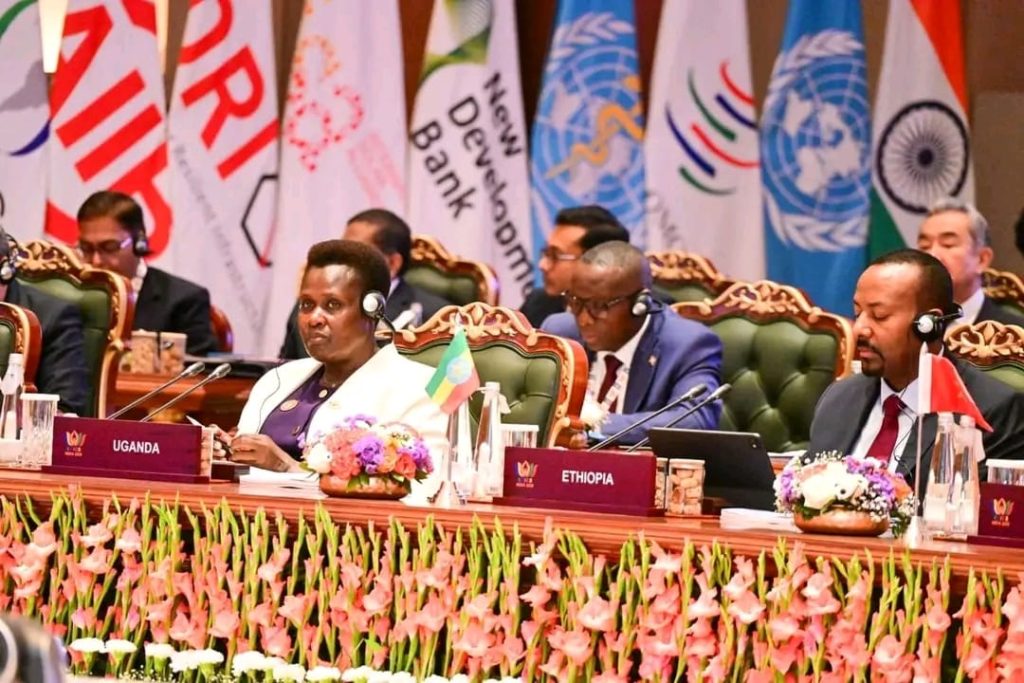 He noted that despite these historical setbacks, resilient traditional structures enabled Africans to survive colonial privations.
“Africans do not easily die,” he said, observing that indigenous farming practices and exposure to livestock had historically protected populations against many zoonotic diseases.
Turning to modern developments, the Ugandan leader who has been in power since 1986, pointed to the dramatic rise of emerging economies like China and India as proof that affluence spreads when global trade is allowed to thrive.
“Where actors have acted right, affluence has spread,” he said, citing China’s rise from a Gross Domestic Product (GDP) per capita of $89 in 1960 to $13,862 today, and India’s growth from $82 to $2,702 over the same period.
He argued that lifting nations out of poverty directly benefits developed nations through expanded international trade, adding that a wealthier Uganda would naturally purchase more industrial goods, such as aircraft, from the West.
While reiterating his commitment to Pan-African reconciliation, the 81-year-old President warned that recent Western interventions such as the 2011 NATO-led attack on Libya—demonstrate that some powers have “learnt nothing and forgotten nothing.”
“We must fight for global affluence and oppose chauvinism and parasitism. With global affluence, everybody will be a winner,” Mr Museveni urged, calling for mutual support among BRICS nations alongside principled reconciliation with global partners.
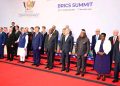
Opening the summit session under the theme “Resilience, Innovation, Cooperation and Sustainability: Shaping the Future for Inclusive Global Growth,” Indian Prime Minister Narendra Modi welcomed world leaders to New Delhi and called for deeper cooperation to navigate ongoing global disruptions.
“Today, the number of conflicts and tensions in the world is continuously increasing, having a negative impact on the lives of ordinary people,” PM Modi said, highlighting vulnerabilities exposed by recent pandemics, climate disasters, and supply-chain shocks.
To address these vulnerabilities, PM Modi announced key initiatives developed under India’s presidency, including a BRICS Integrated Early Warning System for infectious diseases, a Logistics Supply Chain Cooperation Framework, and a Startup Innovation Fund.
The Indian Prime Minister emphasized that the growing appeal of BRICS stems from its commitment to listening to and working alongside developing nations rather than imposing solutions from above.
“The Global South’s confidence in BRICS has grown because their voices are heard, their experiences are respected, and solutions are developed not for them, but together with them,” PM Modi said. “The strength of BRICS lies in our diversity and cooperation.”
Originally founded as BRIC (Brazil, Russia, India, and China) in 2006, the bloc expanded to include South Africa in 2011. The group has grown into an 11-member economic alliance comprising Brazil, China, Egypt, Ethiopia, India, Indonesia, Iran, Russia, Saudi Arabia, South Africa, and the United Arab Emirates.
Uganda currently maintains official partner status alongside nations such as Belarus, Bolivia, Cuba, Kazakhstan, Malaysia, Nigeria, Thailand, Uzbekistan, and Vietnam. The bloc aims to boost trade, financial cooperation, and geopolitical alignment among emerging markets to balance Western-led global institutions.