


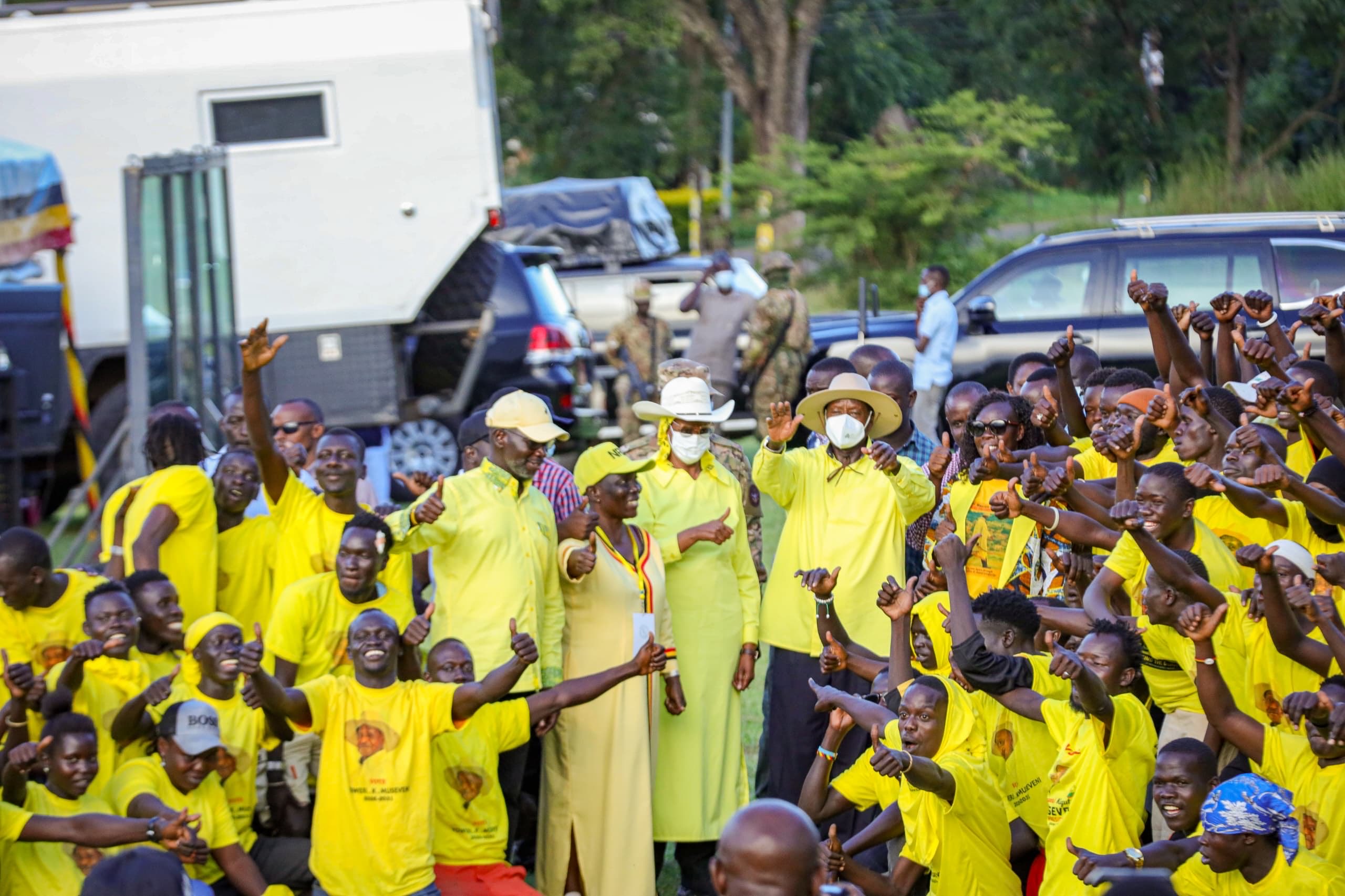
President Yoweri Museveni has unveiled a new set of targeted wealth creation initiatives aimed at eliminating what he calls “spectators” in Uganda’s income generation drive, as he continues to position himself for a seventh term in the 2026 general election.
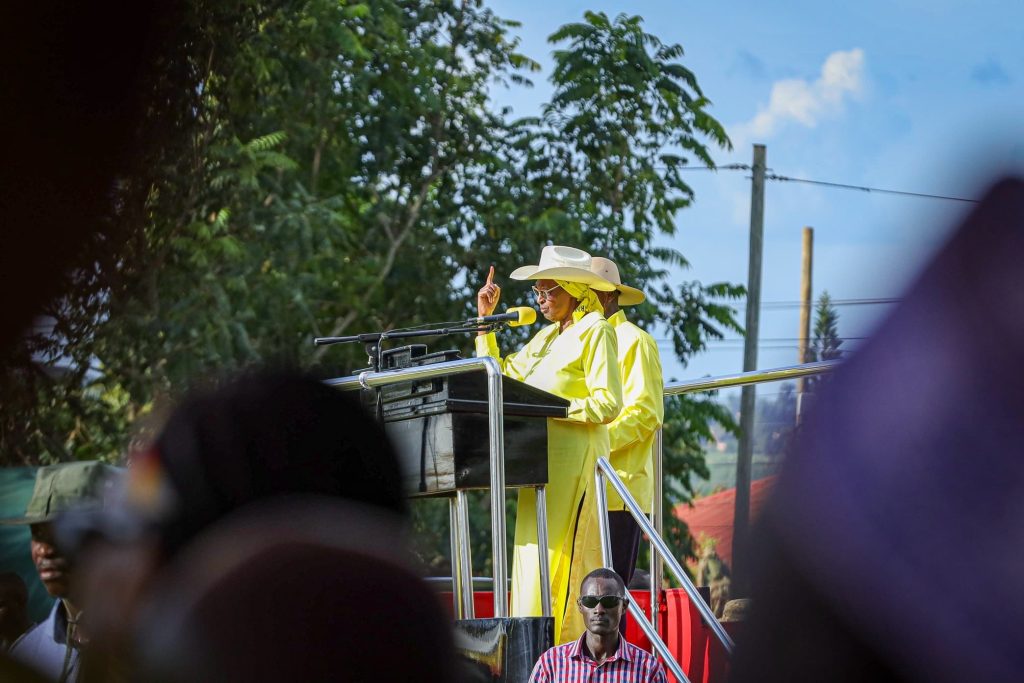
Speaking at a campaign rally at Ajai Stadium in Madi-Okollo District, West Nile sub region, the President promised to launch special funding schemes for unemployed university graduates, religious and cultural leaders, and fishing communities, groups he says must be transformed from passive observers into active players in Uganda’s economic journey.
“These groups must not remain spectators. In wealth creation, everyone must be a player,” Museveni said, stressing his vision to grow Uganda’s economy from its current $50 billion (about shs175 trillion) to $500 billion (about shs1.75 quadrillion) over the next 15 years.
Among the proposed initiatives is a new fund targeting university graduates who have spent more than two years without formal employment.
He stressed that many of the young people graduate, but few find decent jobs, stressing that if elected come 2026, his government must create avenues for them to generate income and build wealth.
According to the Uganda Bureau of Statistics (UBOS), data from the 2024 National Population and Housing Census shows that graduate unemployment stands at 15.2%, with the overall national unemployment rate at 12.3%. Alarmingly, over half (50.9%) of Ugandans aged 18 to 30 are not in employment, education, or training, a demographic Museveni insists must be absorbed into the money economy.
The President’s proposal reflects his longstanding economic message of wealth creation. He stressed that Uganda’s transformation lies in shifting the population from subsistence to commercial production and financial independence.
Museveni also announced plans to establish Savings and Credit Cooperative Societies (SACCOS) tailored specifically for religious leaders, encompassing both Christian and Muslim clergy.
He clarified that the government cannot create separate SACCOS for every denomination.
Similarly, he also pledged to inject funds directly into parish-level SACCOS for fishing communities, with each receiving shs1 million under the Parish Development Model (PDM), a national program designed to lift Ugandans out of poverty by supporting grassroots enterprises.
He noted that development like roads, hospitals, and schools, is for everyone, but wealth is personal, generated at family or individual level.
He said, that every household must be part of the money economy.
Cultural leaders are also slated to benefit from these SACCOS, with Museveni drawing a metaphor from sports to emphasize participation: “In football, there are players and spectators. But in wealth creation, there must be no spectators.”
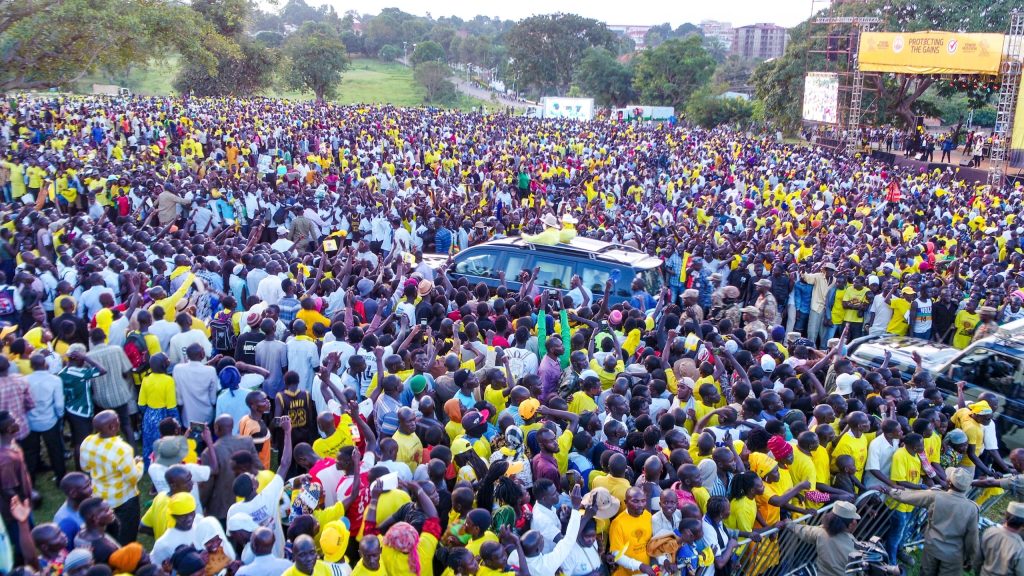
Museveni, who was accompanied by First Lady and Minister of Education and Sports, Janet Kataaha Museveni, later travelled to Arua City for another rally which drew thousands of enthusiastic supporters.
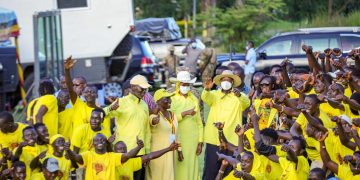
The event was marked by music, dancing, and a vibrant display of yellow, the signature color of the ruling NRM party.
Earlier on, a brass band led a celebratory walk through the city, followed by a convoy of vehicles plastered with Museveni’s campaign posters. Supporters, including youth, women, and elderly citizens, lined the streets in yellow T-shirts, waving flags and singing along to campaign songs booming from a yellow-painted truck fitted with speakers.
Arua boasts 120 government primary schools, 70 in Arua City and 50 in Arua District. In addition, the area is served by 16 government secondary schools, with nine located in the city and seven in the surrounding district.
“For someone who has been here for a long time, seeing this progress makes me very happy,” the President said, highlighting the expansion of education infrastructure as a key pillar of Uganda’s development under NRM.
On healthcare, Museveni unveiled plans to further strengthen local health services. The government, he said, will upgrade Orivu Health Centre III to a Health Centre IV in Ayivu Division East, and elevate Lazebu Health Centre II to a Health Centre III in Arivu Sub-county.
“These upgrades are essential to bring critical services closer to our people,” Museveni said, stressing the importance of health infrastructure in supporting both rural and urban communities.
Turning to economic empowerment, the President underscored the central role of household income in building a sustainable national economy. He warned that homes without income not only suffer internally but also weaken the country’s tax base, which funds vital public services.
“If you have no income in your home, you create problems not only for your family but also for the country,” Museveni said. “The government receives taxes from what people buy. When you have no money, you are not contributing to your family or your nation.”
Here, he also urged Ugandans to embrace wealth creation through agriculture, entrepreneurship, and participation in government programs such as the Parish Development Model, reiterating that the NRM remains committed to fighting poverty at the grassroots level.
The President’s campaign continues in Maracha and Koboko Districts, as he seeks to consolidate support ahead of the 2026 general elections.