



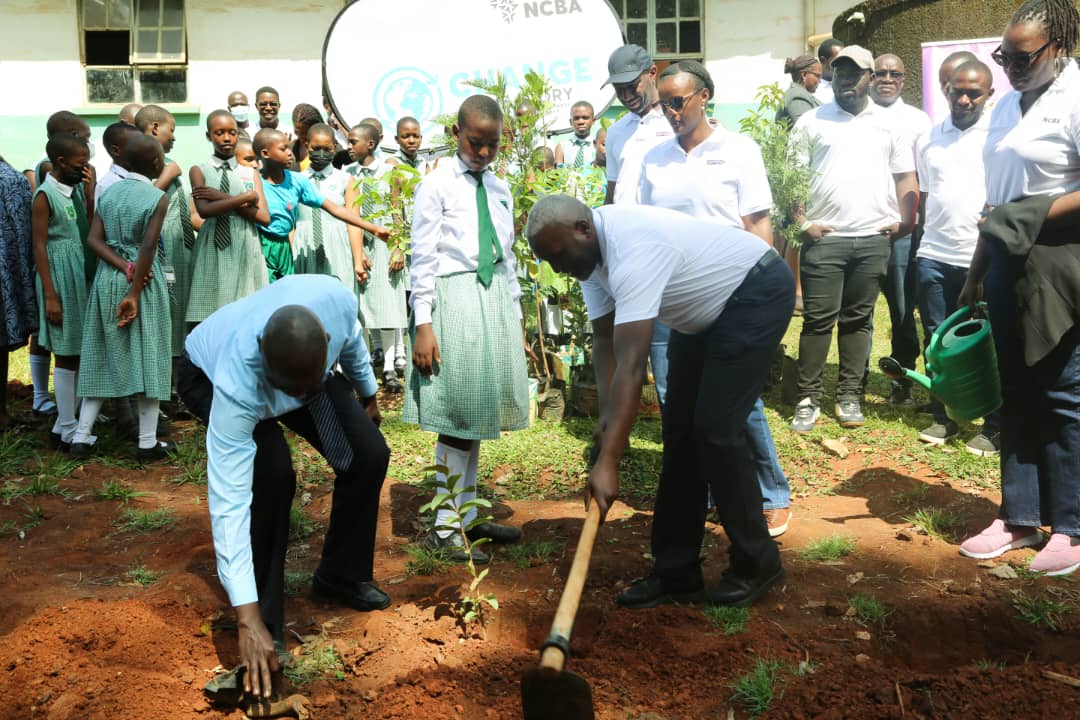
NCBA Bank Uganda, in partnership with Kampala Capital City Authority (KCCA) and law firm Dentons, has established a micro forest at Nakasero Primary School as part of activities to commemorate World Environment Day 2026 and promote environmental sustainability in Uganda’s capital city.
The tree-planting initiative brought together NCBA Bank staff, KCCA officials, Dentons representatives, pupils, and the school administration in a collaborative effort aimed at restoring urban green spaces, enhancing environmental conservation, and fostering community engagement.
Speaking during the event, NCBA Bank Uganda’s Head of Strategy and Sustainability, Martin Mwanje, said the initiative reflects the bank’s commitment to environmental stewardship under its Environmental, Social and Governance (ESG) agenda and the institution’s broader sustainability strategy.
“Today, on World Environment Day, we have come to Nakasero Primary School together with Dentons and KCCA to establish micro forests in urban areas. Our head office is located in Nakasero, and we believe that as part of our ESG strategy, we have a responsibility to contribute towards changing the environmental story in our communities,” Mwanje said.
The project forms part of NCBA’s regional environmental campaign, which seeks to plant at least 10 million trees across East Africa. The bank operates in Uganda, Kenya, Tanzania, and Rwanda, where it continues to implement sustainability-focused initiatives aimed at addressing climate and environmental challenges.
Supporting Uganda’s Environmental Restoration Efforts
Mwanje noted that Kampala continues to face significant environmental pressures, including recurring floods and declining air quality, making urban greening initiatives increasingly important.
“We have seen the effects of flooding in the city and the impact of low air quality. When we talk about urban micro forests, we are referring to pockets of green spaces that are small and intimate but very dense. These forests help improve air quality and contribute to greening the environment,” he explained.
According to environmental experts, micro forests are compact, densely planted ecosystems designed to replicate natural forests within limited urban spaces. Despite their relatively small size, they can support biodiversity, absorb carbon dioxide, improve air quality, reduce urban heat, and enhance climate resilience.
Mwanje described the concept as a practical and proven solution for urban environmental restoration, noting that similar projects have been successfully implemented in various countries around the world.
“The model has worked elsewhere and demonstrates how even small spaces can make a significant contribution towards restoring the environment and creating healthier communities,” he said.
Anchored on NCBA’s Sustainability Strategy
The tree-planting exercise is aligned with NCBA Bank Uganda’s “Change the Story” Sustainability Strategy, which emphasizes environmental conservation, community development, and employee participation in creating positive social impact.
Mwanje said the initiative highlights several commitments under the bank’s 2026–2030 Sustainability Strategy, including growing 100,000 trees by 2030 through strategic partnerships, supporting communities where the bank operates, and encouraging staff participation through the “I Change the Story” programme.
“As part of the World Environment Day celebrations, our immediate objective is to plant 500 trees and support the establishment of a grass field that pupils can use during their recreational time,” he said.
Beyond environmental benefits, the project is expected to provide learners with a living educational resource where they can gain practical knowledge about conservation, biodiversity, and climate action.
Public-Private Partnerships Key to Climate Action
Mwanje commended KCCA for supporting environmental initiatives and acknowledged the government’s efforts to prioritize environmental protection and restoration.
“We thank the government through KCCA for taking environmental matters seriously. This demonstrates a commitment to restoring and protecting our environment for future generations,” he said.
He further emphasized the need for stronger collaboration between public institutions and private sector organizations in addressing environmental challenges that affect communities across the country.
“This is a call to all leaders, especially those in the private sector, to come together and support environmental restoration initiatives. The quality of the air affects all of us, and floods affect all of us as citizens. It is therefore our collective duty to restore and protect the environment,” Mwanje added.
World Environment Day 2026 Focuses on Climate Action
The initiative coincided with the global observance of World Environment Day (WED), the United Nations’ flagship environmental campaign that promotes worldwide awareness and action to protect the environment.
According to the United Nations Environment Programme (UNEP), World Environment Day 2026 focuses on climate change and calls on governments, businesses, communities, and individuals to accelerate action in response to the growing climate crisis.
The global theme for this year’s celebrations is “Inspired by Nature. For Climate. For Our Future.”
The Republic of Azerbaijan hosted the international celebrations in Baku, while Uganda’s national commemorations were held in Adjumani District.
Lasting Impact for Kampala’s Future
The newly established micro forest at Nakasero Primary School is expected to contribute to improved air quality, increased biodiversity, enhanced climate resilience, and environmental awareness among young people.
As Kampala continues to urbanize and confront environmental challenges associated with population growth and climate change, initiatives such as the NCBA-KCCA-Dentons partnership demonstrate how collaborative action can help create greener, healthier, and more sustainable cities.
The project also reinforces NCBA Bank Uganda’s growing commitment to sustainability and responsible corporate citizenship, positioning environmental conservation as a central pillar of its long-term strategy for community development and regional impact.