


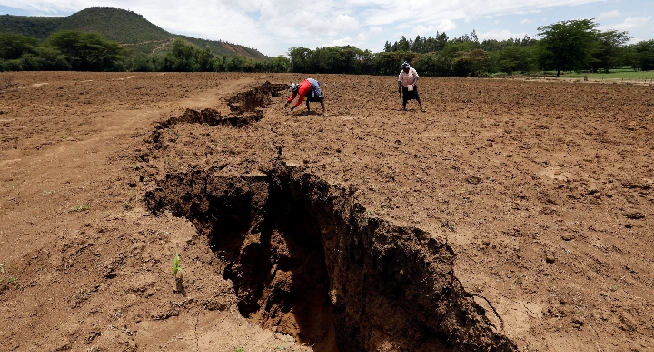
Beneath the vast savannahs and volcanic landscapes of East Africa, the ground is quietly pulling apart. It happens so slowly that no human can feel it, barely half a centimetre each year, yet scientists now believe the continent may be heading toward a dramatic geological future: East Africa could eventually break away from the rest of the continent, and a new ocean may rush in to fill the gap.
A new study published in Nature Communications suggests the process is further along than researchers once believed.
Deep below Kenya and Ethiopia, scientists have identified signs that the Earth’s crust has entered a critical stage known as “necking,” where the land stretches and thins like pulled taffy before finally rupturing.
The discovery places East Africa at the center of one of the most extraordinary geological transformations unfolding anywhere on Earth.
Around 250 million years ago, all continents were fused together in the ancient supercontinent Pangea. Over immense spans of time, tectonic forces shattered that giant landmass into the continents known today.
Now, researchers say, East Africa offers a rare glimpse into how that process begins.
The focus of the study is the Turkana Rift, a rugged region straddling northern Kenya and southern Ethiopia.
There, two tectonic plates, the Nubian Plate and the Somali Plate, are slowly drifting apart. Scientists used underground imaging techniques to examine the crust beneath the rift and found that its center has thinned dramatically, shrinking to about eight miles thick compared with more than 22 miles farther away.
That thinning is significant because it signals the crust may be nearing the point where it can no longer hold together.
“In essence, we now have a front-row seat to observe a critical rifting phase,” said geologist Folarin Kolawole of Columbia University, one of the study’s authors. Researchers believe the stretching accelerated around four million years ago after intense volcanic activity weakened the region from below.
If the process continues, magma from the Earth’s mantle could eventually rise to create an entirely new seafloor.
Millions of years from now, water from the Indian Ocean may pour inland, splitting East Africa from the rest of the continent and forming a new ocean basin.
The idea sounds almost apocalyptic, but geologists stress that continental breakup unfolds over enormous timescales.
Humanity will not witness Africa tearing apart overnight. Instead, the changes occur in increments so slow they are measured in millimetres per year.
Yet the forces involved are the same ones that shaped the Atlantic Ocean and separated continents throughout Earth’s history.
What makes the East African Rift especially remarkable is that scientists can observe the process while it is happening.
The rift already dominates the landscape of the region. It has sculpted towering volcanoes, deep valleys and some of the world’s largest lakes. It is also one of the most important regions in human evolutionary history.
Researchers believe the same geological forces now pulling the continent apart helped preserve an unparalleled fossil record, including the famous Turkana Boy skeleton, one of the most complete Homo erectus fossils ever discovered.
Volcanic ash and rapidly accumulating sediments created ideal conditions for preserving ancient remains, effectively turning the rift into a vast archive of human origins. More than 1,200 hominin fossils dating back four million years have been uncovered there.
For scientists, the connection between tectonic upheaval and human evolution is part of what makes the discovery so compelling. The same restless Earth that may someday divide Africa also helped preserve the story of humanity’s beginnings.
Today, the East African Rift remains a place of beauty and instability in equal measure, a landscape where earthquakes rumble beneath ancient valleys and volcanoes rise above grasslands teeming with life.
To most people, the continent appears solid and eternal. But deep underground, Africa is moving, stretching and slowly rewriting its future map.