



2026 Elections: Uganda’s 81-year-old leader, President Yoweri Kaguta Museveni, has officially entered the race for a fifth term under the country’s multiparty political system, extending a leadership that began nearly four decades ago with a rifle in the Luwero bushes and now continues through the ballot box.
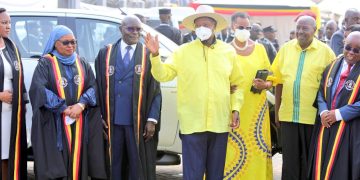
 On Tuesday (September 23, 2025) morning, flanked by First Lady Janet Museveni, senior cabinet officials, and ruling party loyalists, the veteran president arrived at the Electoral Commission (EC) headquarters in Lweza, along Entebbe Road, to present his nomination papers. Hours later, EC chairperson Justice Simon Byabakama announced that Museveni had “fulfilled all the requirements of the nomination as stipulated in the Presidential Elections Act,” effectively greenlighting his candidacy in the 2026 general election.
 Bush war liberator to ballot paper
Museveni’s political journey is one of the most enduring, and polarizing, sagas in post-colonial Africa. After a bitterly disputed 1980 election, Museveni, then a former defense minister and exiled opposition figure, launched a guerrilla war against the Milton Obote government.
His National Resistance Army (NRA) waged a brutal five-year campaign that ultimately seized Kampala in 1986.

Once hailed as a liberator ushering in a “fundamental change,” Museveni promised to restore rule of law and end the era of life presidencies. Ironically, nearly 40 years later, he stands as one of Africa’s longest ruling heads of state, outlasting all his contemporaries and critics.
Initially governing under a Movement System (no-party democracy), Museveni reintroduced multiparty politics in 2005.
However, the same constitutional amendment that allowed political competition also controversially removed presidential term limits, paving the way for his unbroken grip on power.

In his first remarks after the nomination, Museveni projected confidence and a renewed sense of purpose.
“I want to thank the NRM members for again trusting me with the chairmanship of the party and flagbearer in the 2026 General Election,” he said. “Where we are moving to now, is to convince the people of Uganda about what we have achieved and what we are planning to do in the next term.”
The president highlighted what he described as significant economic gains, claiming Uganda’s GDP had doubled in his current term — from $34 billion to $66 billion.

Museveni said, adding that his government would continue to empower the middle class and support small businesses.
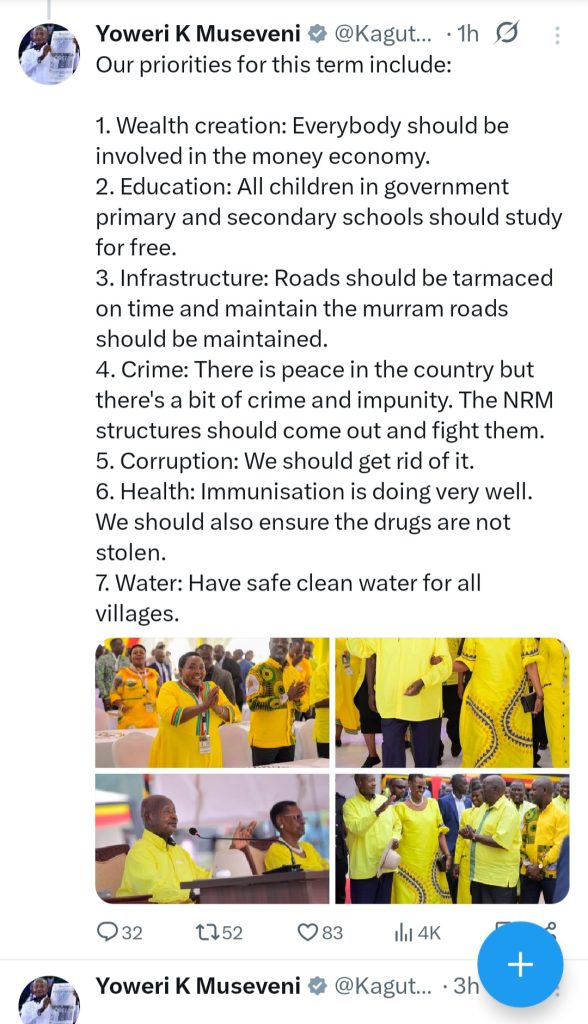
However, he acknowledged growing public dissatisfaction with corruption, crime, and impunity, issues that critics argue have festered under his administration.
“There’s peace in the country; there’s some crime, corruption, and impunity. The NRM structure should come out and help expose criminals… It will be a double mission in the coming kisanji,” he said, using the Luganda term for presidential term.
 Despite operating under a multiparty framework, Uganda’s political arena remains heavily skewed in favor of the ruling National Resistance Movement (NRM). Opposition figures have frequently claimed intimidation, and media blackouts. The 2021 election, in which Museveni defeated musician-turned-politician Robert Kyagulanyi aka Bobi Wine, was marred by violence, internet shutdowns, and widespread allegations of fraud, which were dismissed by Court.
His critics argue that Uganda’s multiparty system exists largely in name, functioning within a tightly controlled space where dissent is tolerated only on the margins.
 However, for many Ugandans, Museveni represents both stability and stagnation.
His defenders point to infrastructure development, military professionalism, and regional diplomacy. His critics point to shrinking civic space, entrenched patronage, and a broken promise of democratic renewal.