


The minister of state for Internal Affairs General David Muhoozi has commended Prison’s top brass for transforming prisons from punitive to correctional systems management.
“Uganda Prisons Service has evolved from a punitive to a correctional philosophy of prison management and from a consumptive to a productive institution hence playing a critical role in the country’s development,” Muhoozi observed.
“Prison’s department has played a very big role particularly in the production of cotton, maize seed and high-quality furniture which has evolved into a symbol of professionalism, discipline and productivity,” Muhoozi maintained.
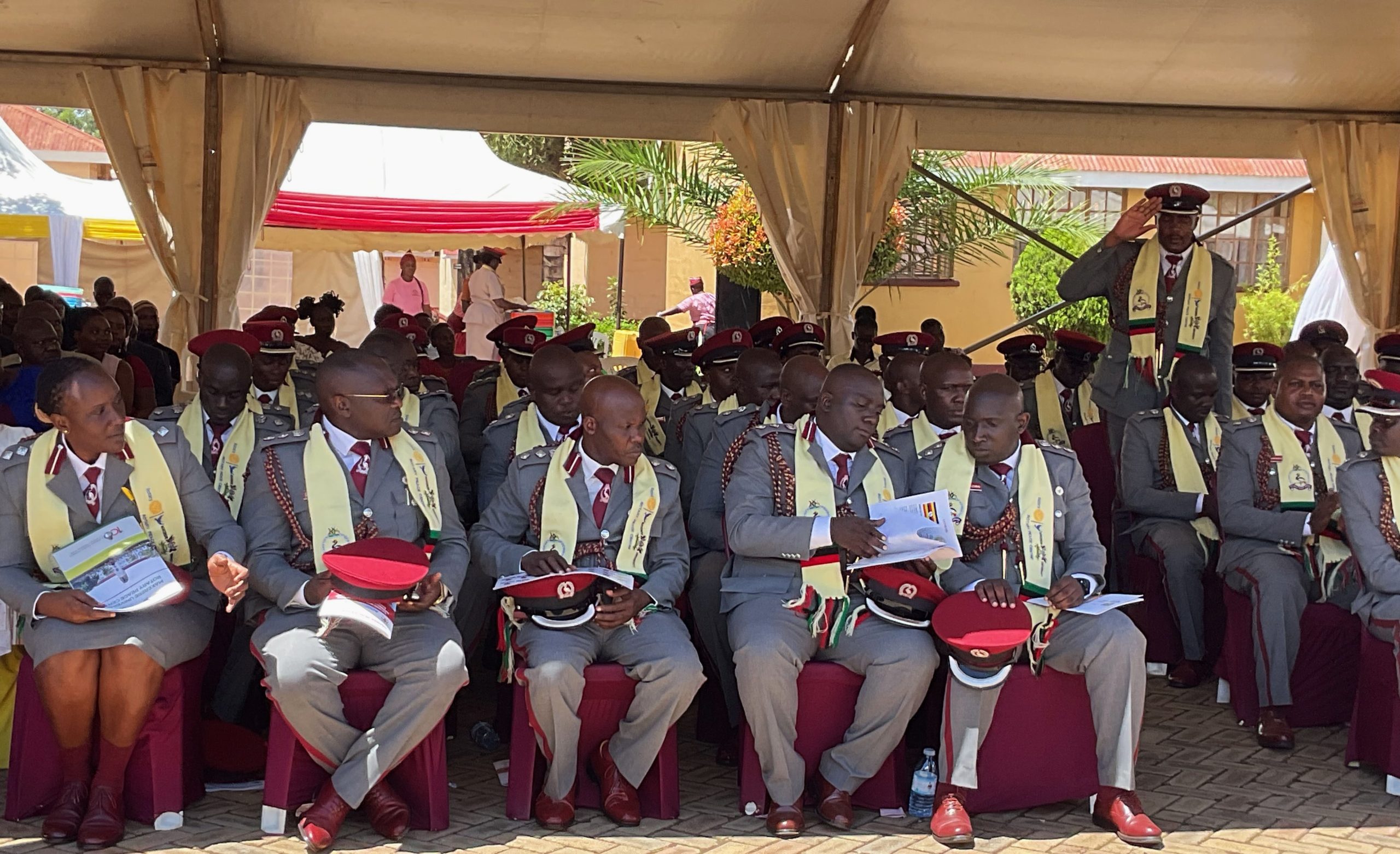
Muhoozi made these remarks while presiding over the third intake of the Prison’s Intermediate Command and Staff Course pass out ceremony held at the Prison’s Academy and Training School on Friday that saw a total of 60 officers passed out.
The minister encouraged the newly passed out officers to ensure they are, “Leaders with a difference, “by upholding values of ideological clarity, patriotism, Pan Africanism and social economic transformation pillars of Uganda’s development vision.

Muhoozi commended the Commissioner General of Prisons Dr Johnson Byabashaija for his transformative leadership emphasizing the importance of human rights observance, strategic policy implementation and national service through correctional reforms.
He noted that the Prison’s Chief has transformed correctional services through strategic alignment in line with the national development goals saying that prisons have moved beyond custodial roles.
Gen Muhoozi disclosed that His Excellency the president had approved a large-scale integrated Prison Industries Project – an initiative aimed at revitalizing Uganda’s prison industries in tannery, textiles, footwear and furniture in line with the Buy Uganda, Build Uganda policy.
Samuel Akena the Deputy Commissioner General of Prisons observed that, “The Intermediate course is aimed at advancing intellectual and practical approaches towards correctional needs of the service, it aims at producing middle level senior officers that effectively manage prison units.”
“Training is not an expense but an investment in human capital. Leadership and learning are indispensable to each other, make good use of the training for better management of correctional facilities,” Akena advised the graduates.
Akena however, decried the increasing congestion within prisons noting that it has greatly affected Prison’s department, he outlined the Service’s ongoing structural and human resources reforms noting that, “Despite a national prisoner population increase of 8% annually compared to a 2.9% national population growth, prisons continue to operate under severe congestion.”
The Justice Law and Order Sector report of the year 2023/2024 indicated that prison congestion in the country stands at 363.3%. The report showed that prisons hold inmate population of 79,000 prisoners which is more than triple its occupational capacity of 20,996.
The existing facilities hold a capacity of 22,000 far short of the current inmate population of 79,000 inmates locked up within the 259 prison units countrywide.
Despite the alarming prison congestion, the report shows that the proportion of remands has slightly reduced from 48.3%in July 2023 to 47.3% in June 2024.
The report also indicates that cases taken to court increased from 68, 405 in 2022 to 84,907 in 2023 although the crime rate reduced to 524 in 2022 to 501 in 2023.
Out of the criminal cases taken to court, the report indicates that 27,125 were convicts while 843 were acquitted. Another 10,096 cases were dismissed whereas 46,843 cases are still pending in court.
The report further indicates disposal of cases has increased from 55% to 63%
To address the congestion rate, Akena cited efforts under the National Development Plan 111 to construct 1,812 staff housing units with an additional 317 units ongoing in Luzira, Masaka, Moroto, Kauga, Nebbi, Kibale and 19 new prison wards with 20 more prisons.