


Bugiri, Uganda — In the rural community of Nankoma West, soya bean farming is doing more than just filling plates, it’s transforming lives, creating jobs, and building stronger families.
At the heart of this transformation is the Nankoma Youth Farmers Cooperative, a dynamic youth-led initiative supported by the SAYE Project (Stimulating Agribusiness for Youth Employment Project) , implemented by Heifer International Uganda and its partners ASIGMA, CURAD, FSME and FSD Uganda.
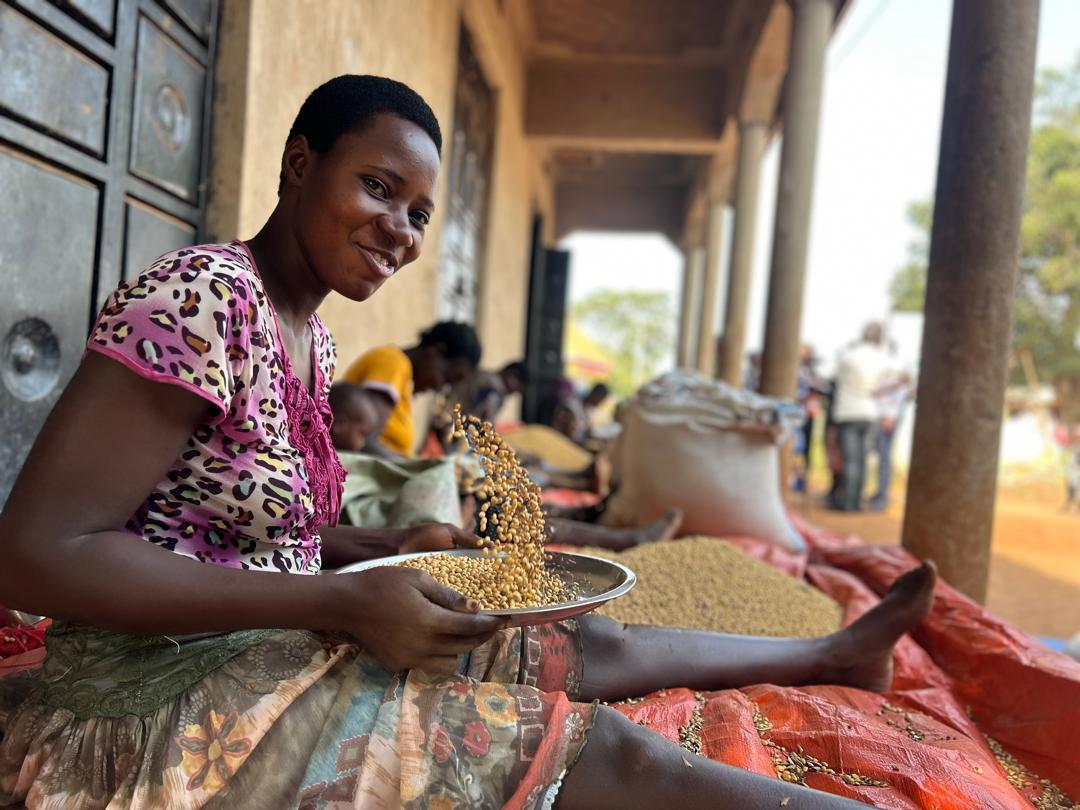
Some success stories include Atenge Magret, who earns 8,000 Uganda shillings daily working at the local Agrihub. Her job is sorting soya beans—supports her household expenses and enables her to save 2,000 shillings per day, steadily improving her family’s financial outlook.
She’s not alone. Isha Nakimuli also works at the Agrihub, sorting two bags of soya beans a day and earning 16,000 shillings. Her income goes toward paying school fees for her children, managing household bills, and meeting daily needs.
Shakirah Kadama, 23, earns 8,000 Uganda shillings daily. She spends 5,000 and saves 3,000. She is happy with the support from the SAYE project, which helped her gain employment with the Nankoma Youth Farmers Cooperative.
These individual stories reflect a larger transformation being led by groups like the Nankoma Frontline Farmers’ Youth Group, chaired by Waiswa Isam. Comprising 31 members—24 of whom are actively engaged in soya bean farming. The group is redefining rural success.
Nankoma Frontline is one of 12 youth farmer groups operating under the umbrella of the Nankoma Youth Farmers Cooperative.
With initial training and guidance from the SAYE Project, the group embraced farming as a business. Each farmer received 40 kilograms of soya bean seed and fertilizer from Soya Bean Africa Limited after paying a 50,000-shilling commitment fee.
This season, the group has planted 36 acres of soya beans, with 16 acres already harvested. Despite limited land ownership, they creatively rented 20 acres at 100,000 shillings per acre and used tractors at the same rate to prepare the land.
“We expect to harvest 22 tonnes from our 20-acre garden,” said Isam. “That’s roughly 56 million shillings in potential revenue. With such results, more youth are likely to join next season.”
The Birth of a Movement: Nankoma Youth Farmers Cooperative
According to Byaruhanga Muhammad Balaba, Production Officer and Secretary of the cooperative, the journey began with a handful of young people struggling to find purpose.
“We started out idle, saving some money, but wasting it on things like Ludo and drugs,” Balaba said. “Everything changed when we were trained by Community Facilitators under the SAYE Project.”
The youth learned how to save through Village Savings and Loan Associations (VSLA). Starting with 34 members, each contributing 2,000 shillings per cycle and shs 500 for a social fund, the group gained momentum and transitioned into productive farming.
They partnered with Soya Bean Africa, paid a 1.2 million-shilling commitment fee, and planted 36 acres of Quality Declared Seeds (QDS) under the name Nankoma Front Range. These seeds now supply both their own farms and local farmers.
Through ongoing training and leadership development from SAYE, the youth formalized their structure into the Youth Farmers Cooperative, which now has 290 members, including; 181 women, 109 men and 29 persons with disabilities
Agrihub: Driving Rural Agribusiness
The cooperative has evolved into a fully functional agribusiness, focusing on both production and bulk marketing. In just two days, the Agrihub expects to bulk 18 tonnes of soya beans, with a seasonal target of 21 tonnes.
The cooperative earns 100 shillings per kilogram, generating income that supports reinvestment and operational growth. This season alone, they project 4 million shillings in profit.
Thanks to the support from Heifer International and its partners, the Agrihub is now equipped with:
- A digital weighing scale
- Durable packaging bags
- A soybean sampling tool for quality testing
- A bag sealing machine
- A digital drying frame to maintain seed quality
Beyond farming, the Agrihub has created steady employment opportunities. Youth and women are involved in sorting, planting, harvesting, and transporting produceearning daily wages and supporting their families.
Couples Working Together: Farming Builds Families
The SAYE Project also encourages family collaboration to improve planning, reduce conflict, and enhance household income.
Naiwumbwe Asha, a member of the Nankoma Frontline group and wife to Chairperson Waiswa Isam, shared how working together as a couple in farming has strengthened their relationship.
“Soya doesn’t require constant supervision, so we have time to do other business,” Asha said. “Farming together has improved our income and brought us closer.”
The couple now cultivates three acres of soya beans and anticipates earning 6 million shillings in the August harvest. They plan to reinvest in their farm and start a small business.
The Road Ahead
Despite their success, the cooperative still faces logistical challenges. Many members walk over 10 kilometers to reach their gardens and must transport heavy bags of soya beans to the Agrihub.
The group is appealing to government and development partners to support them with simple transport solutions, such as tuk-tuks or motorized tricycles, to ease the burden and boost productivity.
Looking forward, the cooperative aims to expand its services and impact by:
- Launching value addition projects, including poultry feed and soya porridge production
- Introducing microbanking services for year-round financial support
- Scaling up the Agrihub’s agribusiness offerings to serve more youth and families
Conclusion
The Nankoma Youth Farmers Cooperative is a clear example of what’s possible when rural youth are equipped with knowledge, tools, and opportunity. What started as a loosely organized group has grown into a robust enterprise feeding families, creating jobs, and strengthening communities.
Agriculture here is not just a means of survival it is a vehicle for empowerment, dignity, and sustainable development.