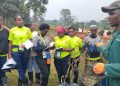




Vice President Jessica Alupo, together with the Teso Parliamentary Group (TPG), is intensifying efforts to promote coffee and cocoa farming in the Teso sub-region, positioning the two cash crops as key drivers in the fight against household poverty.
Teso comprises the districts of Amuria, Kaberamaido, Kapelebyong, Katakwi, Kumi, Ngora, Serere and Soroti, covering an area of 13,030.6 square kilometres. It is home to an estimated 2.5 million people of Iteso and Kumam ethnicity. The sub-region is known for agriculture, particularly citrus growing and cattle rearing.
Speaking during a TPG meeting yesterday, Alupo said she conceived the idea of introducing the two cash crops in Teso while representing President Museveni during the official distribution of coffee and cocoa seedlings in the Bukedi sub-region.
During the ceremony, 50,000 coffee seedlings and 10,000 cocoa seedlings were distributed to farmers across Bukedi.
“I inquired about the same for Teso sub-region. The Ministry of Agriculture, Animal Industry and Fisheries (MAAIF) informed me that the government had already distributed coffee and cocoa seedlings to farmers in Teso. “With this motivation, I requested MAAIF, Operation Wealth Creation (OWC), and the State House Local Content Unit to arrange for more seedlings and prepare more farmers across Teso to benefit,” she said.
The Vice President also urged officials to train farmers in planting, harvesting, drying and marketing the new cash crops.
“This approach will diversify the cash crops grown in our region and greatly support our people in generating household income,” Alupo told Members of Parliament.
She noted that coffee and cocoa would provide farmers with a more reliable and sustainable source of income than traditional food crops.
“With rising global demand and established markets, these high-value crops are viable options for increasing household incomes in the sub-region,” she said. Under the initiative, the government will continue distributing seedlings, providing farmer training and strengthening extension services to improve productivity and crop management.
Alupo encouraged farmers to adopt modern agricultural practices such as irrigation, pest control and proper post-harvest handling.
“We want farmers to move beyond subsistence farming and begin treating agriculture as a business,” she said, adding that coffee and cocoa have the potential to provide steady incomes and improve household livelihoods.
The Ministry of Agriculture’s Commissioner for Coffee Production, Reuben Keimusya, said feasibility studies had confirmed that Teso’s soils and climate are suitable for both crops.
“This is a deliberate move to diversify into coffee and cocoa production, which can reduce overreliance on seasonal food crops and cushion farmers against climate-related shocks,” he said.
Keimusya added that the government now considers coffee and cocoa central to its poverty reduction strategy because of their export value and income stability.
Local leaders are promoting a transition to commercial agriculture, with coffee and cocoa at the centre of the strategy.
Hajjat Aminah Mukalazi, Head of the State House Local Content Unit and Minister of State for Privatisation and Investment-designate, called on coffee farmers to support the government’s push to halt the export of unprocessed raw materials, saying the move would accelerate Uganda’s industrialisation agenda while creating jobs and increasing incomes.
“We must continue to add value to our coffee, cotton, minerals and other resources to create jobs and incomes for our people, while generating revenue for the government to implement major infrastructure projects,” Mukalazi said.
She noted that coffee remains one of Uganda’s leading export crops, contributing between 17 and 20 per cent of the country’s foreign exchange earnings. About 20 per cent of Ugandans earn all or part of their income from coffee, which supports both direct and indirect employment.
Members of Parliament welcomed the introduction of coffee and cocoa farming in the sub-region, emphasizing that the region would promote coffee consumption through outreach activities targeting schools, universities, religious institutions and community gatherings.
The strategy, which is also being accelerated by Operation Wealth Creation, aims to raise household incomes to at least Shs30 million annually by 2040.
Solomon Kajura of Operation Wealth Creation told MPs that coffee farming remains one of Uganda’s most profitable agricultural ventures, particularly when practised organically. He added that successful organic coffee farming begins with quality seed and urged legislators to establish demonstration farms to create a trickle-down effect among communities.
The coffee and cocoa farming program will officially be launched in Katakwi District on June 27, 2026, targeting the second planting season, which begins in July.