


As Uganda reflects on more than three decades of affirmative action, another constitutional debate is quietly gathering momentum, one that could redefine the country’s approach to women’s political participation for generations.
At its centre lies a controversial question: should legislators elected through affirmative action face term limits while Members of Parliament elected through open constituency races continue to seek re-election indefinitely?
The discussion, raised during the induction of Uganda’s 12th Parliament, has moved beyond the future of reserved seats themselves. It now touches the broader principles of fairness, equality before the law and the very purpose of affirmative action in a modern democracy.
The proposal emerged from research examining the effectiveness of Uganda’s affirmative action framework.
Among its recommendations is the introduction of term limits for Woman Members of Parliament, with supporters arguing that such a reform would inject fresh leadership into Parliament, create opportunities for younger women and encourage experienced Woman MPs to transition into directly elected constituency politics.
The argument is not without merit. Around the world, political renewal has become an increasingly important democratic objective.
Long-serving legislators often accumulate political influence, financial resources, institutional networks and electoral machinery that make it difficult for newcomers to compete. Limiting tenure, proponents argue, could prevent reserved seats from becoming permanent political careers and instead preserve them as platforms for developing future national leaders.
Yet the proposal has also exposed what many see as a deeper constitutional contradiction.
If political renewal is considered healthy for democracy, critics ask, why should it apply only to women occupying affirmative action seats?
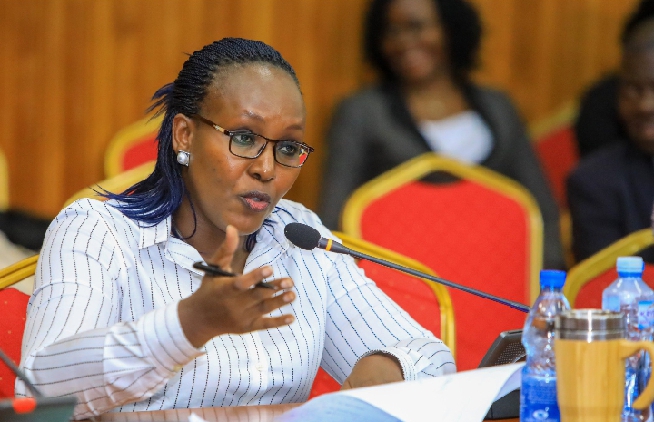
That question was raised forcefully by National Female Representative for Persons with Disabilities Laura Kanushu.
“This research proposes term limits on reserved seats. It does not propose term limits for open seats,” she said.
“The issue of term limits should cut across. It shouldn’t be put on only the women representatives.”
Her concern goes beyond constitutional symmetry. It speaks to the realities of electoral competition.
In Uganda, many constituency MPs have served multiple terms, allowing them to build extensive political structures, cultivate loyal support bases and command significant campaign resources.
A Woman MP forced to leave a reserved seat after reaching a prescribed limit would likely have to challenge opponents who may have represented the same constituency for decades.
Kanushu questioned whether such a contest could ever be considered genuinely equal.
“How do I compete with someone who has served seven terms when I am coming as a first-timer?” she asked.
The concern reflects findings from political science research across Africa and beyond.
Electoral incumbency remains one of the strongest predictors of political success. Incumbents generally enjoy greater name recognition, stronger fundraising networks, easier access to party structures and more established relationships with voters.
For women, whose campaigns frequently begin with fewer financial resources and less institutional backing than those of male counterparts, competing against entrenched incumbents presents an even steeper challenge.
International studies by organisations including UN Women, the Inter-Parliamentary Union and the International Institute for Democracy and Electoral Assistance have consistently found that women remain disadvantaged by campaign financing gaps, party nomination practices, political violence, gender stereotypes and unequal media coverage.
These barriers do not disappear simply because a woman leaves a reserved seat to contest an open constituency election.
Supporters of term limits counter that affirmative action was never intended to become a permanent destination. Rather, they argue, it was designed as a temporary mechanism to correct historical exclusion until women could compete equally in mainstream politics. In that view, remaining indefinitely on reserved seats risks creating parallel political careers instead of integrating women into the broader electoral system.
Others disagree, arguing that the assumption of a level electoral playing field ignores persistent structural inequalities.
Research cited during the parliamentary induction indicates that although women occupy roughly one-third of Uganda’s parliamentary seats, only a small proportion have successfully won directly elected constituency positions.
The study found that women’s overall parliamentary representation has remained relatively stable for nearly two decades despite affirmative action, while very few women have broken through in open constituency races.
Those statistics suggest that reserved seats continue to perform an important corrective function rather than representing a completed transition to equal political competition.
Uganda removed presidential term limits in 2005 and later abolished the presidential age limit, while Members of Parliament contesting constituency seats continue to seek unlimited re-election. Introducing restrictions that apply exclusively to Woman MPs could therefore create two categories of legislators operating under different constitutional rules despite both being elected by voters.
Constitutional scholars argue that such a distinction would inevitably attract scrutiny over whether equal representation is being strengthened or undermined.
There is also the political question of succession.
Advocates of term limits believe mandatory turnover would allow younger women, professionals and community leaders to enter Parliament, broadening women’s leadership beyond a relatively small group of experienced politicians. Critics respond that succession should ultimately be determined by voters rather than by constitutional restrictions and that removing experienced women from Parliament could weaken female influence within national decision-making at a time when women’s voices remain underrepresented in many sectors.
Globally, democracies have adopted different approaches to this dilemma. Some countries rely on constitutional quotas, others use political party quotas, while many have no gender quotas at all. Few, however, impose term limits specifically on legislators elected through affirmative action while allowing unrestricted tenure for those elected through open seats.
That makes Uganda’s emerging debate particularly significant within international discussions on gender equality and constitutional reform.
Ultimately, the controversy extends beyond the future of Woman MP seats.
It challenges lawmakers to decide whether affirmative action should remain a protected pathway into politics, evolve into a system encouraging direct electoral competition or be replaced by entirely new models such as gender parity.
Whatever Parliament decides, the outcome will shape not only women’s political participation but also the broader constitutional principles governing representation, equality and democratic competition in Uganda.
As the country begins this conversation, Kanushu’s central question continues to resonate through the debate.
“The issue of term limits should cut across. It shouldn’t be put on only the women representatives.”
Whether lawmakers embrace that principle may determine whether the next chapter of Uganda’s affirmative action journey is viewed as an expansion of political equality or the creation of unequal rules for those it was originally designed to empower.