



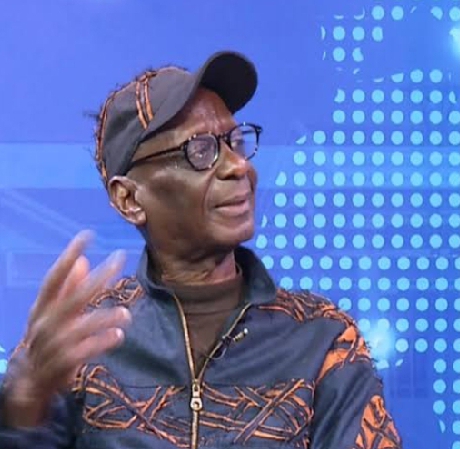
There are people who perform on stage. Then there are those who somehow make the stage feel like a country.
Alex Mukulu belonged to the second group.
For more than four decades, he wrote, acted, directed and provoked. He made audiences laugh, sometimes uncomfortable, sometimes angry, and perhaps most importantly, made them think.
On Saturday, August 15, 2026, Uganda lost the veteran playwright, actor, director and composer at the age of 72.
Mukulu died at Kiruddu Hospital in Kampala, according to information shared by members of the committee handling his farewell. He had been suffering from liver complications.
And suddenly, a man who spent his life writing other people’s final scenes became the subject of one himself.
The curtain falls
Mukulu was not theatre in the quiet, polite sense.
His theatre had teeth.
He could take politics, poverty, power, history, culture and the ordinary contradictions of Ugandan life, dress them up as drama and then leave an audience wondering whether they had come to watch a play or to watch themselves.
His career began in the late 1970s, with Muzukulu wa Kabangala, and grew into a body of work that would eventually run into dozens of productions.
Among his better-known plays were Wounds of Africa, 30 Years of Bananas, Excuse Me Mzungu, The Guest of Honour, Radio Mambo Bado, The People’s President and others.
But if there is one title that will forever be attached to Mukulu’s name, it is 30 Years of Bananas.
The bananas were never just bananas
First staged in the early 1990s, 30 Years of Bananas looked back at Uganda’s political journey since independence.
It was satire, but it was more than satire.
Mukulu used humour to walk audiences through some of the country’s most difficult political questions.
The production became one of his signature works and was later published as a book by Oxford University Press in 1993.
That was Mukulu’s gift.
He knew that sometimes a joke could carry a serious message further than a lecture.
He also knew that Ugandans could laugh at painful things without necessarily forgetting the pain.
He took Africa’s wounds to the stage
In Wounds of Africa, Mukulu turned his attention to the continent’s wider struggles.
In The Guest of Honour, he explored the difficult history surrounding the expulsion of Asians from Uganda and their return.
Then came Journey to Self-Realisation, performed at the opening ceremony of the 2007 Commonwealth Heads of Government Meeting in Kampala putting Ugandan theatre before an international audience.
For an artist who came from the theatre circuit, it was a remarkable journey.
But Mukulu never completely left home behind.
Even when the subject was Africa, Shakespeare or international audiences, Uganda was usually somewhere in the room.
And then Shakespeare came to Uganda
In 2024, Mukulu returned to the National Theatre after a long absence from the Ugandan stage with Kulunkalu ne Kulumbisi, his African adaptation of Shakespeare’s Romeo and Juliet.
The familiar love story was given a distinctly Ugandan treatment, drawing on local language, music, dance, costumes and culture.
It was more than a comeback.
It was Mukulu reminding the industry that age had not taken away his appetite for a good story.
He was still asking questions.
Still provoking.
Still putting Uganda in front of the mirror.
His last major play was reported to be The People’s President, produced in 2022.
For some, he was not a playwright. He was “the judge”
There was another Alex Mukulu known to a generation that may never have sat through 30 Years of Bananas.
He was the stern, sharp-tongued judge on Bukedde TV’s Yolese Ekitone.
His assessments could be brutal.
Praise did not come cheaply.
But that was Mukulu.
He demanded preparation, discipline and seriousness from performers because he had spent much of his own life demanding those things from himself.
Beyond the stage, he became a mentor to younger artists and an important figure in Uganda’s creative industry.
Tributes following his death have described him as a storyteller, mentor, performer and cultural force.
Government has steps into his final act
Mukulu’s burial has already become bigger than a private family affair.
The Ugandan government has joined discussions with the family and the arts fraternity over his farewell, with the possibility of an official send-off being considered.
Abbey Mukiibi, a member of the organising committee, said the government had entered the discussions because Mukulu was considered a national asset deserving recognition.
A letter has also been sent to President Yoweri Museveni seeking his involvement in the final arrangements.
So, while it would be premature to say government has completely taken over the burial, it has clearly moved into the arrangements.
And that matters.
For decades, Mukulu helped build Uganda’s cultural identity from a stage that often had fewer resources than the people sitting in front of it.
Now the State wants to help give him a national farewell.
The arts fraternity is expected to hold a mourning ceremony at the National Theatre, while the final burial date is still being discussed with the family.
Some of Mukulu’s children live abroad and the family wants to allow them time to return home.
What remains after the applause?
Perhaps the easiest way to measure Mukulu’s life is not by the number of plays he wrote.
It is by the questions he left behind.
What became of Uganda after independence?
Why does power change hands but the ordinary person’s struggles remain?
What happens when history is forgotten?
Can theatre entertain people and still challenge them?
Mukulu never appeared afraid of those questions.
He walked straight into them.
For audiences who watched him in the 1980s and 1990s, he was the man who could turn political history into theatre.
For younger performers, he was the demanding director who would not accept mediocrity.
For television viewers, he was the uncompromising judge.
For Uganda’s theatre, he was something larger: one of the people who helped prove that a local story could command a national stage, and, occasionally, an international one.
The last scene
Alex Mukulu spent his life creating characters.
But his own story may be remembered most simply.
A boy who studied drama at Makerere University became one of Uganda’s most recognisable theatre figures.
He wrote about Uganda.
He argued with Uganda.
He laughed at Uganda.
And, in his own way, he loved Uganda enough to keep putting its uncomfortable truths under the spotlight.
On August 15, the spotlight went out.
But the scripts remain.
The questions remain.
And somewhere in a rehearsal room, a young Ugandan actor will eventually step onto a stage, deliver a line, hear the audience respond and discover what Mukulu understood long ago:
Sometimes the best way to tell a country its truth is to make it laugh first.