



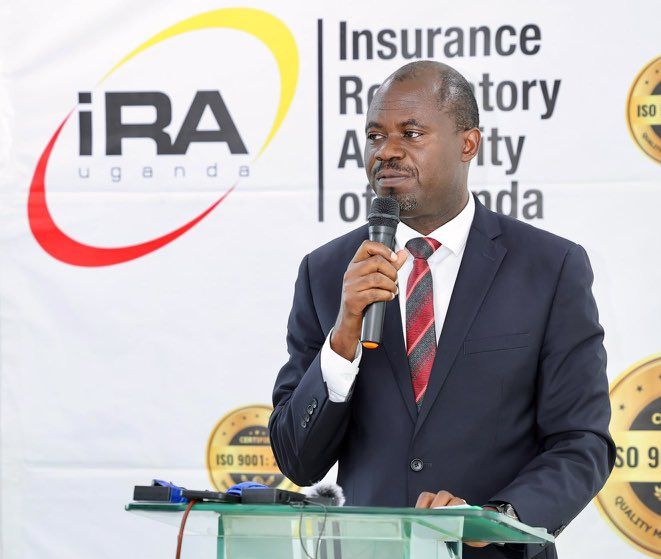
Uganda’s insurance industry has recorded a major milestone after gross written premiums reached Shs1.09 trillion in the first half of 2026, surpassing the Shs1 trillion mark that previously represented a full year’s performance.
The achievement was announced by Protazio Sande, Acting Chief Executive Officer of the Insurance Regulatory Authority of Uganda (IRA), who said the performance demonstrates continued growth and increasing maturity in the sector.
Sande said the industry had recorded Shs1.094 trillion in gross written premiums by June 30, 2026, representing a 7.68 percent increase compared with the same period in 2025.
“This is a very significant achievement for the sector,” Sande said, noting that in 2020, the industry generated about Shs1 trillion for the entire year, while in 2019 it recorded approximately Shs900 billion.
Life insurance drives growth
Life insurance emerged as the strongest driver of the industry’s growth, recording premiums of Shs524.14 billion, representing more than 30 percent growth and close to 48 percent of the overall insurance market.
Sande said the strong performance in life insurance is a sign that Uganda’s insurance market is maturing, while also providing long-term funds that can support investment and economic development.
“The growth in life is good news for the financial sector, for the country and for the wider economy,” he said.
Non-life insurance, meanwhile, accounted for Shs552.9 billion, although its performance declined by about seven percent.
Sande attributed the decline largely to structural changes in the industry, particularly the amalgamation of Jubilee Health and Jubilee Life, which resulted in some premiums previously classified under non-life being transferred to the life insurance segment.
He said the shift should therefore not be interpreted as a weakening of the overall insurance industry.
The changing market composition has also significantly narrowed the historical gap between life and non-life insurance, with the difference standing at only 2.63 percentage points by the end of June.
Over Shs500 billion paid in claims
The regulator also reported a significant improvement in claims payments, with gross claims reaching Shs500.13 billion during the first half of the year.
The figure represents about 46 percent of total gross written premiums, meaning that nearly one out of every two shillings collected in premiums was paid back to policyholders as claims.
Life insurance accounted for the largest share of claims at Shs281 billion, followed by non-life insurance at Shs206 billion. Health Maintenance Organisations (HMOs) accounted for Shs40.2 billion, while micro-insurance claims stood at approximately Shs710 million.
Sande said the high level of claims payments reflects the regulator’s efforts, together with industry players, to promote a zero-tolerance approach towards the non-payment of legitimate claims.
“Effective and timely claim settlement remains fundamental for every insurance market,” he said.
He added that IRA would continue monitoring insurers, particularly where complaints or prolonged settlement periods indicate possible weaknesses in liquidity, reserving or claims management.
Micro-insurance grows by 27 percent
Micro-insurance, which IRA considers an important avenue for expanding insurance coverage among the mass market, recorded strong growth during the period.
The segment underwrote Shs2.67 billion, representing a 27.2 percent increase compared with the first half of 2025.
Sande said the growth demonstrates the potential of specialised insurance products to reach more Ugandans who have traditionally remained outside the formal insurance market.
Bancassurance posts strong growth
Bancassurance also recorded significant growth, generating Shs183.9 billion in premiums during the first half of 2026, compared with Shs138.48 billion during the same period in 2025.
This represented growth of 33.82 percent.
Life insurance accounted for 79.14 percent of bancassurance business, while non-life insurance contributed 20.86 percent.
Banks earned approximately Shs24.72 billion in commissions from bancassurance during the period, highlighting the growing importance of the distribution channel to both banks and insurers.
Insurance brokers also remained a major distribution channel, accounting for approximately Shs411 billion in premiums, up from about Shs370 billion previously.
Sande encouraged businesses handling large or complex risks to consider using professional insurance brokers because of their expertise in identifying appropriate insurers, pricing risks and supporting clients during claims.
Industry remains financially stable
Despite concerns about the sustainability of the sector, Sande assured the public and investors that Uganda’s insurance industry remains financially stable and adequately capitalised.
As of June 30, 2026, the sector had total assets of approximately Shs3.77 trillion.
The weighted average capital adequacy ratio stood at about 271 percent, well above the regulatory minimum of 200 percent.
According to Sande, the requirement means insurers must maintain sufficient capital to absorb risks and meet their obligations to policyholders.
He, however, said IRA would continue closely monitoring companies operating close to the 200 percent threshold to ensure emerging risks do not push them below the regulatory minimum.
Positive outlook for the sector
Sande said the outlook for Uganda’s insurance industry remains positive in both the short and medium term, supported by projected economic growth, controlled inflation, the expected commencement of commercial oil production and the expansion of the middle class.
He said opportunities arising from construction, engineering, transport and liability risks are also expected to create additional demand for insurance.
However, he acknowledged that geopolitical tensions and other external economic risks could present challenges to the industry.
Sande urged insurers to pursue responsible growth through disciplined underwriting, sound capital management and greater focus on policyholder value.
He also called on Ugandans, including businesses and households in both the formal and informal sectors, to make insurance part of their risk-management plans.
“Insurance is and should be your partner,” he said, warning that a single unexpected risk can wipe out years of economic gains if individuals and businesses are not adequately protected.