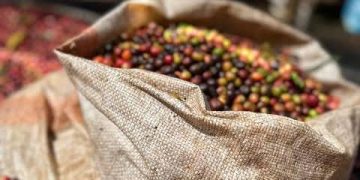



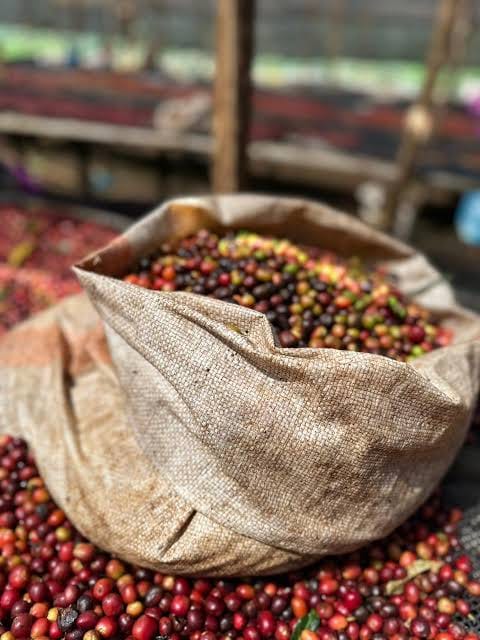
RWANDA (UGNEWSLINE) – A record-breaking sale of Rwandan coffee has drawn international attention to the growing market for premium African beans, but the extraordinary price also highlights a persistent challenge for the continent’s coffee industry: ensuring that higher export values translate into better incomes for farmers.
A kilogramme of coffee produced by Rwandan firm K-Organics sold for $452 at the Best of Rwanda online auction on 21 October, setting a new record and fetching more than five times the winning price at last year’s event.
The coffee, grown in southern Rwanda and processed using specialised fermentation and drying techniques, scored 90.74 points in a quality competition, according to the National Agricultural Export Development Board (NAEB).
The agency said the winning bid was about 66 times the average international price for Rwandan coffee, underlining the substantial premiums available in the specialty market.
However, the sale represents an exceptional achievement rather than the economic reality for most coffee producers in Rwanda and across Africa.
The specialty coffee market rewards distinctive flavour profiles, consistent quality, careful processing and traceability. Buyers, including specialist roasters and premium coffee retailers, are increasingly willing to pay higher prices for beans that meet these standards.
Most African coffee, however, is traded through conventional commercial channels, where prices are shaped by international market benchmarks, quality classifications and global supply and demand.
The challenge for producing countries is to expand access to higher-value markets without leaving the majority of smallholder farmers behind.
The winning Rwandan coffee was one of 31 lots sold at the auction. Organisers had selected just 25 exceptional samples from 320 entries submitted for the competition, illustrating the highly selective nature of the premium market.
The winning price has climbed dramatically in recent years. According to NAEB, the top lot fetched $71.80 per kilogramme in 2024 and $88 in 2025 before reaching $452 this year.
Achieving such quality requires considerable investment and attention throughout the production process. Farmers must harvest ripe cherries selectively, while processors need to manage fermentation, washing and drying conditions carefully to preserve the beans’ distinctive characteristics.
But higher quality does not automatically translate into higher farm incomes. The financial benefits depend on how much of the final selling price reaches producers, alongside the costs of harvesting, processing, transportation and marketing.
The difference between specialty auction prices and conventional trade remains substantial in Rwanda itself.
NAEB chief executive Claude Bizimana said conventionally traded Rwandan coffee sells for approximately 10,000 Rwandan francs per kilogramme.
The country earned $139.3m from exporting 23,000 tonnes of coffee in the previous financial year, according to the agency. This represents an average export value of roughly $6 per kilogramme, although the figure covers different grades and commercial arrangements.
The contrast is also evident in other major coffee-producing countries in East Africa.
Kenya’s opening coffee auction of the 2026-27 season recorded an average price of about $5.95 per kilogramme, while the highest price for an AA-grade lot reached approximately $7.64, according to the Nairobi Coffee Exchange.
In Tanzania, the Coffee Board listed clean arabica at $7 per kilogramme and robusta at $3.40 on its market dashboard on 23 October.
Ugandan market figures also illustrate the differences between coffee varieties and stages of processing. Ministry of Agriculture monitoring data put robusta prices at approximately $3.15 to $3.28 per kilogramme during the first half of September, while arabica parchment traded at around $4.24 to $4.38.
Although these figures are not directly comparable because they reflect different products and points in the supply chain, they demonstrate the distance between exceptional specialty coffee prices and the values typically recorded in mainstream markets.
Further west, Côte d’Ivoire has also faced pressure on producer earnings. The guaranteed farmgate price for its 2026-27 main coffee crop was set at approximately $2.23 per kilogramme, a reduction of 23%.
For African producing countries, the figures raise broader questions about how the value of coffee is distributed along the supply chain.
Expanding specialty production could provide an opportunity to improve export earnings, strengthen rural economies and establish African origins more firmly in international premium markets. But doing so requires more than producing occasional award-winning lots.
Investment in processing infrastructure, farmer training, quality assurance and market access will be essential. Stronger cooperatives and transparent pricing arrangements could also help producers negotiate better terms and secure a greater share of the premiums generated by their coffee.
The continent’s growing reputation for high-quality beans offers an opportunity to move beyond reliance on bulk exports. Yet the lasting economic impact will depend on whether that transition benefits ordinary farming households rather than a relatively small group of producers and specialist exporters.
Rwanda’s $452 sale demonstrates what African coffee can command at the top end of the market. The more difficult task is making a meaningful share of that value accessible to the millions of farmers whose livelihoods depend on the crop.