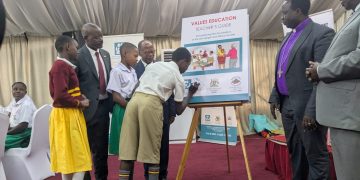



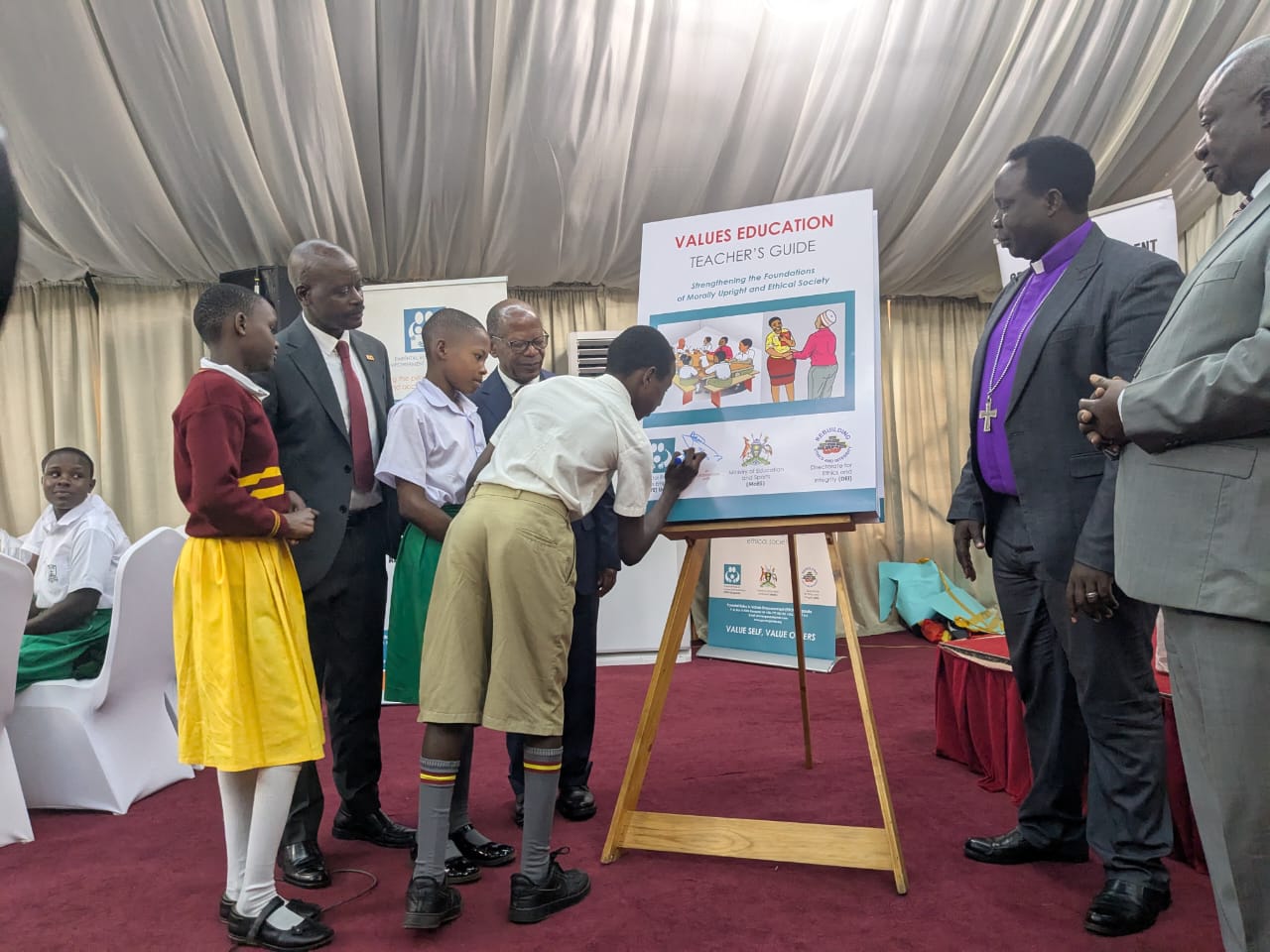
EDUCATION (UGNEWSLINE) – The government has launched a Values Education Teachers’ Guide aimed at strengthening discipline, patriotism, integrity, responsibility and good moral conduct among learners, as part of efforts to prepare children to become responsible citizens and contribute to Uganda’s social and economic transformation.
The guide, developed by Parental Roles in Values Empowerment (PROVE) Uganda in collaboration with government institutions and other stakeholders, is intended to help teachers integrate the country’s national ethical values into classroom instruction and everyday school activities.
The launch was presided over by the Acting Minister of Education and Sports, John C. Muyingo, who represented President Yoweri Kaguta Museveni.
In his message delivered by Muyingo, President Museveni urged learners to value their lives, concentrate on their studies and acquire practical skills that can enable them to become productive members of society.
“I encourage learners to concentrate on their studies, acquire a marketable profession or skill, read their Bible or Quran according to their faith, participate in sports and exercises and help their parents with useful work during the holidays. Students, children must love and take care of their lives,” Museveni said.
The President challenged teachers to use the guide practically, emphasising that education should go beyond academic instruction and examinations to instil discipline, patriotism, integrity and a sense of responsibility among learners.
He observed that although government has expanded access to education through Universal Primary Education (UPE), Universal Secondary Education (USE) and technical and vocational training, such opportunities must be accompanied by deliberate efforts to develop learners’ character and practical competencies.
“A teacher is not only a transmitter of information; a teacher is also an example to the learner. Punctuality, fairness, preparation, respect and commitment to duty are lessons that children see every day,” he said.
Museveni further emphasised the importance of teaching patriotism from an early age, explaining that genuine love for Uganda requires citizens to reject tribalism, regional divisions and gender-based discrimination.
He noted that different groups in society depend on one another, citing the relationship between farmers, traders, manufacturers, teachers, learners, doctors and patients as examples of how people contribute to each other’s welfare.
He warned that corruption, dishonesty and exploitation undermine these relationships and eventually affect the entire society.
The President also called on schools to prepare learners to participate in Uganda’s social and economic transformation by promoting creativity, innovation, practical problem-solving, technical skills and entrepreneurship.
He encouraged young people to recognise opportunities in agriculture, manufacturing, tourism, information technology and other productive sectors rather than concentrating exclusively on seeking formal employment.
On regional integration, Museveni said Uganda’s economic prosperity was closely connected to that of neighbouring countries, noting that a larger East African market creates opportunities for producers, investors and industries to expand their businesses.
He urged young people to appreciate their African identity, heritage, languages and cultures while acquiring the knowledge and skills required to compete in the global economy.
The President also called for environmental responsibility, urging schools to teach learners the importance of tree planting, proper waste management, protecting water sources and responsible land use.
He said lakes, rivers, wetlands, forests and other natural resources support people’s livelihoods and national prosperity, making environmental conservation an essential part of sustainable development.
Museveni stressed that values education should translate into practical behaviour rather than remain theoretical lessons or slogans.
He said the ten national ethical values identified in the guide should influence how learners work in teams, resolve conflicts, care for property, interact with people from different backgrounds, use technology and take responsibility for their mistakes.
He called on the Ministry of Education and Sports, the National Curriculum Development Centre (NCDC) and other relevant institutions to provide teachers with appropriate materials, orientation and practical guidance to ensure effective implementation.
He also emphasised that values education should be delivered according to learners’ ages, with younger children introduced to the concepts through stories, examples, games and demonstrations.
Government calls for stronger parental responsibility
Meanwhile, the Minister of State for Ethics and Integrity, Rose Lilly Akello, called for renewed parental involvement in children’s upbringing, warning that changing family practices and uncontrolled exposure to social media were weakening moral guidance among young people.
In a statement delivered by the Permanent Secretary in the Ministry of Ethics and Integrity, Dunstan Balaba, Akello said parents must reclaim their responsibility of nurturing children and instilling values that promote responsible behaviour.
She observed that many parents had become less involved in their children’s daily lives compared to previous generations, when parents closely monitored their children’s movements, friendships, education and general behaviour.
“Our parents were close to us, we have left our children into housemaids and uncontrolled social media. Our parents disciplined us. We have embraced children’s rights in its totality without understanding it,” she said.
Akello also expressed concern that some parents no longer maintain regular communication with their children’s teachers or know the friends their children associate with.
She noted that family practices such as eating together and discussing children’s daily experiences had also declined in many households.
The minister challenged parents to reflect on what had gone wrong in raising the younger generation and take deliberate steps to restore their involvement in children’s moral development.
She described morality as central to an individual’s usefulness in society, warning that unlike money or physical health, which can be recovered through appropriate interventions, the loss of moral conscience can become a danger to both an individual and the wider community.
Akello said government has established a national framework for promoting ethical conduct among citizens, including the National Ethical Values Policy of 2013, which seeks to preserve Uganda’s cultural identity and promote values that guide citizens’ attitudes and conduct.
She noted that the Ministry of Education and Sports, through the National Curriculum Development Centre, had already integrated national ethical values into the education curriculum.
However, she said the biggest challenge remained translating the values from the syllabus into the hearts and minds of learners.
“Uganda does not lack the resources it requires to achieve a ten-fold growth, as we have said in the National Development Plan. What the country needs is the men and women of sound character to manage these resources,” she said.
Akello identified four priorities for implementing the initiative: ensuring every teacher receives a copy of the guide, supporting teachers to instil the values among learners, mobilising partners to provide teaching aids to schools and strengthening parents’ involvement in nurturing responsible and hardworking citizens.
She said developing children’s character was a shared responsibility that required parents, teachers, government institutions and communities to work together.
PROVE Uganda explains the journey behind the guide
Tom Maani Bamuheire, the founder and team lead at PROVE Uganda, said the guide was the result of years of engagement with government institutions, education stakeholders, parents and civil society organisations to address the declining standards of morality and ethical conduct in society.
He said the initiative was founded on the understanding that a country’s development should not be measured only by academic qualifications, infrastructure and economic opportunities, but also by the character of its citizens and the integrity with which they use their knowledge and resources.
“A nation’s progress cannot be measured by only the qualifications its people acquire, the infrastructure it builds, or the economic opportunities it creates. It must also be measured by the character of its citizens, the integrity of its leaders, and the responsibility with which its people use their knowledge, skills, and opportunities,” Bamuheire said.
He argued that education must prepare children not only to pass examinations and enter the employment market but also to make sound decisions, respect others, act honestly, care for their communities and contribute responsibly to national development.
He observed that knowledge and skills without values could be misused because individuals may lack the moral guidance to apply them fairly and responsibly.
Bamuheire explained that PROVE Uganda began its journey with a question about why morality and ethical conduct continued to fall short of the standards desired in society despite the numerous development initiatives and interventions.
The organisation subsequently developed into a platform committed to promoting values as a foundation for sound judgment and responsible conduct.
He said PROVE Uganda began engaging government institutions in 2016, seeking to develop a child-centred values education programme that could be implemented within school communities.
The organisation initially proposed interactive learning sessions through which teachers, parents and children could share experiences and develop social skills together.
However, following consultations with the Ministry of Education and Sports, it was advised that teachers and parents first needed a stronger understanding and appreciation of values before introducing interactive learning sessions to children.
This led to pilot training programmes involving teachers and parents in selected primary schools.
Bamuheire said the organisation later worked closely with the National Curriculum Development Centre following guidance from the Basic Education Working Group in 2018.
He credited the centre’s technical guidance with strengthening the resource and ensuring that it followed the appropriate national curriculum development processes.
He also recognised the contributions of government ministries and agencies, faith-based organisations, the Uganda National Teachers Union and other stakeholders who participated in consultations that shaped the guide.
He said the ten national ethical values incorporated into the resource were informed by broad stakeholder engagement and the existing national framework on ethical values.
According to Bamuheire, the guide is not simply an organisational publication but a product of collaboration between government, technical institutions, civil society, faith communities, teachers and parents.
Guide seeks to turn values into everyday practice
Bamuheire said the resource would help teachers translate values into practical teaching methods, relationships, classroom decisions and the general conduct of school communities.
He emphasised that children learn not only from what adults tell them but also from what they consistently demonstrate through their actions.
“A school that teaches honesty must practice honesty,” he said.
He explained that when values are consistently reinforced, they can help children develop confidence, self-respect, respect for others and a sense of belonging, while also creating a supportive environment for learning.
He further stressed the relationship between values and skills, noting that while skills enable people to perform tasks, values guide the purpose and manner in which those skills are applied.
Bamuheire said the ultimate ambition is to nurture young people who are not only knowledgeable and capable but also ethical, compassionate, innovative and responsible.
He expressed gratitude to President Museveni, government ministries, the National Curriculum Development Centre and other partners for supporting the development of the guide.