


KAMPALA, Uganda (UGNEWSLINE) – The Government of China, through China Aid, has offered Uganda a funding package of US$2.9 million to strengthen health systems and increase access to quality integrated health services aimed at eliminating the vertical transmission of HIV, syphilis and hepatitis B in the Bunyoro and Busoga regions by 2028.
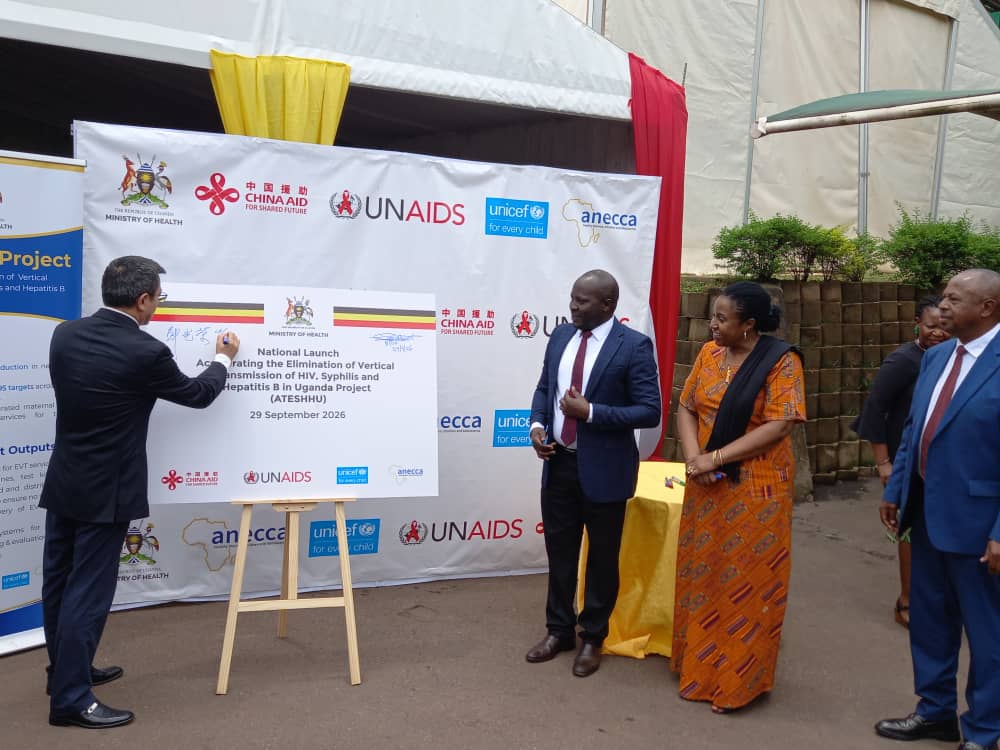
This was announced during the official launch of the Accelerating the Elimination of Vertical Transmission of HIV, Syphilis and Hepatitis B in Uganda (ATESHHU) project, held at the Ministry of Health headquarters.
The Minister of Health, Dr. Chris Baryomunsi, was represented by the Assistant Commissioner in the AIDS Control Programme, Dr. Richard Mutumba, who commended the Government of China, through China Aid, for the funding support.
Dr. Mutumba said the project would build the capacity of stakeholders involved in the programme in the Busoga and Bunyoro regions.
The project, funded by China Aid in partnership with UNAIDS and UNICEF, will be implemented by ANECCA.
The Executive Director of ANECCA, Dr. Denis Tindyebwa, welcomed the support, saying the organisation would build the capacity of sector stakeholders to ensure that the desired goals and objectives of the project are achieved.
He thanked the Ministry of Health for the technical support it has provided, saying ANECCA would strengthen collaboration among stakeholders for a positive impact.
Scope of the project
Dr. Mutumba said the 24-month project, worth US$2,955,791, targets 2,445,800 beneficiaries across 22 districts in the two regions that have been identified as having a high burden of vertical transmission of HIV, syphilis and hepatitis B.
He said implementation would be coordinated and monitored through Jinja and Hoima Regional Referral Hospitals.
According to Dr. Mutumba, more than 4,700 paediatric HIV infections occur every year through vertical transmission. He said HIV prevalence in Busoga stands at 3.0 percent, compared with 4.8 percent in Bunyoro, while teenage pregnancy rates in the two regions stand at 28.4 percent and 24.2 percent in Busoga and Bunyoro, respectively.
He said both regions are among the lowest performers on the World Health Organization (WHO) pathway elimination indicators.
Dr. Mutumba said the 2,445,800 beneficiaries include pregnant and breastfeeding women, who account for 823,500 cases, while 798,800 are children within the vertical transmission risk period. A further 823,500 male partners are expected to benefit indirectly, while 1,622,300 women and children will be direct beneficiaries.
The key investment areas will include health workforce capacity-building and mentorship, integrated antenatal care and triple-elimination services.
Other areas will include health information systems, monitoring and evaluation, diagnostics for HIV, syphilis and hepatitis B, supply chain management and quality assurance, antiretroviral medicines and treatment commodities, district health systems strengthening, community engagement and male involvement.