


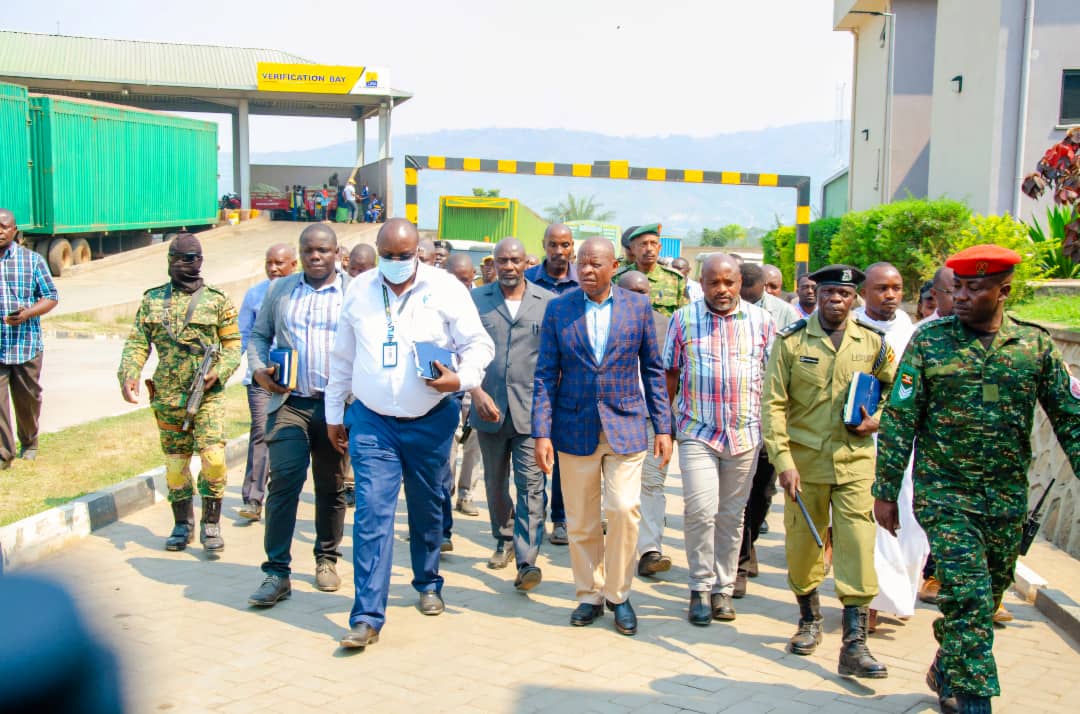
The Minister of State for Trade, Gen. Wilson Mbasu Mbadi, is set to meet his counterpart in the Democratic Republic of Congo (DRC) to resolve outstanding barriers hindering the smooth flow of goods and people between the two countries.
Gen. Mbadi made the announcement during a monitoring visit to the Mpondwe and Ntoroko border crossings, which serve as key trade points between Uganda and the DRC. The visits aimed to assess operations at the borders and explore measures to address existing challenges and enhance trade between the two nations.
In 2022, with support from UKAid through TradeMark Africa, the Government of Uganda upgraded the two border posts into One-Stop Border Posts (OSBPs). Mpondwe was further developed to include a Border Export Zone to facilitate trade by expediting cargo clearance, reducing delays and costs related to customs and other procedures, and improving border marine services for Ntoroko, which is located on the shores of Lake Albert.
However, during his visit, Gen. Mbadi found that the two OSBPs are not yet fully operational. Traders continue to face significant challenges when doing business with Uganda’s neighbors in the DRC.
At Ntoroko, Hamid Juma Aime, the URA Customs In-Charge, informed the Minister that despite Ntoroko being designated an OSBP, it is not fully functional. Critical government agencies such as the Uganda National Bureau of Standards (UNBS), the Ministry of Agriculture, Animal Industry and Fisheries (MAAIF), and others are not present at the border. Additionally, none of the DRC border agencies are represented at Ntoroko OSBP, and they do not attend joint meetings.
“Several times we have invited our colleagues from the DRC for joint border committee meetings to address trader grievances and streamline operations. However, they have never responded or shown up,” Aime reported.
Betty Tembo, Chairperson of the Ntoroko Cross-Border Traders Association, decried the mistreatment of Ugandan traders in the DRC. She explained that traders are not allowed direct access to markets and are instead forced to work through agents and middlemen who sometimes fail to pay them.
“We request our government to construct a border market or Border Export Zone at Ntoroko, similar to Mpondwe, so we can operate from there instead of entering the DRC, where we face many challenges,” said Tembo.
Traders also reported difficulties related to currency exchange. They must first convert Ugandan Shillings into Congolese Francs, then into U.S. Dollars, often incurring losses in the process.
The Ntoroko OSBP faces additional logistical issues, including a lack of grid power. Border operations rely on a generator, which costs UGX 10 million per month to run. The absence of electricity hampers the use of scanners during clearance processes, forcing officers to rely on manual inspection. The poor and slippery road from Karugutu to the border and a small parking yard have further contributed to delays, with long queues of cargo trucks evident during Gen. Mbadi’s visit.
At both Mpondwe and Ntoroko border points, traders raised concerns over visa requirements imposed by Congolese authorities. They pointed out that Uganda scrapped visa fees for DRC nationals under the East African Community (EAC) Common Market Protocol, which promotes visa-free entry for citizens of EAC Partner States. However, the DRC has not reciprocated, despite joining the EAC in 2022.
“Our people still pay $50 in visa fees to enter the DRC, which increases the cost of doing business. Meanwhile, we no longer charge visa fees for DRC nationals,” noted Mabel Nankya, the Immigration Officer at Mpondwe border.
Fish traders at Mpondwe reported high taxes charged by the Uganda Revenue Authority (URA) on fish imports—between UGX 8 to 9 million per truck—compared to UGX 5 million when the market was still inside the DRC. Traders also face hostility in South Sudan, where locals demand a monopoly over the fish trade.
Stanley Bwambale Pandas, Chairman of the Vendors Export Zone at Mpondwe–Lhubiriha Market, requested cold storage facilities to preserve fish during transit, as well as reduced taxes to support businesses. “The fish market is a lifeline for many people, but without storage and favorable conditions, it’s becoming difficult to sustain livelihoods,” Pandas said.
Security threats from armed militias in the DRC were also cited as a major concern. At Mpondwe, border agencies close operations at 7:00 p.m., while Ntoroko closes at 10:00 p.m., unlike other borders that operate 24 hours. The limited hours are attributed to security risks in the area.
Addressing the traders and border officials, Gen. Mbadi said the government will hold talks with the DRC to resolve the visa issues and other challenges in line with the EAC Common Market Protocol, which allows for free movement of people, goods, and services within the region.
“Very soon, we are going to hold a ministerial meeting with my DRC counterpart to iron out all these barriers—just as we recently did with Kenya,” said Mbadi.
He reaffirmed the government’s commitment to creating favorable conditions for cross-border trade with the DRC. He pledged to engage other ministries, including Works, Energy, and Defence, to address infrastructure gaps—especially roads, electricity, and security—to enable 24-hour operations and deeper integration with DRC customs systems.
Gen. Mbadi’s visit underscored the government’s ongoing efforts to promote transparent and efficient trade between Uganda and its neighbors, grounded in regional integration and shared prosperity.
Since the establishment of the two OSBPs, Uganda’s trade with the DRC has grown significantly—from approximately USD 500 million in 2020 to over USD 1 billion in 2025. Revenue collection at both borders has also steadily increased.
“In the 2024/2025 Financial Year, we collected UGX 8.7 billion in revenue at the Mpondwe border alone, surpassing our target of UGX 8.6 billion,” said Gordon Mutungi, URA Enforcement Officer.
At Ntoroko, revenue collections rose to UGX 1.06 billion in 2024/2025, compared to UGX 196 million in 2022/2023.
The DRC remains Uganda’s top export destination within the EAC and COMESA regions, with exports including cement, wheat flour, sugar, soft drinks, bottled water, plastics, mattresses, and various agricultural products.