


By George Mubiru, Manager, Uganda Baati Safal Foundation
That vision inspired the establishment of the Safal Uganda Baati Technical Training Institute in Tororo, which welcomed its first learners on March 23, 2026. Located on Plot 78, Nagongera Road, the institute reflects our commitment to equipping young Ugandans with industry-relevant skills that can open doors to employment, entrepreneurship and lifelong learning.
For years, the Safal Uganda Baati Foundation has supported young people through community skilling programmes, witnessing firsthand how practical training transforms lives. A person who learns to repair a vehicle, construct a building or design clothing begins to see opportunities that once seemed out of reach. But we have also learned that a brief introduction to a trade is not enough. Young people need structured training, experienced instructors and recognised qualifications that validate their abilities.
The institute was established to provide exactly that. It offers courses in automotive mechanics, building and construction, fashion and design, cosmetology, information and communication technology (ICT), and entrepreneurship. While these disciplines differ, they share one goal: giving learners practical skills that can lead to employment, self-employment or further education.
Only months after opening, the impact is already becoming evident. Nineteen-year-old Etyeku James Ivan, an automotive mechanics learner, recently completed a kitchen plate stand as his second practical project. Using wire mesh and a grinder, he transformed raw materials into a functional item for the institute. His work demonstrates the essence of technical education, turning ideas into useful products through hands-on learning.
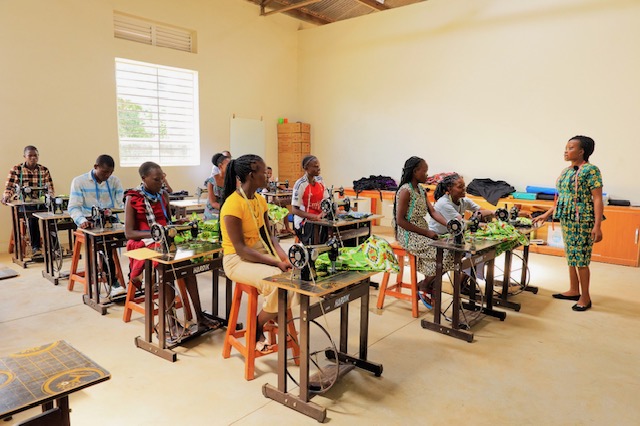
Similarly, 18-year-old Akello Harriet, a fashion and design learner, is already producing shirts, shorts, skirts, gathered dresses and aprons. With every garment she completes, she is mastering the skills needed to convert measurements and fabric into quality clothing. In the building and construction department, learners are gaining practical experience by mixing mortar, laying bricks and perfecting finishing techniques under the guidance of qualified instructors.

To accommodate different learning needs, the institute offers two training pathways: a one-year UVTAB modular skilling certificate and a two-year National Certificate in Craft Levels I and II, both at an affordable cost. This provides families with accessible options for acquiring practical education that can lead directly to income-generating opportunities.
The institute is also encouraging Senior Six graduates to enroll in computer lessons as they prepare for university or the world of work. Digital literacy has become essential across every profession. Mechanics increasingly rely on online technical resources, fashion designers use digital platforms to market their products, and entrepreneurs depend on technology to manage records, communicate with clients and grow their businesses.
Opening the institute marks an important milestone, but its true success will be measured by the achievements of its graduates. The real test is whether learners can apply their skills, secure meaningful employment or create their own enterprises, and whether the training continues to respond to the needs of local industries and communities. Achieving this will require continuous engagement with students, employers and business leaders to ensure the curriculum remains relevant in a changing economy.
At Uganda Baati, we understand the importance of building things that stand the test of time. In Tororo, we have built more than a training institution, we have created a place where young people can develop skills, build confidence and shape their own futures. Our hope is that every learner leaves equipped not only with a recognised qualification, but also with the ability to earn a livelihood, contribute to their communities and help drive Uganda’s economic transformation.