


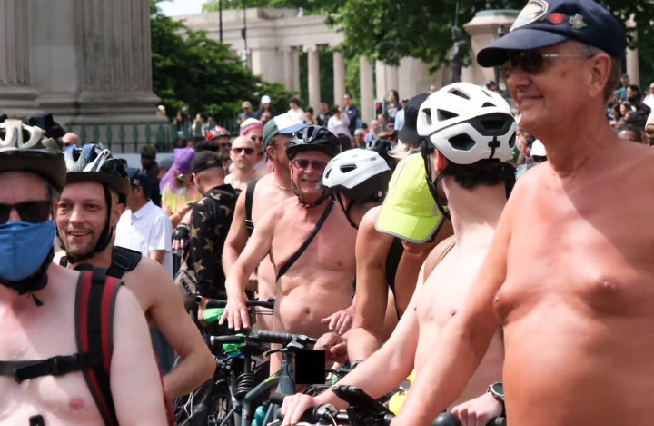
Central London’s streets were transformed into an unexpected spectacle on Sunday, June 14, as hundreds of cyclists took part in the annual World Naked Bike Ride, stripping down and cycling past some of the city’s most iconic landmarks.
What unfolded was part protest, part performance art, and a growing flashpoint in debates over public space, activism, and cultural tolerance.
The event, which has long positioned itself as a demonstration against car dependency, fossil fuel reliance, and the vulnerability of cyclists, once again delivered maximum visibility.
Routes stretching from Tower Hill to Hyde Park converged into a mass ride through Westminster, turning roads into a moving display of body paint, slogans, and bare skin.
Yet the reaction it provoked highlights a deeper tension: whether shock tactics still translate into meaningful political messaging in an age of constant viral spectacle.
A protest struggling to define itself
Organisers describe the ride as a form of environmental activism and body-positive expression, governed by a strict code of conduct and coordinated with police under UK laws that permit public nudity when it is not intended to cause alarm.
However, even participants and observers acknowledged a growing ambiguity in its purpose.
One attendee noted that while the atmosphere felt like a “street party” filled with music and energy, the underlying message was easily lost amid the spectacle.
That disconnect raises a recurring question for modern protest movements: when attention becomes the primary currency, does clarity of purpose suffer?
Visibility vs. impact
Supporters argue the ride successfully challenges social norms around body image and draws attention to cyclist safety in urban environments dominated by cars.
Critics, however, say the visual shock overshadows the cause entirely, reducing it to a viral curiosity rather than a persuasive campaign.
The contrast reflects a broader challenge in activist strategy, balancing visibility with message retention.
In a media ecosystem driven by short attention spans and algorithmic amplification, the loudest image often replaces the deepest argument.
Public space, consent, and cultural friction
Beyond messaging, the event also reignited debate over shared public spaces.
While organisers emphasize inclusivity and non-sexual intent, some members of the public expressed discomfort at encountering mass nudity in everyday settings.
This tension sits at the intersection of legal permissibility and social expectation: what is allowed in public space does not always align with what communities expect to see in it. That gap often becomes the focal point of controversy, regardless of intent.
A movement at a crossroads
Now present in cities worldwide, the World Naked Bike Ride continues to expand as a global form of protest-performance hybrid.
But its future effectiveness may depend less on its visibility and more on its ability to communicate a coherent message beyond shock value.
As one observer put it, the event was memorable, but what it stood for was harder to define. In an era saturated with spectacle, that may be its central challenge.