


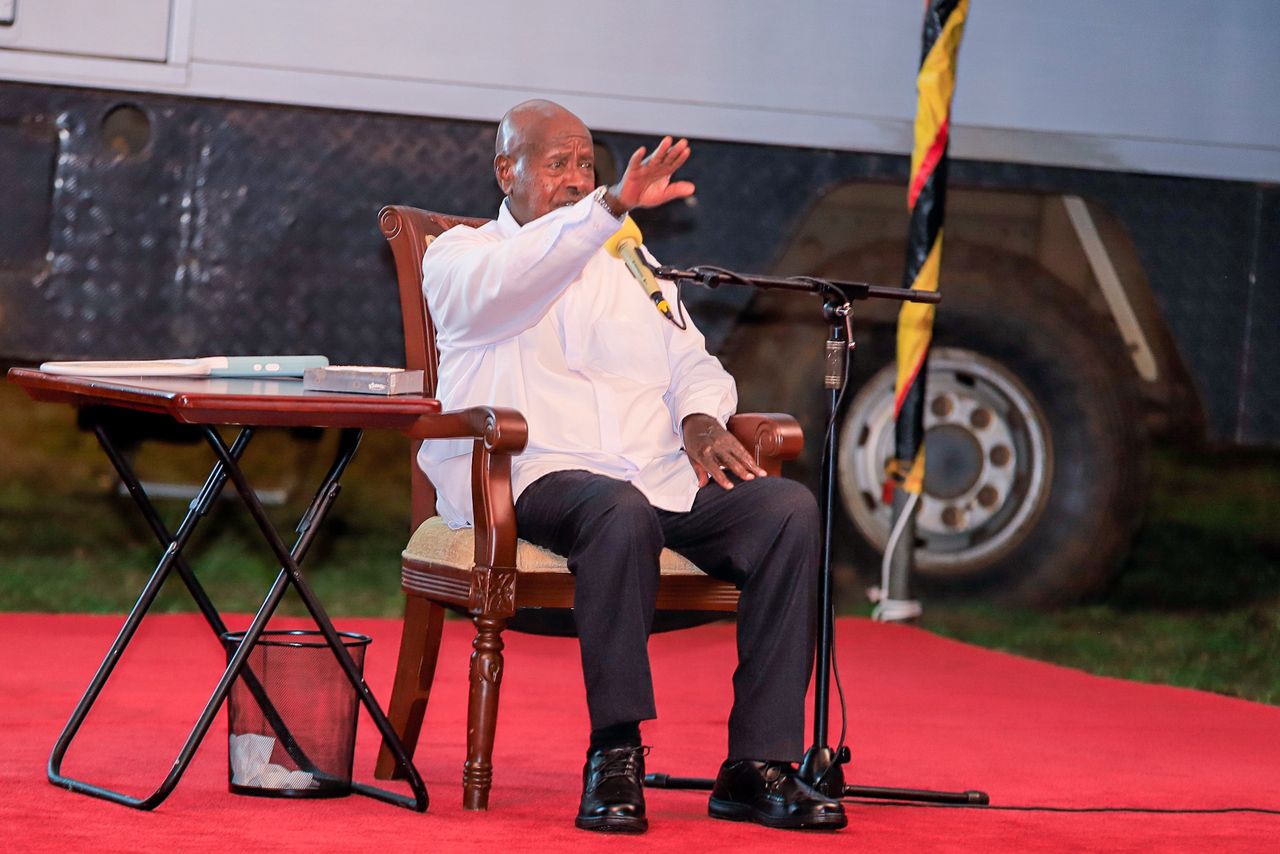
President Yoweri Kaguta Museveni has congratulated Ugandans on the conclusion of the Presidential, Parliamentary, and Local Government elections, describing the process as largely successful and reflective of continued public support for the National Resistance Movement (NRM).
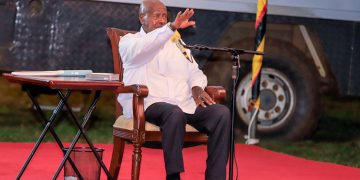
President Museveni who referred to himself as “the Old Man with a hat” said he held 143 rallies across 153 districts during the campaign period. “The atmosphere at these massive gatherings was celebratory and consultative, with whole communities turning up the elderly, the youth and the children,” Museveni said. “It reminded me of the elections of 1996 when the country was united around stability.”
He recalled that during the 1996 elections, many Ugandans rejected what they saw as divisive politics. “Tubadde bulungyi, kati aze kutabula the country has been moving well, now someone has come to disturb,” he quoted voters as saying at the time.
On Unity and the NRM Philosophy
The President attributed past political cohesion to what he described as the NRM’s philosophy of “Okukyenuura” — solving society’s pressing problems.
“Kukyenuura means removing the emikyeno, the bottlenecks of society,” Museveni explained. “By 1996, we had removed extra-judicial killings, restored discipline in the army and ended sectarian politics based on religion and tribe.”
He added that the NRM replaced identity-based politics with “patriotism, Pan-Africanism, socio-economic transformation and real democracy.”
“When the NRM came with this message, abantu bassa ekikowe — people had a sigh of relief,” he said.
Museveni also defended earlier electoral reforms, including the open lining-up voting system introduced during the Movement system. “The secret ballot had been abused with multiple voting and ballot stuffing,” he said. “Our method of lining up behind candidates removed that cheating and rendered elections credible.”
Economic Recovery and Social Services
The President highlighted achievements in economic liberalization, infrastructure rehabilitation and social services.
“We ended ebura ry’ebintu — shortages of essential goods,” Museveni said, noting restored industrial production of sugar, cement, soap and beverages.
He cited gains in agricultural production since 1986, including increased coffee, milk, maize and livestock output.
However, he acknowledged that peace alone was not sufficient to satisfy citizens. “Some people began to ask, ‘Tulya ddembe?’ — Do we eat peace?” he said. “They meant that although there was stability, there was still poverty.”
To address this, he introduced initiatives such as Entandikwa, Universal Primary Education (UPE), land reforms, NAADS, Operation Wealth Creation (OWC), Emyooga and the Parish Development Model (PDM).
“By 2013, 68 percent of homesteads were working only for the stomach — abakolera ekidda kyoonka,” he noted. “OWC reduced this to 39 percent. That was a great achievement, but it was not enough.”
He said PDM was designed to empower communities directly through parish-level SACCOs. “If all adults in the parish form a SACCO and elect their own committee, it is better than state agents doing the distribution,” he said.
On Electoral Integrity and the Opposition
Museveni accused sections of the opposition of engaging in electoral malpractice following the reintroduction of the secret ballot in 1994.
“Ballot stuffing and altering results became the order of the day,” he claimed. “I told those involved that I did not want anybody to cheat for me. Instead, they should use their position to stop cheating.”
He praised the introduction of Biometric Voter Verification (BVV) machines.
“The death knell to the opposition was the BVV machines,” Museveni said. “Where they worked properly, the results were clear.”
He cited districts such as Nebbi, Bulambuli and Namisindwa, where he said the machines functioned effectively and NRM secured strong majorities.
The President further argued that the NRM maintains overwhelming national support.
“If all our registered members turned up to vote, we would have 88 percent support,” he asserted. “That is the real balance of forces in the country.”
However, he acknowledged internal weaknesses within the ruling party.
“The Najja-kulya leaders — those who say ‘I came to eat’ — discourage our people,” he said, criticizing unfair primary practices and lack of grassroots engagement.
Security Concerns and Political Stability
Museveni accused elements within the opposition of promoting violence and intimidation.
“You remember the 28 elders who were cut by machete in Masaka in 2021,” he said. “Those schemes were defeated by the masses working with security forces.”
He warned that any attempts at destabilization would be dealt with firmly. “We shall crush any scheme of the traitors,” he said.
Campaign Reflections
The President said his campaign ran from Luwero on September 30, 2025, to Kololo on January 13, 2026.
“I rejected a proposal to erect a shelter over my vehicle,” he said. “I had to be in the sun and the rain with the tens of thousands of my supporters. As an NRA fighter, I am always with the fighters.”
He also questioned the practice of spending public funds on tents for political elites while ordinary citizens remain exposed to harsh weather.
A Call for Reconciliation
Despite sharp criticism of opponents, Museveni called for national reconciliation.
“I call upon Ugandans to abandon bad behaviour and act fairly to all, even the opposition,” he said. “Work for principled reconciliation, not opportunistic patching up.”
Historical Reflection
The President concluded by reflecting on February 11, 1979, when he crossed the Kagera River with 200 FRONASA fighters alongside Tanzanian forces during the war against Idi Amin. “Between February 12 and April 15, 1979, we built a force of 9,000 fighters,” he said. “That journey reminds us of the sacrifice that built this country.”